Previous section | Next section | Back to Rosarium index | Back to main page
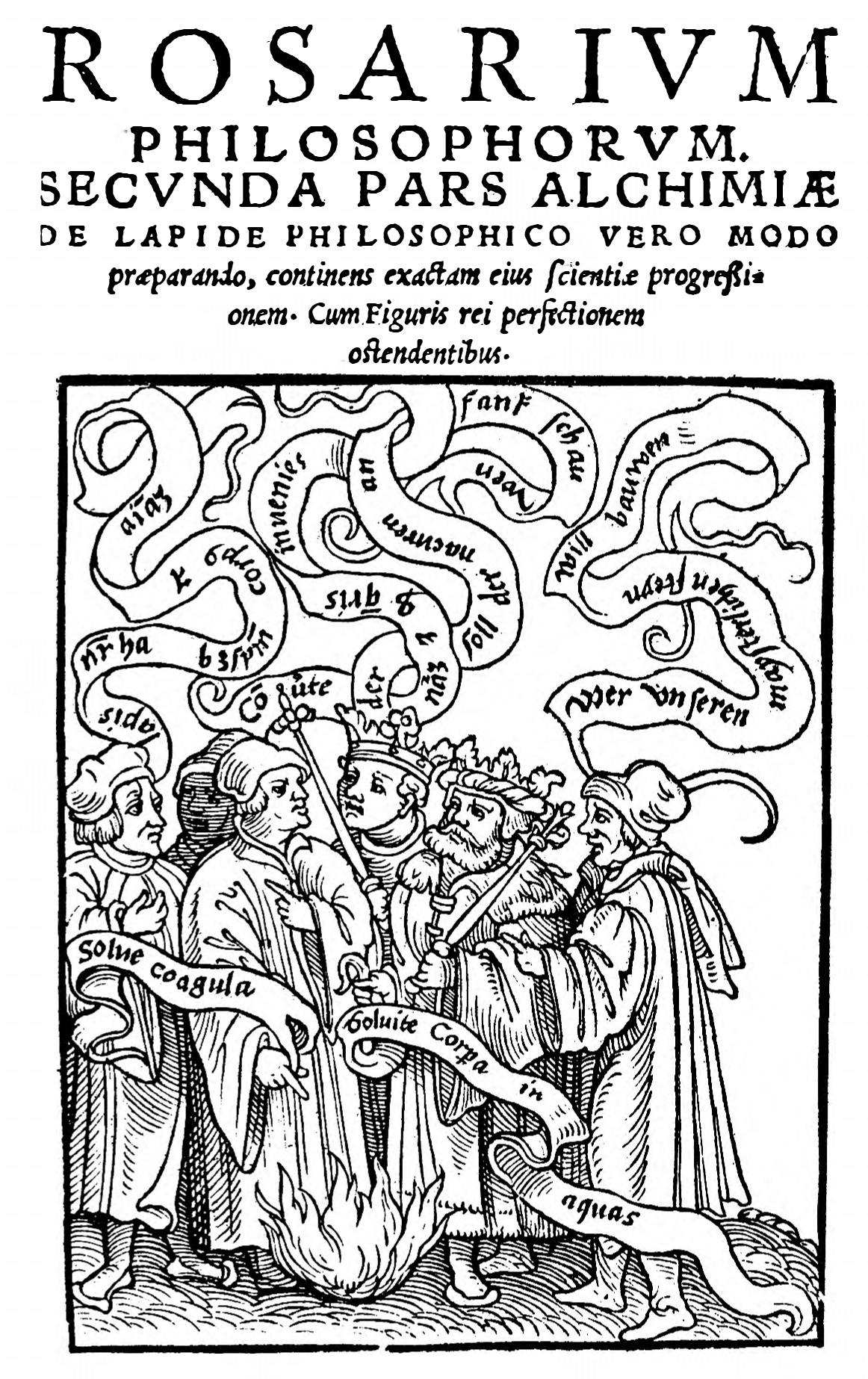
Frontispiece. Upper scrolls from left to right: lapis n[oste]r hab[et] spiri[tum] corp[us] et a[n]i[m]a[m] (“Our stone has spirit, body, and soul”); co[n]v[er]te na[turam] et q[uod] q[uae]ris invenies (“Transform nature and you shall find what you seek”); der soll der naturen anfank schauwen / wer unseren maysterlichen steyn will bauwen (“He who wishes to build our masterly stone should look into the beginning of nature”). Lower scrolls from left to right: solve coagula (“Dissolve, coagulate”); solvite corp[or]a in aquas (“Dissolve the bodies in the waters”)
[p. 1]The Rose Garden of the philosophers:
The second part of the Alchemy
concerning the true preparation of the philosopher’s stone,
with an exact development of that science
and figures showing the perfection of the matter.
[p. 2]Craftsmen of this art have been named, as Vincent [of Beauvais] refers to in the Mirror: [1]
Adam. Noah. Idris.[2] Squilia.[3] Chora.[4] Moses. And his sister Miriam. Catho.[5] Virgil.[6] Aristotle.[7] Alexander.[8] Geber.[9] Iahie.[10] Rhazes.[11] Abimazar.[12] Maurienus, also called Morienes.[13] John the Evangelist.[14] Cardinals Garsias[15] and Gilbertus.[16] Bishop William, called Huck.[17] Aegidius, a magister hospitalis, who extracted a book from 125 stones.[18] Androicus, also a bishop, and an apostle of the Lord.[19] And Jacob Aranicus Judeus,[20] who taught me not a little in this art. Petrus and Dirandus, monks.[21] Avicenna.[22] Arnaldus de Villa Nova.[23] And Raymund,[24] who flourished in these most recent times.
[1] Vincentius Bellovacensis (ca. 1184/94–1264), author of the Speculum Naturale (“Mirror of Nature”), a massive encyclopedia including much alchemical information. According to Telle, the oldest sections of Speculum, including the following list of “masters of the art,” are taken from a 12th century text falsely attributed to Avicenna, De anima in arte alchimiae (“On the soul in the alchemical art”). This list of names appears in in Book VII, chapter 87 of Speculum. The following historical and biographical notes and indebted to Telle’s monumental efforts.
[2] In Islamic tradition, the second prophet after Adam, identified in the medieval period with Hermes Trismegistus.
[3] Uncertain. A “Squiliarupiz” appears in pseudo-Avicenna’s De Anima.
[4] Korah, the Biblical figure who rebelled against Moses and Aaron. Held in Arabic alchemical legend to have been taught alchemy by Moses.
[5] Possibly Marcius Porcius Cato (234–149 BC), the Roman statesman, standing together with Virgil as a representative of Greco-Roman alchemy. Telle notes that “Catho” is cited in pseudo-Avicenna’s De Anima as a variant of the name “Claron,” where it may be identified with the Greek philosopher Zenon.
[6] Publius Vergilius Maro (70–19 BC). Medieval interpretation of certain sections of the Aeneid, as well as later pseudepigraphal attributions, resulted in Virgil’s acquiring a reputation as an alchemical authority.
[7] The Greek philosopher (384–322 BC) who stood as the ultimate authority in medieval European and Arabic texts; but also standing in here for a corpus of pseudo-Aristotelian alchemical texts.
[8] Alexander the Great (356–323 BC), here standing in for a pseudepigraphical corpus attributed to him.
[9] The name belongs to the Arabic scholar and alchemist Abu Musa Jabir ibn Hayyan (d. early 9th c.). There exist two separate pseudepigraphal corpuses attributed to him, one in Arabic dating from the 9th and 10th centuries, and one in Latin dating from the 13th and 14th centuries. The Latin Geber corpus is the one cited under Geber’s name in this text.
[10] Probably Yahya ibn Dhi'n-Nun, who appears in pseudo-Avicenna’s De Anima. Otherwise unknown.
[11] Abu Bakr al-Razi (b. c. 864), a Persian physician, philosopher, and alchemist.
[12] Probably Abu Nasr al-Farabi (c. 870–950), who is cited as a “master of the art” in pseudo-Avicenna’s De Anima.
[13] A character of the Arabic alchemical text, “Khalid's Questions to the Monk Maryanos” (Masa'il Halid li-Maryanus al-rahib).
[14] Medieval legend attributed alchemical expertise to the Biblical author.
[15] Cited in pseudo-Avicenna (De Anima) and Michael Maier (Symbola), but otherwise unidentified.
[16] Like Garsias, cited in pseudo-Avicenna’s De Anima but of uncertain identification. A treatise named De aqua penetrativa, quae solvit omnia metalla (“On penetrating water, which dissolves all metals”) is attributed to a Cardinal Gilbertus.
[17] Unknown. A bishop “Hugo” is cited in pseudo-Avicenna (De Anima) and Michael Maier (Symbola); “Huck” may be a corruption of this.
[18] According to pseudo-Avicenna’s De Anima, author of a treatise called “On 125 Stones,” and apparently a member of the Order of the Knights Hospitaller in Jerusalem.
[19] Cited in pseudo-Avicenna (De Anima), where he is described as a “master of weights” who taught in Africa.
[20] “Jacob the Aranean Jew.” Cited in pseudo-Avicenna’s De Anima as Jacob “Alhartarne”; otherwise unknown.
[21] Both unknown. In pseudo-Avicenna’s De Anima, named respectively “Penus” and “Durandus.”
[22] Ibn Sina (980–1037), the Arabic and Persian philosopher and physician. Of the texts attributed to him in the Rosarium, only the one titled De humoribus (“On the humours”) is certainly genuine.
[23] A semi-legendary Catalan physician and theologian (ca. 1240–1311).
[24] Ramon Llull (c. 1232 – 1316), a Majorcan philosopher and theologian. From the 14th century on, an alchemical corpus later became associated with his name, and with a Lullist movement.