Previous section | Next section | Back to Rosarium index | Back to main page
[p. 10]
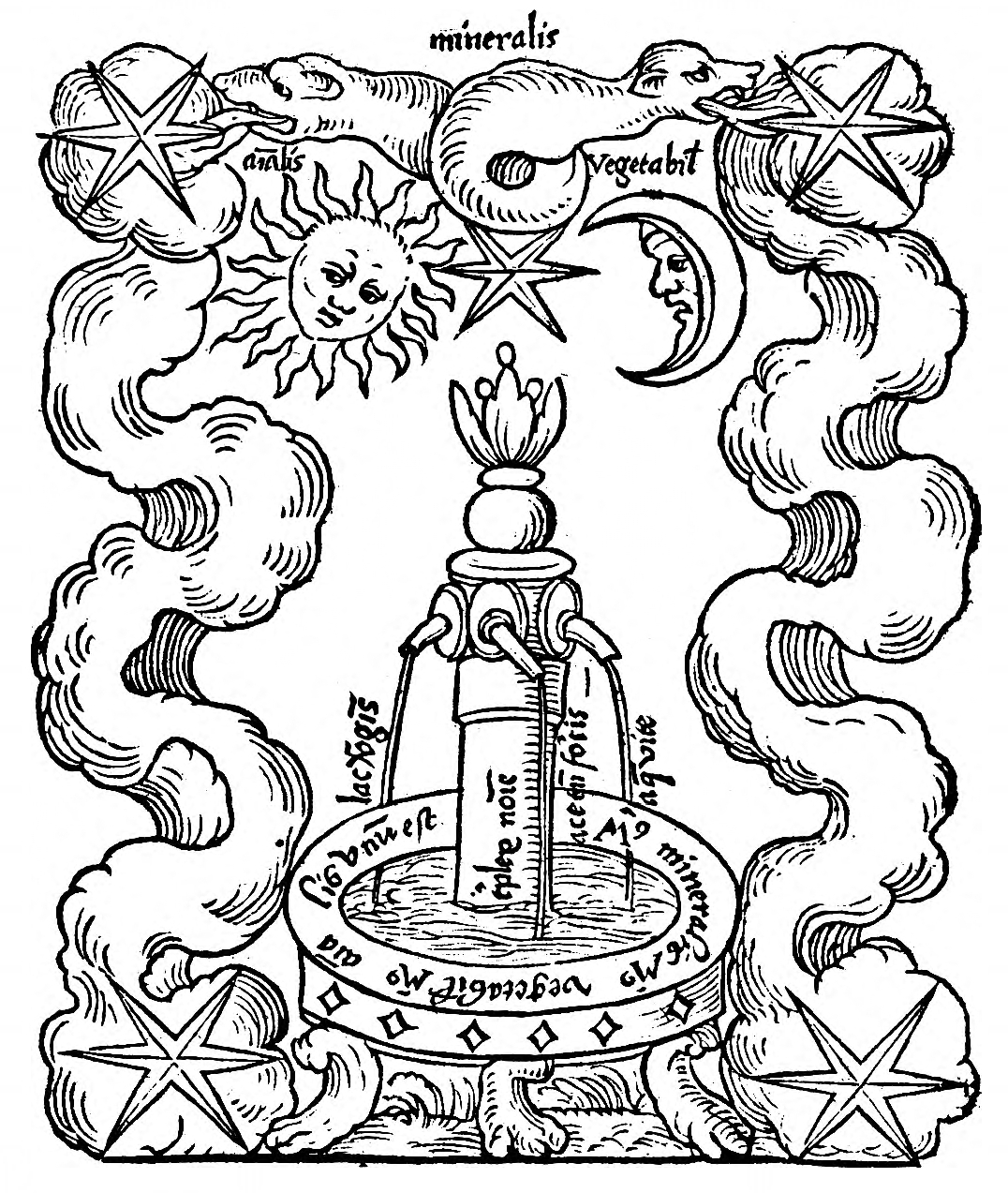
Figure 1. Surrounding top of frame: mineralis / a[n]i[m]alis / vegetabil[is] (“mineral / animal / vegetable”). Along streams of liquid, left to right: lac v[ir]gi[ni]s / / acetu[m] fo[n]tis / aq[ua] vit[a]e (“virgin’s milk / vinegar of the spring / water of life”). On the fountain: t[ri]plex no[m]i[n]e (“threefold by name”). Clockwise along the rim: M[ercurius] mineralis M[ercurius] vegetabil[is] M[ercurius] a[n]i[m]a[lis] sic unu[m] est (“mineral Mercury, vegetable Mercury, and animal Mercury are one in this way.”)
Wyr sindt der metall anfang und erste natur /
Die kunst macht durch uns die höchste tincture.
Keyn brunn noch wasser ist meyn gleych /
Ich mach gesund arm und reych.
Und bin doch jtzund gyftig und tödlich.
We are the beginning and first nature of metals;
By us art makes the highest tincture.
No fountain or water is like unto me.
I make poor and rich healthy
And yet I am now poisonous and deadly.
[p. 11]The lunar juices [succus lunariae], water of life [aqua vitae], quintessence [quinta essentia], burning wine [ardens vinum], vegetable Mercury [Mercurius vegetabilis]—all these are the same. The lunar juices are made from our wine, which is known to a few of our sons. With it our solution is made. Our drinkable gold is made by means of it, and by no means without it.
The imperfect body has been converted into first matter, and those waters, conjoined with our water, produce one pure water. The latter is clear and purifies everything. It contains everything necessary within itself, and it is dear and lowly. From it and with it our magisterium is perfected. It has not dissolved bodies in a vulgar solution, as is taught by the ignorant who convert the body into cloudy water [aquam nubis], but by true philosophical solution, in which the body is converted into first water [aquam primam], and from which the body was from the beginning. This same water transforms bodies into ash.
Know that the art of Alchemy is a gift of the Holy Spirit. And know that, in our days, we had a master: Arnaldus de Villa Nova, of the Roman Curia, the highest of physicians and theologians. He was also a great Alchemist. He made rods of gold, and consented that they be submitted to all manner of testing. [p. 12]Arnaldus: The craftsmen of Alchemy ought to know that the shapes [species] of metals cannot be transformed—unless perhaps they are reduced to first matter. And then they are indeed transmuted into a different shape than the one that was before. This is so because the corruption of the one is the generation of the other, in artificial things as much as in natural things. Art imitates nature and, in certain respects, corrects and subdues it. In the same way, the industry of physicians is an aid to the sick man’s nature.
The Mirror:[1] Therefore make use of venerable nature, for nature is not corrected except in its own nature. Do not introduce to it what is alien, neither powder nor any other substance. Diverse natures do not correct our stone, nor does anything enter into it that has not arisen out of it. If something extraneous should be applied to it, instantly it is corrupted, and what is sought will not be gotten from it.
The Mirror: I make note that unless, when beginning to cook, you took like substances, and you subtilized them without grinding [contritione] until all the waters were made, you have not yet discovered the work. So that they may not weary themselves in vain, I teach students of the most precious mystery that this magisterium is nothing but cooking quicksilver and sulphur. [Do this] until a quicksilver is made which defends sulphur from combustion. Then as long as the vessel has been well sealed so that the quicksilver cannot [p. 13]vanish away, the sulphur also cannot be burnt or wasted: for quicksilver is our clearest water.
We see, for example, in common water, that everything which is cooked with it never burns until the water consumed, no matter how strong the fire is. And when the water has been consumed, what is in the vessel is burnt. For this reason, the philosophers have commanded that the mouth of the vessel be stopped, so that our blessed water may not breathe out, but rather may defend what is in the vessel from combustion. Since the water had been set together with these things, it prevented the fire from burning them, and they were made. The greater the flame’s assault, the more the water is hidden within lest it be harmed by the fire’s heat. But the water receives them into its belly and repulses the flame from them. Now, I order all of this art’s investigators to make the fire slight at first, till patience is made between water and fire. After you see that the water has been fixed without any rising [ascensione], then pay no heed to the fire’s quality—although it is good to oversee things patiently until spirit and body are made one. Likewise the corporeal becomes incorporeal, and the incorporeal corporeal.
Water is that substance which whitens and reddens. Water is what kills and vivifies. Water is what burns and makes brilliant white [candidat]. Water is what dissolves and congeals. Water is what putrefies and then germinates new and [p. 14]diverse substances. Thus, my son, I warn you to focus wholly on the decoction of the water. Let this not weary you, if you wish to get the fruit. Attend not to any other vain matter, but to the water alone. Cook it gradually by putrefaction till it changes from its colour to a perfect colour. And take care, in the beginning, that you do not burn its flowers or its greenness. Do not complete your work hastily. Take note that your door be well and firmly shut, so that he who is within may not escape. God willing, you shall attain the end. Nature performs her operation gradually, and I desire that you do likewise. Even your imagination should be according to nature. See according to nature, which regenerates bodies in the bowels of the earth. Imagine this with a true imagination, not a fantastic one. Likewise, observe what heat is used for the decoction, whether it be violent or sweet.
Here begins Geber, On the Investigation of Truth.
In our volumes on the secret potencies of nature and on the properties of natural things, as well as through our experiences of discovery, we have considered the matter of the investigation to be altogether certain. We found nothing at all but this: those things which elicit our medicine to transmute bodies have in themselves the following [p. 15]qualitative properties.
First, it[2] has in itself a very subtle and incombustible earth. The latter is suitable in every way for fixing, and it is fixed with its own radical moisture.
Second, [this radical moisture is] airy and fiery moisture, conjoined in one form, such that if one were volatile, the other would be also. This moisture is above all moistures. But as for what it lacks, it awaits the heat of fire to complete the ash needed to thicken it with inseparable permanence. This means, without evapouration of the annexed earth.
Third, the natural disposition of moisture is as follows. Thanks to its homogeneity in all the differences of its properties, it has annexed earth by the conversion of both. In either one[3] the moisture is well and virtuously tempered by homogeneity, by a total union, and by a bond of inseparable connection. After the final preparatory step, it yields good melting.
Fourth, having been artificially cleansed of any combustible or inflammable matter, this homogeneity has such purity of essence that it does not burn, but rather preserves everything with which it is even a little conjoined.
Fifth, it has within itself a clear and splendid tincture. This may be white or red; it is pure, and incombustible, stable, and fixed. Fire is unable to alter it by any means, [p. 16]nor can burning sulphur or sharp corrosives corrupt or defraud it.
Sixth, the whole compound, bound with its final complement, is of such subtle and tenacious matter that, even after the final infusion at the end of its decoction, it still melts thinly like water. Moreover, it penetrates deeply, to the limit of alterable matter. In a complement, it exhibits any manner of melting. It naturally adheres to smoke due to its nearness and affinity to it. With an inseparable consolidation, it reduces bodies spiritually into its own nature, opposing the impression of fire in this its hour.
Having considered all this, we found through our investigation seven necessary and useful properties of substances in our stone, and these are oiliness, thinness of material, affinity, radical moisture, purity [or] clarity, earth that fixes, and tincture.
First, the property of differences is oiliness. When the medicine is cast forth [in projectione],[4] oiliness gives it a general [quality of] melting and opening. Indeed, the first necessity after casting the medicine forth is its immediate and appropriate melting, which is accomplished and internalized by means of natural oiliness.
Second is the thinness of the medicine, that is, its [p. 17]spiritual subtlety. “Thin” means that it flows like water when infused, and it penetrates into the depths of alterable substance. Thus, secondly, what is necessary after melting the medicine is its immediate ingression [into another substance].
Third is the affinity, or nearness, between the elixir and the substance to be transmuted. This causes it to adhere and hold fast when encountering what is like unto it. Thus, thirdly, after the ingression of the medicine, adhesion is immediately appropriate and necessary.
Fourth is radical and fiery moisture, which congeals and consolidates the parts which were held fast through adherence to their likes (and through the eternally inseparable union of all like parts). Thus, fourthly, after the adhesion, consolidation of parts by means of its radical, viscous moisture is useful and necessary.
Fifth is purity or clarity that has been cleansed. This gives the shining splendor of actual combustion to what remains unjoined, after the parts to be putrefied have been consolidated. The acting, actual fire is able to burn away all the extraneous superfluities which have not been consolidated. Thus the putrefaction[5] follows immediately and necessarily.
Sixth is earth that fixes. It is tempered, thin, subtle, fixed, incombustible. It gives permanence of fixation and adheres in solution, standing by itself and persevering against fire. Thus, sixthly, after the purification, fixation is necessary and useful.
[p. 18]Seventh is tincture, which gives a splendid and perfect colour, white and intense yellow. It yields the lunification and solification[6] of transmutable substances. Thus, seventhly, after the fixation, the highest tincting colour, or the tincture, is also necessary. This colours convertible material into true gold or silver, with all their certainly known differences. Calidius the philosopher[7] says of our water: For it is fire because it burns and pulverizes all things.
Quicksilver is vinegar. Socrates says in the Turba:[8] The first force is vinegar, that is, quicksilver. The Turba: If you place a body over fire without vinegar, it will be burnt – that is, without quicksilver. The Turba says: It is sharpest vinegar which produces the pure body. Without it comes no colour.
[1] Not the Speculum naturae of Vincent of Beauvais, but rather the Speculum alchimiae, which circulated under the name of Arnaldus de Villa Nova.
[2] While the introductory paragraph of this section refers to a plural set of substances, the remainder of the section discusses the properties of a singular substance.
[3] The referents of “both” and “either one” are unclear. Perrot suggests they refer to earth and moisture (“the moisture has annexed earth by the conversion of the earth to be annexed and the moisture”). Perhaps also the airy and fiery moistures named in the previous section might be meant, in which case the “conversion” might correspond to the “thickening” of the previous section.
[4] The meaning of projectio is not entirely clear here. Literally it refers to the action of throwing or casting forth, or of scattering. Given the surrounding discussion of the capacity of the medicine to penetrate into alterable substances, it seems likely that the medicine is envisioned as being thrown with some force into another body.
[5] The following sections seem to refer to this process as “purification” rather than “putrefaction.” This may be the result of a typo. On the other hand, purification and putrefaction appear several times throughout the Rosarium as apparently interchangeable terms.
[6] I.e., the processes of producing Luna and Sol.
[7] Khalid ibn Yazid (c. 668–704 or 709), an Umayyad prince, to whom many alchemical texts were later attributed. Also known in translation as “Hali.”
[8]Turba philosophorum, the “Commotion of philosophers,” the oldest extant Latin treatise on alchemy, although probably not originally written in Latin. A. E. Waite has published an English edition.