Previous section | Next section | Back to Rosarium index | Back to main page
[p. 19]
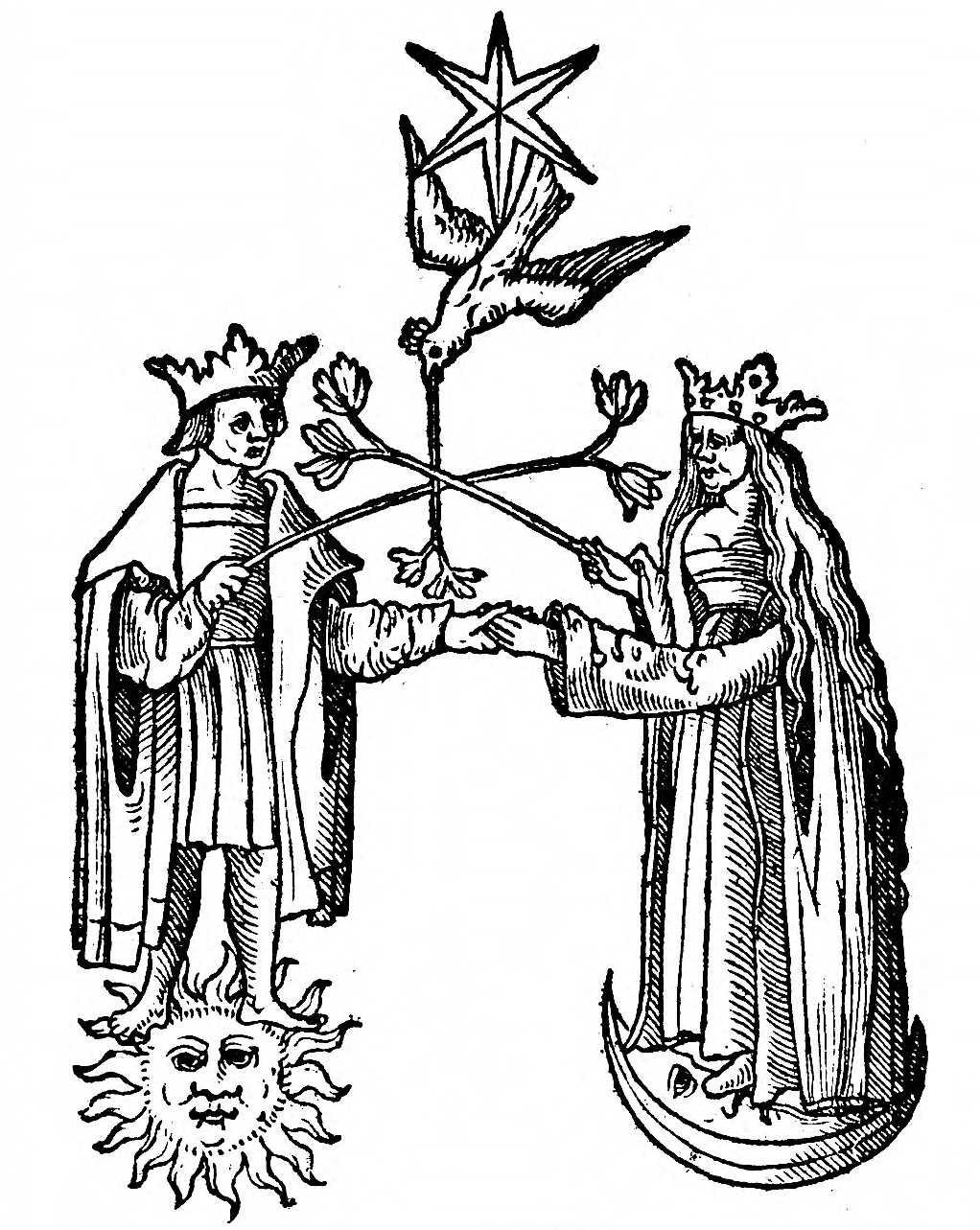
Figure 2.[1]
Note well: In the art of our magisterium, the philosophers have hidden nothing except the secret of the art, which may not be revealed to anyone. If this came about, he [to whom it was revealed] would be cursed and would incur the Lord’s indignation, and he would perish of apoplexy. Every error in the art occurs because [p. 20]the proper material is not taken up. Make use, then, of venerable nature, for from her and through her and in her our art is born, and not in another. Again, our magisterium is a work of nature and not of a craftsman [opificis]. Whoever is ignorant of the principal aim does not attain it, and whoever is ignorant of what he seeks is also ignorant of what he shall find.
Know, then, that copper [aes],[2] which is philosophical gold, is their gold. Senior also said: Our gold is not common gold. But you asked about the greenness, believing that copper was a leprous body because of that greenness it has. To this I reply that the whole of what is perfect in copper is just the greenness in it. For according to our magisterium, that greenness is quickly turned into our true gold—and we have proven this. You shall never, however, be able to prepare the stone without green liquid duenech,[3] which seems to be born within our minerals. O blessed greenness, who beget all things! Learn from this that no vegetable or fruit appears in growth but that a green colour is there. Know, likewise, that the generation of this substance is green: this is why the philosophers have called it a sprout. Again, they have called it the water of their purification or of their putrefaction, and they spoke the truth, since by means of its water it is putrefied, or purified, of its blackness. It is washed [p. 21]and returns white, then red.
Know that no true tincture is made except from our copper. Cook it together with its soul, grind it to powder, cook it: repeat this until the spirit is conjoined with its body and they are made one, and you shall have what you strove for.
Wise men have given it many names. As for you, think of that one and only substance which adheres to quicksilver and to bodies, and you shall have the true science. But so that you may not err, know what it means to adhere in bodies. Some have said that common quicksilver adheres in bodies; this is false. They believe that they understand Geber’s book on quicksilver, where he says: When we sought among other substances, we did not find in our investigation that another substance was friendlier with the bodies’ natures than quicksilver, etc. But this ought to be wholly understood about philosophical quicksilver: it alone adheres in bodies. The ancient philosophers could discover no other substance but philosophical quicksilver which adheres in bodies—nor shall the Moderns discover it. Common quicksilver does not adhere in bodies; rather, bodies adhere to this quicksilver. And this has been proven true, for if some body is conjoined with common quicksilver, then either the quicksilver retains its own nature, or it recedes and does not turn the body to [p. 22]its own nature. Therefore, it does not adhere to bodies, but rather bodies adhere to it. Many have thus been deceived while working with common quicksilver.
Our stone is dying quicksilver [argentum vivum occidentale]. It has preferred itself above gold and vanquished it, and it is what dies [occidit] and causes to live. Know that quicksilver, which has been coagulated and mortified in its own nature, is the father of all the wonders of this magisterium of ours. It is spirit and body—that is, it is spiritual body, since it ascends through sublimation. And this is what Geber has said: To consider the true substance [rei] that perfects everything is to consider the extractors [electorum] of the pure substance [substantiae] of quicksilver. But it is often asked, from what can this substance be best extracted? We respond that it is extracted out of those things which it is in. Therefore, my son, consider and see where this substance is: accept this and nothing else if you desire to attain to true understanding, etc. I say to you in Christian charity that neither we nor the philosophers have been able to discover any substance which persists in fire except that unctuous and perfect moisture which does not burn. And once it has been prepared in the necessary way, it leads all bodies which it touches to the truest solar complement [solare complementum],[4] and it is above all bodies, especially above the Moon.
The root of the art is the soap of the wise and the mineral of all salts. Since it comes from the mineral of the sea, it is called bitter salt. [p. 23]It is sharper than all salts of its kind, for it is the mineral with which body and spirit are calcined, and with which the elixir is redissolved and coagulated. Geber: Note that no silver can be made unless everything is first dissolved. Second, no solution ought to be made except in blood, whether one’s own or another’s. This means in the water of Mercury, which is also called dragon’s water. Third, this dragon’s water should be made using an alembic without adding any other substance. Fourth, this water can dissolve amalgam, body, spirit, cinnabar—briefly, each and every natural thing.
Fifth, this water ought to be pure. It must be made only from a dragon that has been purged. The dragon is purged by elevating it three times, and then vivifying it. Sixth, the solution must putrefy in the hot and moist, that is, in horse’s dung. From this arises a blackness. Seventh, let it be coagulated in the Sun’s dryness-in-moisture, that is, in a bain-marie. Eighth, the time of the elixir’s perfection is less than one year. Rather, observe the time of human gestation in the mother’s womb. Ninth, Mercury cannot be slain except by the odor of a perfected body—a red [body] for red [Mercury], and a white [body] for white [Mercury]. And this body is able to give weight while retaining its own weight. Our work is accomplished through four things: [p. 24]weight, fire, body, and spirit.
Tenth, everything which is received[5] must be rejected in this art. Eleventh, place the substances in the vessel once they have been prepared. It will then be child’s play, for the magisterium may be fulfilled even in a single vessel. Whoever has true Mercury has the elixir, and the elixir is Mercury which has been mortified, that is, fixed with the body’s odor. For the dragon does not die except with its brother and its sister. Again, note that it is entirely necessary that Mercury be made out of the body: the volatile must be fixed with the volatile, that is, with pure Mercury. It is also necessary that there be more of the volatile than the fixed—[the ratio being] from twice up to fivefold or sixfold or up to tenfold, but not more. The more the volatile parts, the slower they are fixed. The volatile becomes fixed in the space of a month. And note that the elixir cannot come to be unless body and spirit pass through all the elements, or rather through the natures of all the elements. That is, they are made first into earth, then into air (that is, vapour), thirdly into water, and fourthly, after they have been fixed so that they cannot flee it, into fire. For whatever does not flee fire and is not withered away or consumed in it is called fire.
As for whoever wishes to investigate the secret of this art, he must know the first matter of our bodies. Otherwise, he will be frustrated in his labour. [p. 25]The first matter of bodies is not common Mercury, but rather is unctuous and moist vapour. The mineral stone is made out of the moist, and the metal body out of the unctuous. Bodies must be converted in this sort of unctuous vapour, and in this conversion they are destroyed. Then the grain of the body is strewn into death and is completely mortified; the body is made white and red in the midst of our water. Now understand this: unless a grain of wheat (that is, the grain of the body) has been cast to the ground (that is, into its first matter, or into the unctuous vapour, or into the Mercury of the wise philosophers), etc.[6] This vapour is called the stone that is known in the chapters of books. It is called the principle of our material’s operation. It is called the unctuous sulphur within a complement from which quintessence is extracted. And it is called Mercury which tincts all bodies into Sun and Moon; from this the stone is finally prepared. Note again that nearly all the ancient wise men of alchemy, having spoken much of salt, conclude that is the soap of the Wise, the little key that shuts and opens and shuts again so that no one opens [what is locked]. Without this little key, say the wise men, nobody in this age is able to reach this science’s perfection—that is, unless they know to calcinate the salt after its preparation. They say that it must be in a warm place for three days, so that the [p. 26]fire’s heat and smoke evaporate.
From this I conclude that every good and perfect medicine of Alchemy, every elixir and powder, must be in the manner of salt, and must be salt, and must have the virtue of salt. When it is cast over [projecta super] metal bodies, or when it is melted or ignited, it must be very slow in melting and penetrating. Geber also advises thus when he says: The medicine must melt more quickly than Mercury, so that it flows faster than Mercury can flee;[7] fire must be unable to consume or destroy it. Then the salt is called meltable [fusibile], and is called incombustible oil and the soap of the wise. Again, note that the salt of metals transmutes Mercury into true Sun and Moon. Just so, the salt of animals transmutes any animal matter into [its] correct temperance and ideal complexion [veram temperatiam et optimam complexionem].
Dung-fire is the agent cause in the work of our stone’s digestion. The fire of a bain-marie, even if it be very much tempered, is not fit for the former’s place. Thus Alphidius says: As for what I shall show you, to cook it by fire is to bury it in horses’ moist excrement, which is the wise men’s fire, moist and dark. It is hot in the second degree but moist in the first degree. A property of this fire is that it does not destroy oil (that is, material), but rather augments it because its moisture has been tempered. Only this heat is equal and well tempered, and such a heat is of the highest necessity in the generation of that substance. Geber says, For the fumes are most subtle and require a well tempered decoction, so that they may be [p. 27]thickened equally in themselves. Only a tempered heat is a thickener of moisture and a perfecter of mixture, though beyond this it does not go. The generation and procreation of natural things can only come about through a very tempered and equal heat, and only moist, hot horse dung is like this.
[1] No verse accompanies this woodcut in the 1550 edition. In the 1530s manuscript, a verse appears as follows: Ich pin ain Kunig mechtig und mit gSundem lib / Min hertz und gmuet senet sich nach aim wib. // Ain Kunigin pin ich von edler art / Ain gemachel gezimty minem lib zart. “I am a mighty King with a healthy body. / My heart and mind long for a wife. // I am a queen of noble birth; / My delicate body shall have a husband.”
[2] Aes refers to any mined crude metal except gold or silver; it is cognate with English “ore.” It is often used to refer particularly to bronze and to copper (aes Cyprium, whence cuprum, “copper”); it also has the standard metonymic meaning of “money” or “payment.” The sense “copper” is necessary here, and “copper” will translate aes unless otherwise noted.
[3] An alchemical allegory refers to a duke named Duenech, who was cured of his melancholy by a certain procedure involving his being sealed into an airtight bed, which was then heated. Duenech fell unconscious and sweated till the black bile was purged from him, and his palate became white. After being revived, he was cured of melancholy.
[4] That which is missing for them to be solar, i.e., to be made into gold.
[5] Receptae, meaning also “recovered.”
[6] The sentence is grammatically incomplete. Presumably, “etc.” should completed as “... it abideth alone; but if it die, it bringeth forth much fruit.” (John 12:24)
[7] Despite the editor’s citation, Geber’s advice seems to be contrary to that of the preceding sentence.