Previous section | Next section | Back to Rosarium index | Back to main page
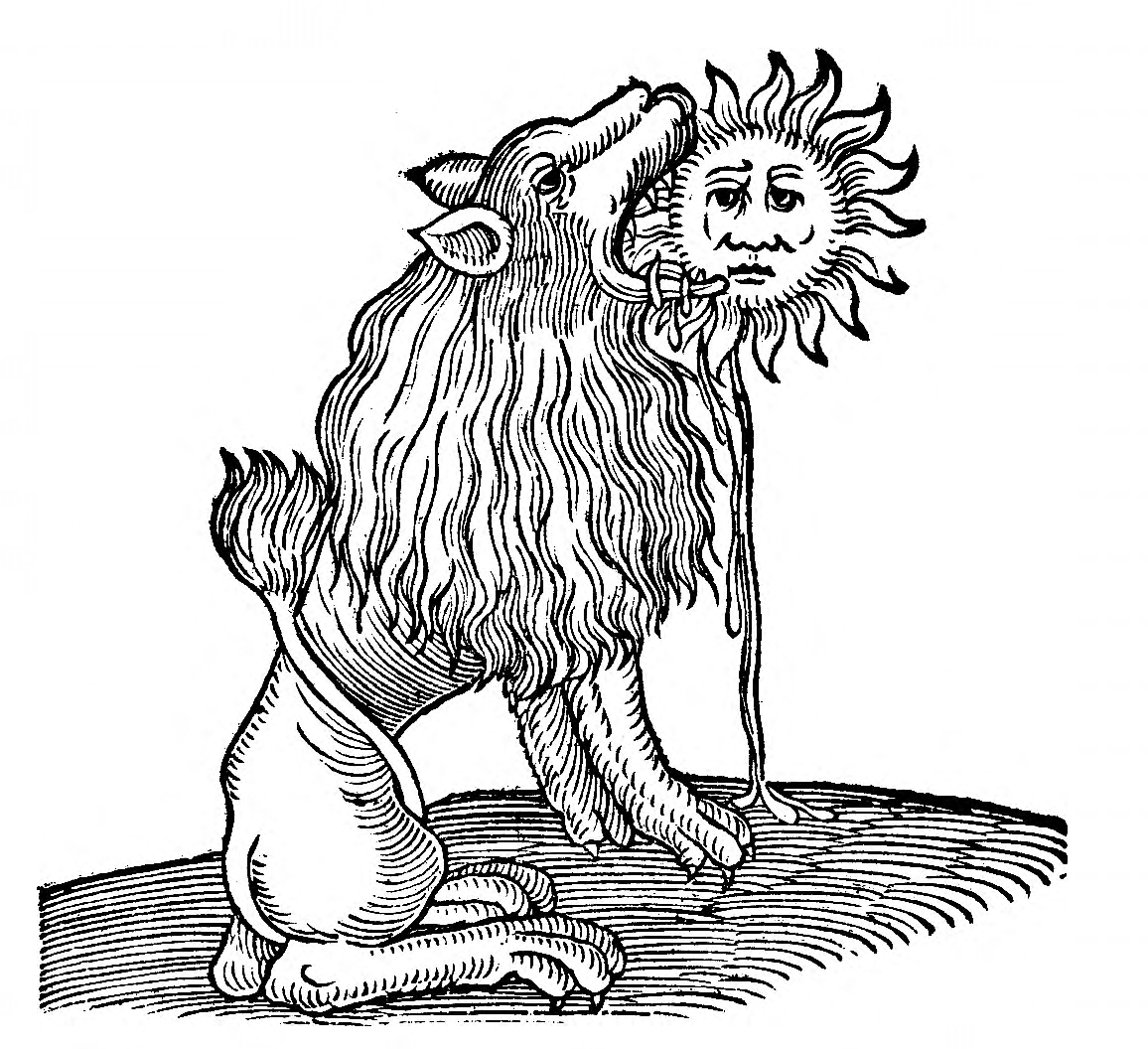
Figure 18.
Ich bin der war grün unnd guldlich Löwe ohn sorgen /
Inn mir steckt alle heimlichkeyt der philosophen verborgen.
I am the true green and golden Lion without worries;
In me are hidden all the secrets of the philosophers.
[p. 174]On our Mercury, which is a green Lion that devours the Sun.
Mercury is he: And know that it is cold and moist, and God has created all minerals out of it. It is also the airy element which flees from fire. When any part is fixed to it, it effects the sublime work, and it is useful spirit, and there is nothing in the world but it, nor does any other [substance] stand in its place, and it is alone what deepens in every body, irrigating it. When, therefore, it is mixed with a body, it vivifies it, and illuminates and converts it from disposition to disposition, and from colour to colour. It is the whole elixir of white and red, and it is enduring water, and water of life and death, and virgin’s milk, and herb of ablution, and it is the living spring—whoever drinks from it does not die—and it is what takes up colour, and it is their medicine, and it causes [substances] to acquire colour, and it is what mortifies, what dries, and what moistens, heats and cools, and it makes opposites according to the measure of its rule. When it is alive, some operations belong to it; and when it is dead, operations other than the others belong to it; and when it is sublimated, other operations; and when it is dissolved, other operations. And it is the dragon which marries itself, and impregnates itself, and bears in its day, and it kills [p. 175]all animals with its venom. Fire destroys it in a short time because it is quicksilver—for quicksilver has no power over fire, nor does it devour it, but it flees from the latter. The wise first philosophers have engineered it in ingenious ways, until little by little it was made to long for fire. Thus it does not lack a grade superior to fire’s assault, and it is fed by it, so that when some fixity is fixed to it, then wonderful transformations come about. When it is transformed, it transforms [others], and its blackness appears together with its sound and its splendour. When it is tincted, it is both tincted and tincturing; when it is coagulated, it is coagulated and coagulating; when it is dissolved, it is dissolved and dissolving. And it causes whitening in the vision of the eye, and reddening in succession, and it is water that gathers together, and milk, and strong urine, and softening oil, and the father of all marvels, and it is a fog and clouds and a fugitive slave and western [occidentalis] Mercury.
It prefers itself to gold and kills it. Therefore the gold says to it, “Do you prefer yourself to me? I am the lord of stones, I long for the fire.” And our Mercury says to it, “Yes, but I begot you and you were born of me, and one part of me vivifies many parts of you. You, however, are greedy and give me nothing in return. Whoever binds me with my brother and my sister lives and rejoices, and this is enough for him in his life. Εven if he were to live a thousand thousand years, and if every day he fed seven thousand men, he would not be lacking. [p. 176]I am the whole secret, and in me the science is hidden, for I convert all bodies into Sun and Moon. My nature is such that I soften what is hard, and I harden what is soft.” And the philosophical stone, which is to be created by the true alchemy, is likewise. It is one in the whole world, and whoever lacks this one errs; he is thought to have fallen from the precipice. Yet it was not perfected in its own nature, to which the minerals led it, but in that to which it was led by the art itself. For without the magisterium, it is worth nothing to us and is of no use to anybody, nor is it of any perfect help, but rather corrupts.
I say this so that you make use of it together with the magisterium, for this is the pure phlegm, and the philosophers call it sulphur and yellow melancholic because of its wonderful virtuous effect. Some have wished [to believe] that God created all peoples out of it and set their origin in it. Some have also called our stone white copper [aes]. Lucas and Eximeus:[1] Know, all you seekers of the science, that no tincture is made except out of our white copper; for our copper is not common copper. Common copper is corrupted and tarnished by whatever touches it, but copper of the philosophers perfects and whitens whatever is brought near. Plato says likewise: All gold is copper, but not all copper is gold; therefore our copper has body, soul, and spirit, and these three are one, for they all are from one and [p. 177]of one and with one, which is their root. Therefore, copper of the philosophers is their elixir, completed and perfected out of spirit, body, and soul. In this way, the philosophers have named the stone with many names, so that it might be plain to the wise and hidden from the ignorant. But by whatever name it is named, it is nevertheless one and the same, and it comes from the same.
Whence Merculinus:
Est lapis occultus, et in imo fonte sepultus,
Vilis et eiectus fimo vel stercore tectus,
Unus habet unius lapis omnia nomina dinus
Unde deo plenus sapiens dixit Morienus
Non lapis hic lapis est animal quod gignere fas est,
Et lapis hic avis et non lapis aut avis hic est.
Hic lapis est moles, stirps et Saturnia proles,
Juppiter hic lapis est Mars sol Venus et lapis hic est
Alliger et luna, lucidior omnibus una.
Nunc argentum, nunc aurum, nunc elementum,
Nunc aqua nunc vinum nunc sanguis nunc crisolinum,
Nunc lac virginum, nunc spuma maris vel acetum,
Nunc in sentina foetenti stillat urina,
Nunc quoque gemma salis, Almisadir sal generalis,
Nunc auripigmentum primum statuunt elementum
Nunc mare purgatum cum sulphure purificatum
Siccine transponunt quod stultis pandere nolunt.
Sicque figuratur, sapiens ne dicipiatur,
Et quod tractatur stultis ne distribuatur.
Haec luna vocatur omnibus nominibus una.
The stone is hidden, buried at the bottom of the spring,
Lowly and cast away, covered in dung or filth.
The one, unique, divine stone has all names,
Whence, filled with God, the wise Morenus said:
This stone is not a stone; it is animate, it may produce,
And this stone is a bird and it is not a stone or a bird.
This stone is a mass, a shoot, progeny of Saturn.
This stone is Jupiter; this stone is Mars, Sun, Venus.
I am also bound by the Moon, the one brighter than all.
Now it is silver, now gold, now element,
Now water, now vine, now blood, now chrysolite,
Now virgin’s milk, now sea form or vinegar,
Now urine drips into in the foul dregs,
Now also a gem of salt, Almisadir,[2] general salt,
Now they place orpiment as first among the elements,
Now the sea purged with sulphur is purified.
Thus do they transmit what they wish not to be opened up to fools,
And in this way is it figured so that the wise man is not deceived,
[p. 178]And so that what is treated of is not given to fools.
This one Moon is called by all names.
These are the modes of the operation of the stone, by means of which the substance which we seek is produced and led into actual being. There is one mode of sublimation, Another of descension [descensio], a Third of distillation, a Fourth of Calcination, a Fifth of solution, a Sixth of congelation, a Seventh of fixing, an Eighth of iteration, a Ninth of ceration; and so on endlessly. Now, although these modes are diverse with respect to each other, they are nevertheless the same in substance. Sometimes, when the philosophers consider their material which is in the vessel, Sun and heat seem to breathe out of the container, or it evaporates into the shape of a very subtle smoke, and it rises up to the head of the vessel; and then they have called such an ascension “sublimation.” But when, after the material has ascended, they look at what descends to the base of the vessel, then they have called this “distillation” or “descension.” And then, when they see that the same material is thickened and blackened and produces an evil stench, they have called it “putrefaction.” Seeing that the black or dark colour and evil stench go away after a long time, and a sort of whiteness like the colour of ash comes, they have called it “incineration” or “whitening.” Morienes says: The whole magisterium is nothing but the extraction of water from earth, and the spreading of water above earth until it putrefies [p. 179]and the earth is putrefied with the water. And when this has been made clean, it will be a help to all rulers, and the whole magisterium is perfected. Now, seeing that the earth is mixed with its water, and that the water is diminished bit by bit through a temperate decoction, and that the earth grows, they [the philosophers] all have said that this was the perfect ceration. A philosopher says that with water earth is cerated, imbibed, and tempered by the decoction of the Sun (that is, of heat); and it is dried, and the whole material turns into earth. The same philosopher: This force is whole if it is turned into earth.
Then, seeing that the whole material was arriving at a certain dissipation, and that it then reduced itself to a solid substance [substantia], and that it did not flow, but rather stood rigidly, they said that this was the perfect congelation. Plato says: Dissolve our stone, and then congeal it with great caution as it has been demonstrated to you, and you have almost the whole magisterium. And again, [Plato says] elsewhere: Take our stone and put it in a vessel and roast it with a light fire until it is broken into pieces, and then cook it by the heat of the Sun until it is congealed. And know that the whole magisterium is nothing but to make the true solution and the perfect and natural congelation. Plato likewise says: Dissolve and congeal, and thus you shall know the whole magisterium. Again, [the philosophers] seeing the aforementioned material after it had been perfectly congealed and thickened, so that it did not [p. 180]dissolve anymore in water or in smoke in any way, they said that it had been truly fixed. They had seen the same congelation and thickening or fixing arrive at perfect desiccation and whitening as a result of a greater decoction of heat. And since this whiteness was above all whiteness, they said that this was the perfect calcination. But seeing that this material, which once remained in its colour, was transformed into infinite colours—which could not have happened previously, except by a redissolution of the material—they called this redissolution the solution. The neighboring elements are made discontinuous by this redissolution; they act and suffer action, and so the philosophers call these elements “spouses.”
Thus the ignorant err badly when they believe that the philosophical medicine is made from another substance, for the philosophers say: Alchemical sons, believe in all your dissolutions, sublimations, conjunctions, separations, congelations, preparations, and insist that all others are deceptions. Let them be silent who say that another gold comes from us, another water comes from us, another dissolution and congelation, effected by a light fire, comes from us, another putrefaction comes from us, etc. Plato, in the summary: What you seek is belongs to the same kind as both of the world’s lights, for gold surrounds the superior part, but silver the inferior, lunar part. Aristotle: No [p. 181]tincting poison is produced without Sun and its shadow, that is, its wife. Hermes in his secrets: Its father is the Sun, its mother is the Moon. Rosarius: Whoever strives to seek after another tincture without Sun and Moon is like a man who wishes to climb stairs without steps. Therefore we must have our suitable receptable for the tincture, one which is consonant with it because of a certain similarity of fathers. This receptacle must be the Moon itself, for the Sun by itself melts with great difficulty, and similarly with respect to its liquefaction; and this is true also of the Moon by itself. But when they are joined together, then together they flow and liquefy with great ease, and in this way goldsmiths join two solids together. A philosopher: A woman is a receptacle of male semen, for she preserves semen in her cells and in her womb, and there it is nourished and increased until the time of maturity. Therefore let us now choose a wife for him, so that he has a receptacle for his semen. We are able to select this in [the form of] a wife because she is near to him in simplicity and purity, for nothing is closer to a man than his wife; they are homogeneous. Hermes in the Allegories [of the Wise]: The Moon is the lamp of the night; night is the birth of darkness, which God created to rule the world. But the Moon receives light from the Sun and is a delight to him, for the Sun’s light is in her, just as the nature of the Sun overshadows the nature of the Moon. Our Mercury is made from the mineral and the [p. 182]vegetable joined together equally. They are of more use conjoined than if they had been separated out. Given this, consider the need for both mercuries.
[1] “Lucas” and “Eximeus” derive through Arabic from Greek Leukippos and Xenophanes, both referring to speakers in the Turba philosophorum.
[2] Prepared ammonium salt.
Ich bin der war grün unnd guldlich Löwe ohn sorgen /
Inn mir steckt alle heimlichkeyt der philosophen verborgen.
I am the true green and golden Lion without worries;
In me are hidden all the secrets of the philosophers.
[p. 174]On our Mercury, which is a green Lion that devours the Sun.
Mercury is he: And know that it is cold and moist, and God has created all minerals out of it. It is also the airy element which flees from fire. When any part is fixed to it, it effects the sublime work, and it is useful spirit, and there is nothing in the world but it, nor does any other [substance] stand in its place, and it is alone what deepens in every body, irrigating it. When, therefore, it is mixed with a body, it vivifies it, and illuminates and converts it from disposition to disposition, and from colour to colour. It is the whole elixir of white and red, and it is enduring water, and water of life and death, and virgin’s milk, and herb of ablution, and it is the living spring—whoever drinks from it does not die—and it is what takes up colour, and it is their medicine, and it causes [substances] to acquire colour, and it is what mortifies, what dries, and what moistens, heats and cools, and it makes opposites according to the measure of its rule. When it is alive, some operations belong to it; and when it is dead, operations other than the others belong to it; and when it is sublimated, other operations; and when it is dissolved, other operations. And it is the dragon which marries itself, and impregnates itself, and bears in its day, and it kills [p. 175]all animals with its venom. Fire destroys it in a short time because it is quicksilver—for quicksilver has no power over fire, nor does it devour it, but it flees from the latter. The wise first philosophers have engineered it in ingenious ways, until little by little it was made to long for fire. Thus it does not lack a grade superior to fire’s assault, and it is fed by it, so that when some fixity is fixed to it, then wonderful transformations come about. When it is transformed, it transforms [others], and its blackness appears together with its sound and its splendour. When it is tincted, it is both tincted and tincturing; when it is coagulated, it is coagulated and coagulating; when it is dissolved, it is dissolved and dissolving. And it causes whitening in the vision of the eye, and reddening in succession, and it is water that gathers together, and milk, and strong urine, and softening oil, and the father of all marvels, and it is a fog and clouds and a fugitive slave and western [occidentalis] Mercury.
It prefers itself to gold and kills it. Therefore the gold says to it, “Do you prefer yourself to me? I am the lord of stones, I long for the fire.” And our Mercury says to it, “Yes, but I begot you and you were born of me, and one part of me vivifies many parts of you. You, however, are greedy and give me nothing in return. Whoever binds me with my brother and my sister lives and rejoices, and this is enough for him in his life. Εven if he were to live a thousand thousand years, and if every day he fed seven thousand men, he would not be lacking. [p. 176]I am the whole secret, and in me the science is hidden, for I convert all bodies into Sun and Moon. My nature is such that I soften what is hard, and I harden what is soft.” And the philosophical stone, which is to be created by the true alchemy, is likewise. It is one in the whole world, and whoever lacks this one errs; he is thought to have fallen from the precipice. Yet it was not perfected in its own nature, to which the minerals led it, but in that to which it was led by the art itself. For without the magisterium, it is worth nothing to us and is of no use to anybody, nor is it of any perfect help, but rather corrupts.
I say this so that you make use of it together with the magisterium, for this is the pure phlegm, and the philosophers call it sulphur and yellow melancholic because of its wonderful virtuous effect. Some have wished [to believe] that God created all peoples out of it and set their origin in it. Some have also called our stone white copper [aes]. Lucas and Eximeus:[1] Know, all you seekers of the science, that no tincture is made except out of our white copper; for our copper is not common copper. Common copper is corrupted and tarnished by whatever touches it, but copper of the philosophers perfects and whitens whatever is brought near. Plato says likewise: All gold is copper, but not all copper is gold; therefore our copper has body, soul, and spirit, and these three are one, for they all are from one and [p. 177]of one and with one, which is their root. Therefore, copper of the philosophers is their elixir, completed and perfected out of spirit, body, and soul. In this way, the philosophers have named the stone with many names, so that it might be plain to the wise and hidden from the ignorant. But by whatever name it is named, it is nevertheless one and the same, and it comes from the same.
Whence Merculinus:
Est lapis occultus, et in imo fonte sepultus,
Vilis et eiectus fimo vel stercore tectus,
Unus habet unius lapis omnia nomina dinus
Unde deo plenus sapiens dixit Morienus
Non lapis hic lapis est animal quod gignere fas est,
Et lapis hic avis et non lapis aut avis hic est.
Hic lapis est moles, stirps et Saturnia proles,
Juppiter hic lapis est Mars sol Venus et lapis hic est
Alliger et luna, lucidior omnibus una.
Nunc argentum, nunc aurum, nunc elementum,
Nunc aqua nunc vinum nunc sanguis nunc crisolinum,
Nunc lac virginum, nunc spuma maris vel acetum,
Nunc in sentina foetenti stillat urina,
Nunc quoque gemma salis, Almisadir sal generalis,
Nunc auripigmentum primum statuunt elementum
Nunc mare purgatum cum sulphure purificatum
Siccine transponunt quod stultis pandere nolunt.
Sicque figuratur, sapiens ne dicipiatur,
Et quod tractatur stultis ne distribuatur.
Haec luna vocatur omnibus nominibus una.
The stone is hidden, buried at the bottom of the spring,
Lowly and cast away, covered in dung or filth.
The one, unique, divine stone has all names,
Whence, filled with God, the wise Morenus said:
This stone is not a stone; it is animate, it may produce,
And this stone is a bird and it is not a stone or a bird.
This stone is a mass, a shoot, progeny of Saturn.
This stone is Jupiter; this stone is Mars, Sun, Venus.
I am also bound by the Moon, the one brighter than all.
Now it is silver, now gold, now element,
Now water, now vine, now blood, now chrysolite,
Now virgin’s milk, now sea form or vinegar,
Now urine drips into in the foul dregs,
Now also a gem of salt, Almisadir,[2] general salt,
Now they place orpiment as first among the elements,
Now the sea purged with sulphur is purified.
Thus do they transmit what they wish not to be opened up to fools,
And in this way is it figured so that the wise man is not deceived,
[p. 178]And so that what is treated of is not given to fools.
This one Moon is called by all names.
These are the modes of the operation of the stone, by means of which the substance which we seek is produced and led into actual being. There is one mode of sublimation, Another of descension [descensio], a Third of distillation, a Fourth of Calcination, a Fifth of solution, a Sixth of congelation, a Seventh of fixing, an Eighth of iteration, a Ninth of ceration; and so on endlessly. Now, although these modes are diverse with respect to each other, they are nevertheless the same in substance. Sometimes, when the philosophers consider their material which is in the vessel, Sun and heat seem to breathe out of the container, or it evaporates into the shape of a very subtle smoke, and it rises up to the head of the vessel; and then they have called such an ascension “sublimation.” But when, after the material has ascended, they look at what descends to the base of the vessel, then they have called this “distillation” or “descension.” And then, when they see that the same material is thickened and blackened and produces an evil stench, they have called it “putrefaction.” Seeing that the black or dark colour and evil stench go away after a long time, and a sort of whiteness like the colour of ash comes, they have called it “incineration” or “whitening.” Morienes says: The whole magisterium is nothing but the extraction of water from earth, and the spreading of water above earth until it putrefies [p. 179]and the earth is putrefied with the water. And when this has been made clean, it will be a help to all rulers, and the whole magisterium is perfected. Now, seeing that the earth is mixed with its water, and that the water is diminished bit by bit through a temperate decoction, and that the earth grows, they [the philosophers] all have said that this was the perfect ceration. A philosopher says that with water earth is cerated, imbibed, and tempered by the decoction of the Sun (that is, of heat); and it is dried, and the whole material turns into earth. The same philosopher: This force is whole if it is turned into earth.
Then, seeing that the whole material was arriving at a certain dissipation, and that it then reduced itself to a solid substance [substantia], and that it did not flow, but rather stood rigidly, they said that this was the perfect congelation. Plato says: Dissolve our stone, and then congeal it with great caution as it has been demonstrated to you, and you have almost the whole magisterium. And again, [Plato says] elsewhere: Take our stone and put it in a vessel and roast it with a light fire until it is broken into pieces, and then cook it by the heat of the Sun until it is congealed. And know that the whole magisterium is nothing but to make the true solution and the perfect and natural congelation. Plato likewise says: Dissolve and congeal, and thus you shall know the whole magisterium. Again, [the philosophers] seeing the aforementioned material after it had been perfectly congealed and thickened, so that it did not [p. 180]dissolve anymore in water or in smoke in any way, they said that it had been truly fixed. They had seen the same congelation and thickening or fixing arrive at perfect desiccation and whitening as a result of a greater decoction of heat. And since this whiteness was above all whiteness, they said that this was the perfect calcination. But seeing that this material, which once remained in its colour, was transformed into infinite colours—which could not have happened previously, except by a redissolution of the material—they called this redissolution the solution. The neighboring elements are made discontinuous by this redissolution; they act and suffer action, and so the philosophers call these elements “spouses.”
Thus the ignorant err badly when they believe that the philosophical medicine is made from another substance, for the philosophers say: Alchemical sons, believe in all your dissolutions, sublimations, conjunctions, separations, congelations, preparations, and insist that all others are deceptions. Let them be silent who say that another gold comes from us, another water comes from us, another dissolution and congelation, effected by a light fire, comes from us, another putrefaction comes from us, etc. Plato, in the summary: What you seek is belongs to the same kind as both of the world’s lights, for gold surrounds the superior part, but silver the inferior, lunar part. Aristotle: No [p. 181]tincting poison is produced without Sun and its shadow, that is, its wife. Hermes in his secrets: Its father is the Sun, its mother is the Moon. Rosarius: Whoever strives to seek after another tincture without Sun and Moon is like a man who wishes to climb stairs without steps. Therefore we must have our suitable receptable for the tincture, one which is consonant with it because of a certain similarity of fathers. This receptacle must be the Moon itself, for the Sun by itself melts with great difficulty, and similarly with respect to its liquefaction; and this is true also of the Moon by itself. But when they are joined together, then together they flow and liquefy with great ease, and in this way goldsmiths join two solids together. A philosopher: A woman is a receptacle of male semen, for she preserves semen in her cells and in her womb, and there it is nourished and increased until the time of maturity. Therefore let us now choose a wife for him, so that he has a receptacle for his semen. We are able to select this in [the form of] a wife because she is near to him in simplicity and purity, for nothing is closer to a man than his wife; they are homogeneous. Hermes in the Allegories [of the Wise]: The Moon is the lamp of the night; night is the birth of darkness, which God created to rule the world. But the Moon receives light from the Sun and is a delight to him, for the Sun’s light is in her, just as the nature of the Sun overshadows the nature of the Moon. Our Mercury is made from the mineral and the [p. 182]vegetable joined together equally. They are of more use conjoined than if they had been separated out. Given this, consider the need for both mercuries.
[1] “Lucas” and “Eximeus” derive through Arabic from Greek Leukippos and Xenophanes, both referring to speakers in the Turba philosophorum.
[2] Prepared ammonium salt.