Previous section | Next section | Back to Rosarium index | Back to main page
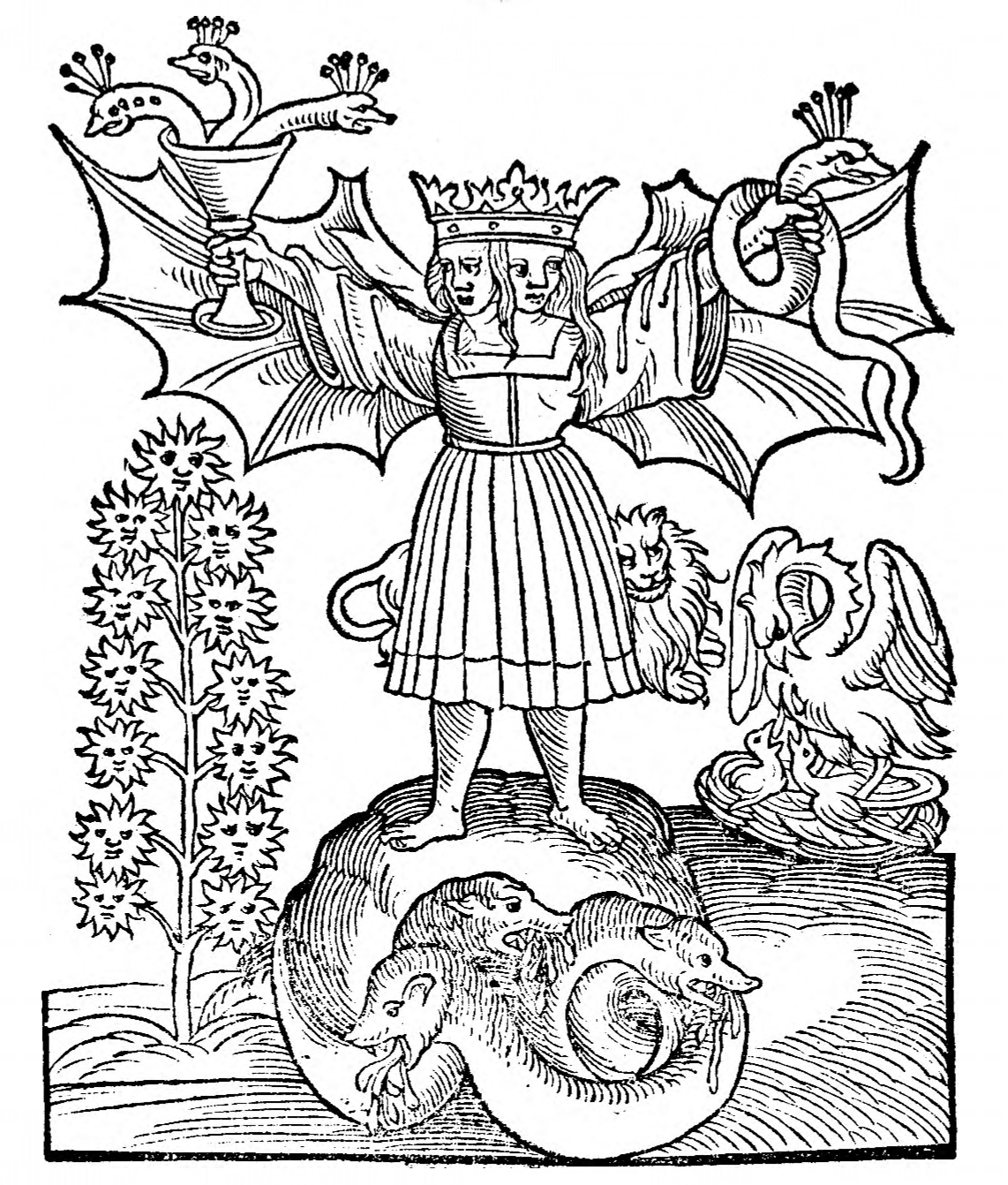
Figure 17.
The King’s Riddle.[1]
Hye ist geboren der keyser aller ehren /
Keyn höher mag uber in geboren werden.
Mit kunst odder durch die natur /
Von keyner lebendigen creatur.
Die philosophi heysen ihn ihren son /[2]
Er vermag alles was sie thun.
Was der mensch von ihm begeren ist /
Er gibt gesundheit mit starcker frist.
Goldt silver und eddel gestein /
Sterck / junckheyt schön und reyn.
Zorn / trawren / armut / kranckeyt er verkert /
Selig ist der mensch dem es gott beschert.
Here is born the King of all honor;
[p. 167]No higher can be born
With art or through nature
From any living creature.
The philosophers call him their son.
He accomplishes all that he does,
All that man desires of him.
He gives long-lasting health,
Gold, silver, gemstones,
Strength, youth, beautiful and pure.
He transforms anger, sorrow, poverty, and illness.
Blessed is the man to whom God grants this.
Response of the Moon Queen.
Hye ist geboren die eddel keyserin reich /
Alle philosophi nennen sie ihrer dochter Gleich.
Die mehret sich und gebürt kinder on zal /
Die seind untödlich / reyn on alles mal.
Sie vertreybt den todt und hasst armut /
Sie gibt reichtumd / gesundheit / her / und gut.
Und ubertrifft gold / silber / und eddelgesteyn /
Alle ärtzney gross und klein.
Nichts ist aufferdrich ihr geleich /
Des sagen wir danck got von himelreych.
Here is born the noble, rich Queen;
All the philosophers call her equal to their daughter.
She multiplies, bears numberless children
Which are undying, pure, and without any stain.
She drives off death and hates poverty.
She gives wealth, health, honor, and good,
And surpasses gold, silver, and gemstones,
All medicines great and small.
Nothing on earth is her equal;
For this we thank God in Heaven.[3]
Geber: Through the investigation which has made us sure, and through plain proof, we have judged that all the words which have now been written in our volumes are true, according to what we have seen through experiment and reason, as has been summarized in the same volumes. In the summary of our perfect magisterium, we have written what we extracted with our fingers and saw with our eyes through experimentation.
[p. 168]Therefore let the wise craftsman study our volumes, piecing together our intention, which we have scattered and set forth in many places lest it be published to the malicious or ignorant. Let him try to conceive what he has pieced together by study and experimentation. And since through work and perseverance of spirit he will accomplish the whole, let the craftsman task himself, and he shall find. But so that we may not be bitten by the wicked, we say that we have not handed down our science in continuous speech, but have scattered it in various chapters. This is because the just, as much as the unjust, would trespass unworthily if it had been handed down continuously. We have likewise hidden it where we spoke more openly; we have spoken of the art not in a riddle but underneath the plain order of speech, and in this manner of speaking we have written of what belongs to God alone, high and blessed, sublime and glorious. It fell upon us, we who wrote this, to recollect it to mind—or rather [it was brought about] by grace of the divine goodwill which pours forth, which gives to and takes away from whomever it wishes.
Therefore, let the son of doctrine not despair, for if he seeks [the art], he shall discover it—if his seeking after nature is of his own will and not merely out of doctrine. Whoever seeks out of the goodwill of his own industry shall find the science. But whoever looks to chase through books will attain to this most precious art very slowly, for we have set out this art, which we alone have investigated, for ourselves alone [p. 169]and not for others. It is most true and altogether certain. We have set out the path of investigation only for those who are wise in some art, and through the genius handed down to us. And it has not been discovered except insofar as we alone have written it. But let the craftsman of a good mind task himself with the method of discovery and the modes of genius, through what we have handed down, and he will rejoice that the highest gift of God comes to him. As for the search for this excellent art, these words are enough—thus Geber.
Geber in his summary in the sixteenth chapter on the natural principles says: It must be noted that after the stone has been purified and perfectly cleansed of all corrupting substance, and after it has been fermented, you need not further change the vessel or open it up; only let God guard it from shattering. For this reason the philosophers have said that the whole magisterium is accomplished in one vessel. And it should be known that the white work is completed in forty days and nights after the purification of the stone. (The time of the purification, however, cannot be determined unless the craftsman works well.) And the red work is completed in ninety days and nights; these are true bounds of the total perfection. Understand this about the coagulation, that it is after the purification, and that this purification cannot be made except in putrefaction and the conversion [p. 170]of bodies into pure spirit. When you have this, praise God.
Senior: I am the waxing Moon, moist and cold, and you are the Sun, hot and moist (or dry). When we have copulated in equal status in the mansion (which is none other than a light fire which has what is heavy in it), we shall be emptied like a woman is emptied, and her husband shall be of noble birth—this is true of speech. And when the Sun and I are conjoined, when we are emptied in the belly of the closed house, by flattery I shall take your soul from you. If you take my beauty and my comely figure away from your presence, I shall rejoice and be exalted in the exultation of spirits. When we ascend to the rank of elders, then the lamp of your light will be filled of my lantern, and a mixture of wine and sweet water will be made from you and me. And I stop my flow after you are endowed with the blackness of my colour, which becomes like ink after my solution and coagulation. When we enter into the house of love, my body will be coagulated ,and I will be in my emptiness.
The Sun responds to the Moon, saying: If you do this, O Moon, and you do me no harm, my body will turn back, and then I will give you a new virtue of penetration, by which you will be potent in the battle of the fire of liquefaction and purgation. You will emerge from this free from the diminution or darkness, like [that of] copper [aes] and lead. And you will not be fought against, [p. 171]since you are not rebellious. This comes from Ademarus.
Raymund Lully, in a letter to Rupert the King of France, writes in a letter:
You ought to know that a certain oil of a golden colour, or the like, is extracted from philosophers’ lead. And if you sublimate three or four times the stone that is mineral, vegetable, or animal, or [the stone] that has been mixed after the first mixing, then you will be excused from all the work of solutions and coagulations. The reason is that this is hidden oil, which makes medicine that is penetrable, amicable, and able to be conjoined with all bodies. And its effect is increased beyond measure, so that there is nothing in the world more secret than it.
I say these wonderful things, which were incredible to all the ancient philosophers, namely, that if you know how to separate this oil well from wateriness, and if you work according to the method of mixing just stated, then you will be able to build the stone in thirty days. But this is not necessary in itself, since its solutions and coagulations (as has been said) happen quickly.
[p. 172]Nevertheless, if its sublimation were brought about, then I believe that the tincture of the stone would be greatly amplified. So choose your intent from all this. Galen,[4] on the yccir[5] or elixir, says that many doctors make many medicines. Some say that yccir is of mountain minerals, other say of herbs, others of beasts and urine, etc. Let it be made from one of these substances. Place it in an ymbic,[6] First, the water leaves as smoke (that is, spirit); second, the oil in the liquor, which is soul [leaves as smoke]; but the third, which remains in the vessel, is earthy and is called body. Therefore, out of these three—spirit, soul, and body—the yccir can be cooked so that it mixes and pours forth. Others say that sulphur and quicksilver, if they are made meltable [fusibilia], are yccir.
Note that no water or oil or fire has power in itself to tinct, unless first it has been rectified by repeated reduction to sediment [feces] and distillations—we add [that this must be repeated] eight or ten times. Hold to this method with respect to all substances, those which are to be dissolved as much as those which are to be fixed, to be tincted, and to be perfected. This is because the intent of the required method is to furnish and complete the substance. That is, the imperfect bodies should be calcinated as needed, subtly washed, softened, imbibed or cerated, made fertile, and placed in the aforesaid solution. And the spirit should be subtly washed and purified, and set to be softened and humbled. And what is hot [p. 173]and dry should be dissolved, calcinated, or sublimated depending on [the labourer] sees; the judgment is better left to his healthy senses.
[1] Aenigma regis, a Hermetic fragment from the Septem tractatus seu capitula aurei (“Seven treatises or chapters of gold”).
[2] In the 1530s manuscript, a line is inserted after this one: Im ist undertanig Sun und mon, “The Sun and Moon are subject to him.”
[3] A truncated repetition of Das Nackte Weib, which appears in its longer form earlier.
[4] Probably not the ancient physician (129–199), but rather a text attributed to him pseudepigraphally.
[5] Presumably the substantive component of the Arabic al-‘iksir, whence elixir.
[6] Arabic al-‘imbiq, whence alembic.