Previous section | Next section | Back to Rosarium index | Back to main page
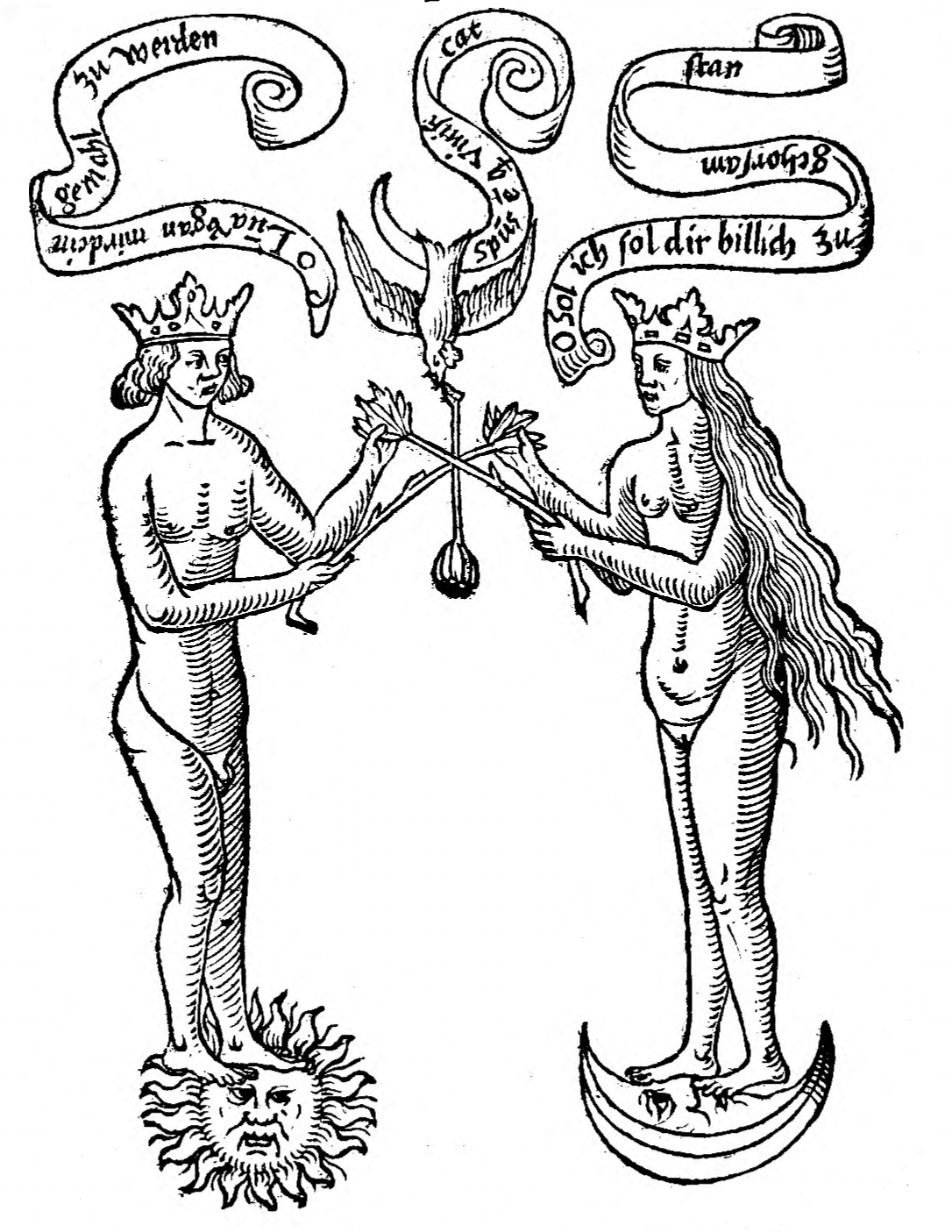
Figure 3. Scrolls left to right: O Lu[n]a v[or]gan mir dein gemahl zu werden (“O Luna, grant me to become your husband”); sp[irit]us e[st] q[ui] vivificat (“It is the Spirit who gives life [John 6:63]”); O Sol ich sol dir billich zu gehorsam stan (“O Sol, rightly shall I be obedient to you”)[1]
[p. 28]Hermes, in the fourth book of the Treatises:[2]
He who wishes to be led into this secret art and wisdom must reject the vice of arrogance. He must be pious and upright, profound in reasoning, humane towards men, of a serene countenance and cheerful. Carefully he must preserve himself as an observer of the everlasting secrets which are revealed to him. My son, before all else, I warn you to fear God. He is the help of whatever is hidden away, and in him your disposition is seen.
Geber, in the book of the perfected magisterium.
Before he may attain to the art, the craftsman of this science must have a subtle intelligence; he must know and recognize the metals’ natures, their generations, their weaknesses, and the imperfections of their minerals. The craftsman shall not succeed in tracking down the art, so long as he is filled up with a coarse and rough intelligence, or if he is lustful or greedy with respect to costs and expenses. A man of two minds, lacking a gall-bladder and a neck, who wavers in judgment, or who is too hasty or captious, cannot succeed in this. The son of doctrine is rather a man endowed with the subtlest intelligence; he is sufficiently wealthy, generous, healthy, firm and constant in his purpose, patient, mild, long-suffering, and temperate. Alphidius: My son, know that you cannot possess this science until you purify your mind with God’s help, and until God knows that you have a sure and proper mind. And then [p. 29]he will make you ruler over the world. Aristotle: O, if God knew a faithful mind in man, certainly he would reveal the mystery to him.
The Correction of the Foolish:[3] Every art must act like [imitari] dross. It must know what substance is the nature of its nature: thus does art represent [imitatur] its own nature. You fool, know that nature itself is discerned by the art. Nor can nature be corrected, for it is impossible for one who does not imitate nature [naturae non imitatori] to attain his purpose, that is, to arrive at the philosophers’ secrets.
Hermes and Geber.
If a man, once he perfected this art, needed to live for a thousand thousand years, and on each day to feed four thousand men, he would lack nothing. Senior says, in confirmation of this: It is from a rich man who has the stone that the elixir is made. Similarly, he who has fire gives fire to whomever he wishes, whenever he wishes, however much he wishes, without any danger or fault on his part. Aristotle, in the twentieth book of De Anima: The most natural and perfect work is to beget the same kind as oneself.
The Greater Tablet of the Science.[4]
First, the true material is held to be in our green Lion, and to have its colour. It is called Adrop, Azoth, or green Duenech. Second and also third,[5] it is held similarly [p. 30]that bodies are dissolved in quicksilver of the philosophers (that is, in the water of our Mercury), and one new body is made. Fourth, it is held that the putrefaction of the philosophers has never been seen in our days. It is called sulphur. Fifth, it is held that the greater part of that water is made with black and feculent earth; all the philosophers speak about this. Sixth, it is held that in the beginning, black earth stood above the water. Gradually it submerged to the base of the vessel. Seventh, it is held that that the earth was dissolved in the water. It was again the colour of oil, and this was called the philosophers’ oil. Eighth, it is held that the dragon was born in the blackness and fed on its Mercury. It killed itself and was submerged in it. Then the water whitened somewhat—and this is elixir. Ninth, it is held that the water is wholly purified of blackness, and it remains the colour of milk, and many colours appear in the blackness. Tenth, it is held that those black clouds, which were in the vessel above the water, descended into the body from which they came out. Eleventh, it is held that the whitest ash was made, white like glittering marble. This is white elixir [elixir ad album], and the ash is the fetus. Twelfth, it is held that the whiteness was turned into a redness transparent like a ruby. This is red elixir [elixir ad rubeum].
If you wish to understand the whole work well, read [this passage] part by part, and you shall see wonders. I have seen all this in our days, up till [p. 31]the lion. And I have not spoken of everything which appears and is necessary in this work, for there are some things of which man may not speak. Nevertheless, I have depicted it to its end—although I have not seen the latter—since I know that the work arrives of necessity at this sort of nature. It is impossible to know this except that it be known through God, or else through a master who may teach it. And know that this is a lengthy road, and that patience and time are necessary in our magisterium.
Quicksilver is common salt [sal comune]. Rosarius[6] says: Common salt dissolves gold and silver. It increases the redness in gold and the whiteness in silver, it and transforms Copper [Aes] from corporeality to spirituality. With this [spirituality], bodies are calcinated. The Light of Lights:[7] If omnipotent God had not created this salt, the elixir would not be perfected, and the study of Alchemy would be in vain.
Note: there are four Mercuries, namely crude Mercury, sublimated Mercury, Mercury of Magnesia, and unctuous Mercury. Magnesia is the full Moon, the Mercury of the philosophers; it is the material in which Mercury of the philosophers is contained. Nature has worked over it a little, and has formed it into a metallic form and then left it, albeit imperfect. He said this: It must be noted that the sort of substance called the medium of ingression is neither perfect nor wholly imperfect. Nothing can be made out of nothing. As for what nature has not perfected in itself, the craftsman is to help reduce nature itself from imperfection to perfection. And this is called the [p. 32]invisible stone, the holy stone, the blessed stone.
Geber: Quicksilver cannot burn. Therefore, it has the natural capacity to purify earthliness and remove wateriness. If it is pure, then the force of white and unburning sulphur will coagulate it into silver, and the latter is the best substance out of which silver elixir [elixir ad argentum] may be made artificially. But if is excellent red sulphur, of an unburning nature, then this substance will be the best from which gold elixir [elixir ad aurum] may be made. Such [red] sulphur is our sulphur and the sulphur of the wise. It is not found above the earth, unless it is extracted out of those bodies. Arnaldus: The sulphur hidden in quicksilver gives the form of gold to that quicksilver. This is by virtue of the colour of mineral sulfur, which is extrinsic to it. Avicenna: This kind of sulphur is not found above the earth, except for that which is found in bodies. Thus, those bodies are subtly prepared so that we may have sulphur above the earth. Through our magisterium, the perfected body helps to perfect the imperfect, without admixture of any extraneous substance. Any other sulphur, howsoever it may be gotten, hinders proper melting [fusionem], as is clear in the case of iron: Iron cannot be poured if it is discovered to have sulphur fixed in it. But even if the sulphur is not fixed and a good melting is expected, it is still checked by fire: it burns and evaporates, as is clear in the case of lead and other weak bodies. Thus, common sulphur does not belong to [p. 33]the truth or perfection of our art, since it hinders what is perfect in its own operations. Geber: Sulphur can never be fixed unless it is calcinated. When it has been calcinated, it yields no melting whatsoever. Senior: Sulphur and arsenic are not the true medicine of this magisterium; they neither complete nor perfect. This is well enough known about all lesser minerals. Albertus:[8] The property of sulphur is to congeal Mercury and, together with Mercury, to make perfect. But the tincture exists only in two perfected bodies, from which the sulphurs may be removed.
A philosopher: The foundation of the art is the Sun and its shadow. Morienes says: Three species are enough for the whole magisterium: white smoke (that is, fifth force, or heavenly water), the green Lion (that is, Hermetic copper), and foul water, which is the mother of all metals. From foul water, through it, and by it, the philosophers prepare the elixir in the beginning and the end. Do not reveal to anyone these three species for the preparation of the elixir; a fool treats of this magisterium around any other matter. It is the most secret mystery of the philosophers. Hermes, the father of the philosophers, says: philosophy has three parts, namely Sun, Moon, Mercury. Having conjoined these, father Hermes knew how to prepare the tincture. Johannes of Aquino:[9] Whoever is ignorant about destroying gold [p. 34]must necessarily be ignorant about its construction in the course of nature. It is easier, then, to construct gold than to destroy it. But as for whoever thinks to effect the tincture without these things, he goes to practice blind, like an ass to its meal. For body does not act on body, nor spirit on spirit; all the more so, form does not receive an impression from form, nor matter from matter. For like cannot act on or suffer action from like, since neither of them is worthy of it with respect to the other: an equal cannot command an equal. Aristotle: the only true generation comes from that which agrees in nature. Substances do not come to be except according to their nature. An elder tree never produces pears, nor a bramble pomegranates; a bad tree cannot bear good fruit. Likewise the philosopher says: Our Mercury is transformed into every nature—or all those natures—with which it has been either joined or divided.
A philosopher: Whoever knows how to destroy gold, so that it shall no longer be gold, will attain to the greatest mystery. Another philosopher says: It is difficult to destroy gold, very difficult to construct it; it is easier to destroy the accident than the essence. Gold is wholly Mercury. This is evident from its own weight and from its easy combination with Mercury. The philosophers’ whole, radical will and intent are within it. By means of heavenly heat and the motion of the planets, it has acquired those excellent virtues which are impossible to create as such, except inessentially [per accidens]. [p. 35]But a craftsman may indeed attain to all these things within Mercury—that is, if he begins the work through meditation, by the help of fire, and with art. The riches are the riches of work. Albertus: It is evident that a great quantity of quicksilver is a cause of perfection in bodies. But a high level of sulphur, that is, of impurity, is a cause of both perfection and corruption. Euclid,[10] the wisest of men, counseled us that nothing is worked over except in Sun and Mercury joined together; this is what the philosophers’ stone consists in. Nothing comes from what is already perfect, since it is already perfected.
Take, for example, the nature or artifice of which we have an example in bread. Bread that has been fermented and baked is perfect in state, that is, in its being. It has attained to its final end, and no more can be fermented by it. Just so with gold. By the fire assay pure gold is drawn out of a firm and fixed body, and then it is entirely impossible to ferment anymore with it, according to the philosophers—unless the metals’ first matter is at hand, in which gold may be dissolved into its first matter and into miscible elements. Therefore let us receive that material from which there will be gold. Let it be drawn through the art [artificium] into the true ferment of the philosophers. And, through art [ingenium], let us transform this into a perfect material, or into the spirit of perfect bodies. Many among the modern labourers, even philosophers, are deceived, since they cease the work when it ought to be begun. Alas, you sons of doctrine! who hope to pick fruit before it is mature and to reap before the harvest. Another philosopher: Nothing can come out of what is perfected; the form of substances, if perfected in its own nature, does not alter, but rather [p. 36]is corrupted. Nor can anything come to be from what is imperfect, according to the art. The reason for this is that the art cannot induce the first dispositions. But our stone is the middle substance between the perfect and the imperfect body, and through the art [artem] it leads what nature itself has begun to its perfection. If you begin in Mercury to work over what nature has left imperfect, you shall find perfection in it, and you shall rejoice. What is perfect is not altered but corrupted. But what is imperfect is altered for the better: therefore the corruption of the one is the generation of the other.
[1] In the 1530s manuscript, the banners belonging to Sol and Luna each contain a couplet rather than a single line: O Luna vergun mir din gemachel zu werden / So gebirstu den richesten Kaiser uff erden. “O Luna, grant me to become your husband; / Thus you bear the richest King on Earth.” O Sol ich sol dir billich zu gehorsam sten / Wir sollen aber vor in user naturlich bad gon. “O Sol, rightly shall I be obedient to you; / But first we shall go into our natural bath.”
[2] Hermes, or Hermes Trismegistus, was the legendary founder of alchemy. The Treatises refer to a work titled Septem tractatus seu capitula aurei (“Seven treatises or chapters of gold”) or Tractatus aureus de lapidis philosophici secreto, in capitula septem divisus (“Golden treatises on the secret of the philosophers’ stone, divided in seven chapters”), which circulated in Latin translation since the 13th century.
[3] Corrector Fatuorum, Correctorium Fatuorum, or Correctio Fatuorum, which appears as Book I in the first volume of De alchimia opuscula complura veterum philosophorum (of which Rosarium comprises the second volume). Anonymous, or something attributed to Ricardus Anglicus, otherwise unknown.
[4] Tabula Scientiae Maioris. This and other passages appear in the Donum Dei, a collection of quotations closely related to the text of the Rosarium.
[5] Trigesimo, “thirtieth,” which seems likely to be a typo for “third” given the numerical sequence.
[6] Probably not a name, but rather a common title used in alchemical works of the time. A certain Rosarius minor dating from the 16th century used rose-garden allegory to explain alchemical doctrine.
[7] Lumen luminum, a title borne by several alchemical texts. Telle considers that the one cited in the Rosarium may be attributed to Rhazes.
[8] Albertus Magnus (c. 1200–1280), a philosopher, theologian, and natural scientist. Most of the texts attributed to him are pseudepigraphal, with the possible exception of De mineralibus (“On minerals”).
[9] Of uncertain identification.
[10] Not the ancient Greek geometer, but an obscure alchemical authority.