Previous section | Next section | Back to Rosarium index | Back to main page
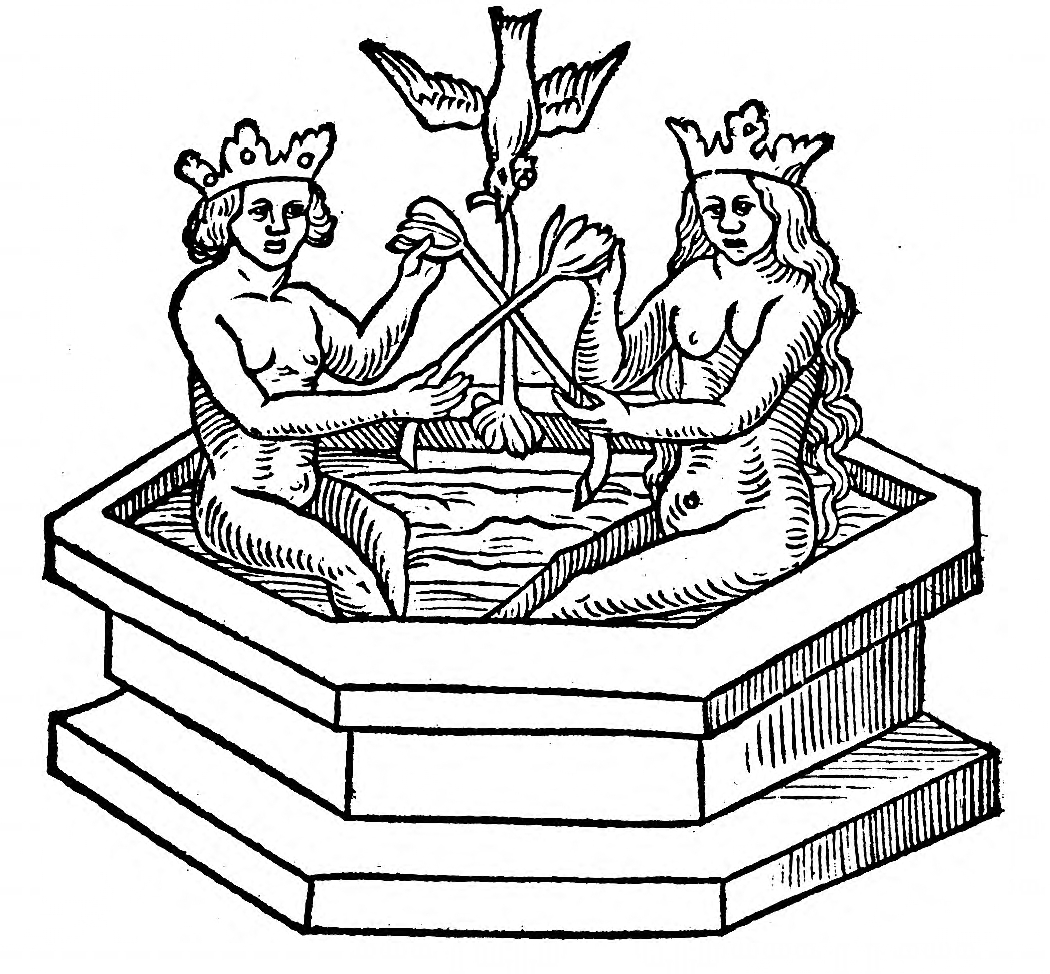
Figure 4.[1]
[p. 37]The Mirror: Our stone must be extracted from the nature of two bodies before the complete elixir can be made out of it. It is a necessity that the elixir be purer and better digested than gold and silver. This is because elixir has power to bring wholly to perfection what is broken in the gold or silver of the philosophers; the latter can hardly make perfect. If they [gold and silver] gave of their own perfection to another, they would themselves remain imperfect, since they are not able to tinct except what they extend themselves into. Just so, no substance whitens except according to its own whiteness, nor does any substance redden except according to its own redness. And likewise, the works are done in our stone so that the tincture in it may be improved beyond its own nature, and so that the elixir may be according to the Allegories of the Wise:[2] [namely, that it be] a compound of clear forms, a spice, an antidote, a medicine, and a purgative of all bodies that ought to be purged and transformed into true Moon-maker and Sun-maker [lunificum et solificum].
Hermes: A conjunction of two bodies is made there, and this is a necessity in our magisterium. If one of the two bodies were not in our stone, it could never yield the tincture. Likewise the philosopher says, the wind has borne it in its belly.[3] Therefore it is plain that wind is air, and air is life, and life is soul [anima], meaning [p. 38]oil and water.
Arnaldus: Experiment shows that there are degrees between the moderate quantity of fire. Fire will always be weak in solution, moderate in sublimation, tempered in coagulation, continuous in whitening, and strong in reddening. If you err unknowingly in these things, you shall weep often over what happens in the work. Therefore, you must embark on the work assiduously, for the art is strengthened by intelligence, and intelligence likewise by the art. Strive only for completion and let all other things pass. Saint Thomas Aquinas:[4] The material of the stone is coarse water [aqua grossa]. But the agent is heat, or cold which freezes the water. Have faith, then, that those stones which come from animals are more precious than others.
The Light of Lights: But you can prepare nothing like the stone without green and liquid duenech which gives strength. It is born in our minerals. Rhazes: My son, contemplate the deepest things of the world to your right and to your left. Ascend to the place where our stone is found, that mountain which bears every kind of pigment, shape, and mineral.
Malchamech:[5] The stone required in this work is of animal substance. You will find it everywhere in the plains, in the mountains, and in the waters; the rich have it as much as the poor. It is base and dear, it grows out of flesh and blood. How precious it is to the knowing man! From the Treasury [p. 39]of Philosophy:[6] The philosophers have said that our stone comes from spirit, body, and soul, and they spoke truly. For the imperfect body they called “body,” ferment they called “soul,” and water they called “spirit,” and they did well indeed. The imperfect body, in itself, is the burdensome, infirm, and dead body. Water is spirit, the body that purges, makes subtle, and whitens. Ferment is the soul; it gives that life to the imperfect body which it lacked at first, and it leads it to a better form. The body is comely and feminine, the spirit is Mercury and masculine, the soul is Sun and Moon. The body can be liquified into its first matter, which is Mercury, as Morienes says: Our Mercury is gotten only from bodies that have been liquified. And this is not by a common liquefaction, but only by the liquefaction that endures until wife has been joined to man in matrimony, and they are unified, up until the whitening. Morienes says: Take phlegmatic and choleric, and pulverize sanguine with them until the sanguine is made to tinct the heavens.
Hermes: Understand, sons of the wise, that this most precious stone cries out, Protect me as I protect you; give me what is mine by right so that I may help you. For my Sun and my innermost rays are within me, and the Moon belongs to me, and my light overcomes all light, and my goods are more sublime than all goods. To those who desire, I give much joy, happiness, wealth, and delight. When I seek after anything, they know it, and I make them to understand and to possess the divine force. [p. 40]I beget light, but darkness is also of my nature—unless my metal should be dry. All bodies need me because I liquify them, remove the rust from them, and extract their substance [substantiam]. Therefore, when I have been conjoined with my son, nothing in the world can be greater or worthier of veneration.
The disposition of the vessel [vasis] appropriate to our work, according to the tradition of one Ferrarius by name.[7]
Let there be made a round vessel [concha] of glass, whose base is of slight thickness, like a serving dish. And in the middle of its neck [spondilium] let a girdle of glass be made to encircle it. Above that girdle, let a round wall be built, equidistant from the walls of the vessel, of the same thickness as the vessel’s cap, such that the wall of the cap will fall through this distance largely without pressure. Let the height of this wall be more or less to the measure of the height of the wall of the vessel. Let two caps be made, equal to the measure of the concavity between the two walls, and let their length be equal [to the concavity], and let it be about two large handspans long, and the shape of one of them should be pyramidal. Let there be two holes on their topmost points, that is, one hole in one, another in the other, so that a hen’s [p. 41]feather may pass through both. The whole intent of the vessel is that its stopper may be removed at will by the craftsman, and that its joint is ingeniously fitted, so that even without the use of any lute no escape lies open to spirits, that is, to Mercury and lazmaris. Beyond this, a special intent is that the lower vessel should penetrate up to the middle of its cover with its necks.
Hermes: The Dragon does not die except if it is killed with its brother and sister—and not just one but both at the same time, namely, Sun and Moon. A philosopher: Mercury never dies except if it is killed with its sister. That is, it is necessary to congeal it [congelare] with Moon or with Sun. Note that the Dragon is quicksilver that has been extracted from bodies, and it has body, soul, and spirit within itself. In addition it is said: The Dragon does not die except with its brother and sister (that is, with Sun and Moon, or with extracted sulphur, which has in itself a moist and cold nature because of the Moon). Thus dies the Dragon—that is, the quicksilver which was extracted in the first place from the bodies, the enduring water [aqua permanens] of the philosophers. This happens after the putrefaction and the separation of elements. The water is also called by another name: foul water [aqua foetida]. A philosopher: This foul[8] water brings everything it needs with it. Aristotle, in the second [p. 42]book of the Physics: It is a ridiculous thing to make the imperfect better using the perfect.
The philosopher Bonellus:[9] The Copper [Aes] of which I spoke is not common Copper or tin. It is our true work. It must be mixed with the body of magnesia, so that it may then be cooked and pulverized with aqua vitae till it is destroyed. You sons of the art, you must have much water, and this straight away, until you have designated this water according to the parts of water [donec per partes aquae apposuisti], and until the greatest part of the earth has been dissolved. Avicenna: What is spiritual in the vessel shall rise up, but what is thick and coarse remains at the bottom. You shall achieve nothing unless you blacken and destroy the body to the point where the water does not wish to be mixed with it, nor to be received by the earth. When spiritual powder is in the vessel, it remains at the bottom. Thus, unless you turn everything into spiritual powder, you have not yet pulverized it. And what you do in the white body, do also in the red, for this medicine is in essence one, and in mode of action one.
Verses:
Aes in aquam puram nil plus perficere cura,
Tinctura gymme de rebus fixis in igne.
Solvitur in igne rata lapis est aqua fixa gelata,
Quum redit in formam primam sic percipe normam
Tunc erit aes nostrum lapis instans philosophorum.[10]
Copper in pure water is no longer concerned with perfecting.
The gem’s tincture, which comes from substances fixed in fire,
Is dissolved in the reckoning fire. The stone is fixed, frozen water,
Which returns into its first form. Thus, grasp the precept,
And then our copper will be the philosophers’ stone drawing near.
[p. 43]On the salt of the philosophers.
There are three stones, and three salts, which the whole magisterium consists of: mineral, plantal [plantalis], and animal. And there are three waters: Solar, Lunar, and Mercurial. Mercury is mineral. Moon is plantal, because it receives two colours: white and red. Sun is animal, because it receives threefold: constriction [constrictionem], white, and red; and it is called the great animal. Ammonium salt [sal armoniacus][11] is made out of Sol. Moon is called plantal, and alkali salt is made out of it. Mercury is called mineral stone, and common salt is made out of it. When the philosophers saw that the substance of this art had been dissolved, they called it ammonium salt. And when it was putrefied, then they said that our stone is base and is found in filth. And many have dug up and worked in filth, and they found nothing. When it has been turned into water, rich men have it as much as poor men, and it is found in every place, and at any time, and among all things—although the search aggravates the seeker. When it has been whitened, the philosophers called it arsenic, and the name of all white things, and virgin’s milk. And when [p. 44]it was red, they called it Jacinth sulphur, and blood, and the name of whatever is red.
Gratianus: Ash can be made from every substance, salt from the ash, and water from the salt. Mercury is made from this water, and from this Mercury, by different operations, Sun is made. Arnaldus: Ash needs to melt [fusione caret] so that it may enter and tinct things. Surely it liquefies itself (that is, makes itself sweat) in the manner told by the philosophers. What manner is this? Is it to dissolve in water? Certainly not. For the philosophers are not concerned with waters that adhere to what touches it, or with other moistures of this kind.
A philosopher: Whoever wishes to alter bodies and spirit, and to transform something from its nature, must first reduce them to the nature of salts and alums. Otherwise, he will accomplish nothing. He should then dissolve them. A philosopher: Salts and alums are that which is made by our work. Arnaldus: Let everyone praise God who would have subtle salt and incombustible oil. Avicenna says: If you wish to be enriched, prepare salts until they become pure water. Salts are converted by fire into spirit; salts are the roots of your work. Hermes: All salts of any kind are contraries to our art, except for our lunar salt. Arnaldus: The reason it is not in salts or alums is that [p. 45]it is foolish to seek from nature what is not in it. A philosopher: Salt of metals causes Mercury to dissolve in pure water under dung. When this has been mixed and coagulated, it will be perfect medicine.
Note: every well prepared salt returns to the nature of ammonium salt. The whole secret is in prepared common salt. Note: Roman vitriol[12] has the nature of the stone of metals, and it is hot and dry. Again: Alum seems to be coagulated Mercury, but it falls short of its completion. Mercury is what is hot and moist, and is said to be like unto the one. Thus, whoever knows salt and its solution knows the hidden secret of the ancient wise men. So set your mind on salt, and do not think about other things. The science, and the highest secret mystery of all the ancient philosophers, are hidden in this alone.
[1] No verse accompanies this woodcut in the 1550 edition. The 1530s manuscript reads, O Luna das bad ist so edel und freudenrich / es macht uns den himelschn corpern glich. // O Sol solt das naturlich bad nit sin / So mocht kain stain empfachen unsern schin. “O Luna, the bath is so noble and joyful, / it makes us equal to the heavenly bodies. // O Sol, without the natural bath, / no stone could receive our glow.”
[2] Allegoriae sapientum supra librum Turbae XXIX distinctiones (“Allegories of the wise on the book Turba, in 29 distinctions”). Despite its title, it bears no relation to the Turba Philosophorum.
[3] From the Emerald Tablet attributed to Hermes Trismegistus.
[4] A considerable alchemical corpus was later attributed to the Christian scholastic (1224/25–1274).
[5] Of uncertain identification.
[6] Thesaurus philosophiae, a late-medieval collection of dicta, textually related to the Rosarium.
[7] “Ferrarius” means “smith,” and was likely originally a designation of profession rather than a name. The following passage, describing the construction of an alchemical vessel, is very obscurely written. Perrot omits it entirely, and the extant English translation is incoherent. The description is of an alembic, a primitive apparatus used for distillation. An alembic has three components: the cucurbit, the vessel that is heated; the cap, a hollow headpiece which fits over the mouth of the cucurbit, condenses the rising vapour and channels it to a tube that projects downward out of it; and the receiver, a separate vessel into which the tube of the cap is inserted to receive the distilled liquid. This text describes the construction of the cucurbit and head, with an unusual joint designed so that the vessel will be airtight without needing to lute it (to stop it with clay or cement).
The cucurbit is a round glass flask with a neck. A ring of glass is to be attached halfway up the length of the neck, which is then extended into a cylinder up to the full height of the neck, so that the upper half of the neck is surrounded by a cylinder of glass. Unlike a usual cap, which attaches to the cucurbit by a small, loosely fitted joint, the cap here must have a projecting cylindrical joint that fits into the space between the neck of the cucurbit and the cylinder surrounding its upper part, thus tightly sealing the connection. The specified length of two hands, or about 8 inches, suggests that the vessel itself must have had a neck stretching over a foot and a half long; the specification is for a large alembic. Two caps are made, one whose body is in the shape of a pyramid. Depictions of such pyramidal covers occur in contemporary manuscripts. They are usually tetrahedral, being fitted with a tube at each of their bottom vertices, so as to channel distillate into three vessels at once. The shape of the other cap is not specified. Probably it was the usual, roughly spherical sort, and it may have had a tube for a receiving vessel, or may have been completely sealed. Each cap is fitted with a small ring on top, to allow it to be manipulated while hot by using a rod. The last sentence suggests that the joint should be internal to the chamber of the cap rather than below it, so that the lower vessel’s neck penetrates up to the center of the cap’s chamber when joined. Lazmaris is unknown; Telle suggests reading it as lac maris, “milk of the sea.”
[8] Reading foetida for foetum. The reading is rather strained with foetum, but would be rendered “This water brings with it everything it needs—the fetus.”
[9] According to Telle, derived from Greek Apollonios via Arabic Balinus, and identified with the legendary Apollonius of Tyana, who is held to have discovered the cosmogony Sirr al-haliqa (“Secret of creation”), as well as the Tabula smaragdina (“Emerald tablet”) of Hermes Trismegistus.
[10] Reading gymme as gemmae; it might also be a non-standard form of gummi, gum, in which case the line would read like “The gum-tincture, which ...”. I have reproduced the original capitalization and punctuation of the verses as printed; however, the editor of this edition seems to have misunderstood the syntax of the lines. The underlying Latin is correct, but is impossible to read according to the punctuation. The translation ignores the punctuation.
[11] That is, smelling salts.
[12] Copper(II) sulfate.