Previous section | Next section | Back to Rosarium index | Back to main page
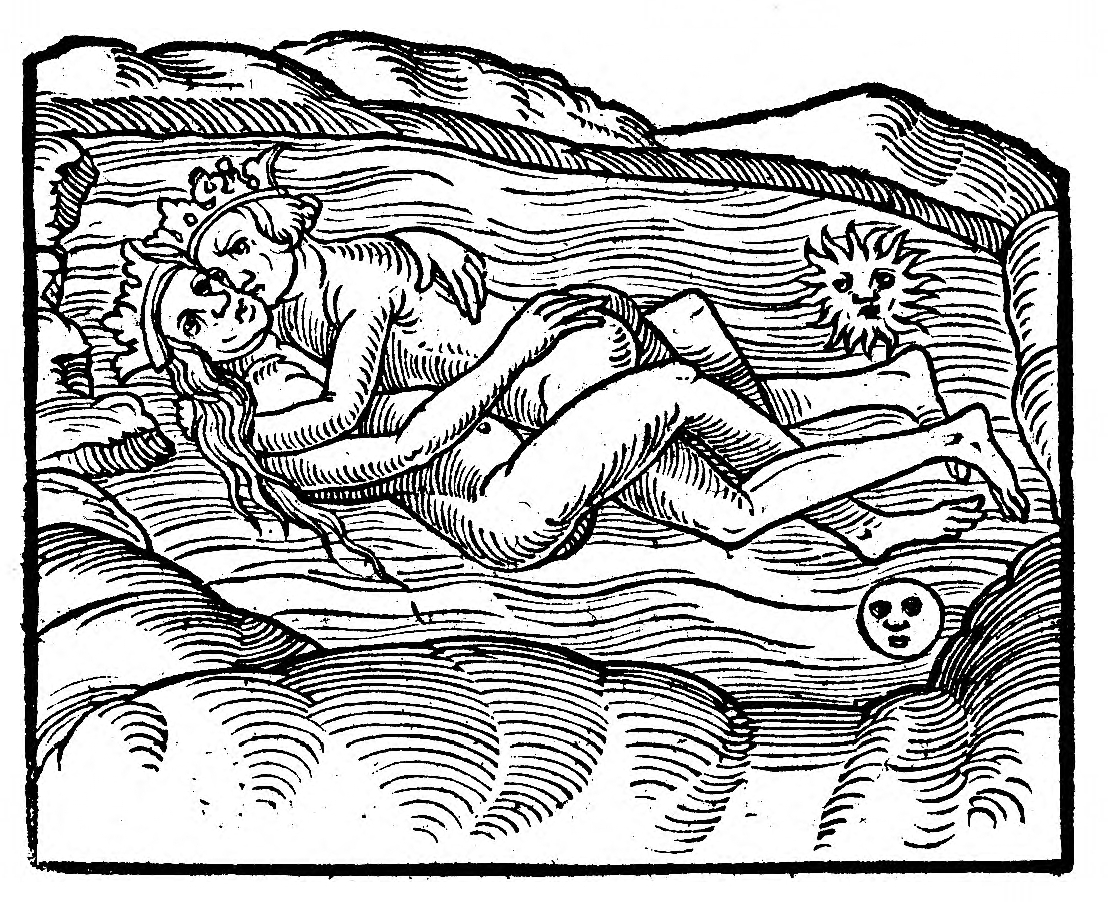
Figure 5.
O Luna durch meyn umbgeben / und susse mynne /
Wirstu schön / starck / und gewaltig als ich byn.
O Sol / du bist uber alle liecht zu erkennen /
So bedarftstu doch mein als der han der hennen.
O Luna, through my embrace and sweet love,
You become beautiful, strong, and powerful as I am.
O Sol, you are above all light to know,
Yet so do you need me, as the rooster the hen.
Arisleus, in the Vision.[1]
Conjoin Gabricus, beloved of all your sons, with his sister [p. 47]Beya,[2] a radiant, sweet, and tender girl. Gabricus is the masculine and Beya the feminine. She gives him everything that comes from her. O blessed nature, blessed also is your operation, for out of what is imperfect you make what is perfect. Therefore do not take up nature unless it is pure, clean, raw, lovely, earthly, and proper. If you do otherwise, it will be worth nothing. See that nothing contrary enters in with our stone; use nothing but it alone. And so conjoin our servant with his fragrant sister, and they will bear a son between them, who will not be like the parents. Although Gabricus is more dear than Beya, there is no generation without Gabricus. The lying of Gabricus with Beya itself dies straight away, for Beya ascends above Gabricus and encloses him in her womb, so that nothing can be seen of him within. With such love she has embraced Gabricus that she has conceived him wholly in his nature, and divided him into indivisible parts.
Thus Masculinus[3] says, in verses:
Quae quasi lac fuerat conceptio sanguinem mutat,
Pallida nigrescunt, rubea diffusa litescunt,
Candida mulier, si rubeo sit nupta marito,
Mox complexantur complexaque copulantur.
Per se solvuntur, per se quoque conficiuntur,
Ut qui duo fuerant, unum quasi corpore fiant.
The conception that was like milk changes into blood;
The white blackens, the scattered red glitters.[4]
If the white woman is married to her red husband,
Soon they embrace, and, having embraced, copulate.
They dissolve in themselves and are produced in themselves,
So that they who were two are made like one body.
[p. 48]Miriam the sister of Moses says: Join gum with gum in a true marriage, and make it like a torrent of water. Astanus:[5] Spirits are not conjoined to bodies until they are perfectly purified. In the hour of conjunction, the greatest miracles appear. Then the imperfect body is coloured with a firm colouration by fermentation, the ferment being the soul of the imperfect body. By means of the soul, the spirit is conjoined and bound together with the body. Together with the soul, it is made into the colour of the ferment, and is made one with them. Basius says:[6] In the perfect magisterium, the stones do not mutually receive one other unless both have first been cleansed. Unless they are first perfectly purified of all filth, the body does not receive the spirit nor the spirit the body—and then the spiritual may become corporeal, and the corporeal spiritual. Senior: O Sun, you need me as the rooster needs the hen, and I need your work.
Alexander in the Secrets of Nature:[7] Know that nothing is born that has been born, except for what has been born from a man and a woman. Hermes in the second treatise: Learn this, my son, that unless someone knows how to marry and make pregnant and produce species, nothing will be made, nor will anything be accomplished. But if he does this, he will be of the greatest worth. The philosopher Rosinus:[8] The mystery of the art of gold is of the masculine and the feminine. The feminine [p. 49]rejoices in receiving the masculine force, since the feminine is strengthened by the masculine. Alphidius: My son through faith in glorious God, the embrace [complexio] comes from the embrace between the two luminaries, masculine [Sol] and feminine [Luna]. They embrace and copulate with each other, and a modern light is born from them. There is no light like it in the whole world. Senior: Make the water out of two waters. If you have understood my words, every rule will be beneath your feet. Rosarius: You must have two waters; one is white, the other red.
Senior: This is the water in which the powers of white and red are gathered together. Hali,[9] the philosopher and king of Arabia, says in his secret: Take a dog of the same age and an Armenian female whelp. Join them together, and these two will bear you a dog-son of a celestial colour; this son will serve you from the beginning in your home, in this world and in the other. Senior: The red servant took the white as his wife, and in their conjunction, the wife being pregnant, a son was born who served his parents in everything, and who was more splendid and lucid than they. Rosinus the philosopher: This stone is a key; nothing is made without it. Our stone is of the strongest spirit, bitter and brazen. Bodies will not mix with it until they are dissolved. If, however, I were to call it by its name, novices [p. 50]would not believe it exists. Arnaldus: You who long to investigate the secret of this art, know that you require the first matter of metals, or else you will be frustrated in your labor. Rosinus: We make use of true nature, for nature does not correct nature except unto its own nature. There are three principal philosophers’ stones, namely, Mineral, Animal, and Vegetable. Mineral, vegetable, and animal stone: threefold in name, one in being [esse].
Spirit is twofold: it tincts and it prepares. Albertus: Preparing spirit dissolves Copper and extracts magnesia from a body, and then reduces it again to its own body. Senior says: The same is the preparer and extractor of soul from its body, and it reduces it to its own body. Tincting spirit is called quintessence [quinta essentia]; it is force and a soul which stands, pours forth, and penetrates. The Book of Three Words:[10] You must extract quintessence, or else you will labor in vain. Doubtless, this cannot be done without water. But the second spirit, which is outside of the body, is of the nature of water, and this is what tincts the body in the elixir, as the Turba says. Now, the body is masculine, and the spirit is feminine. Arnaldus: Spirit is not altered by the body, for it would lose its spiritual virtue. Rather, every body is altered and tincted by spirits. Aristotle: Note these words and mark these mysteries. The spirit which dissolves white foliated earth does not [p. 51]retain anything fixed from them, unless you fill it with the body from which it was prepared in the first place. Enduring water [aqua permanens] (that is, perennial water, that is, burning wine) is called water of the body—when, that is, the body has been reduced into Mercury. Without enduring water, nothing is made. It is also called water of life [aqua vitae].
A philosopher: I swear by the heavenly god that the art is nothing but dissolving and coagulating the stone forever. Again, only with burning wine can you complete the perfect elixir. The water of the philosophers is called the Hermetic vessel, about which the philosophers wrote thusly. All modes come to be in our water: sublimation, distillation, solution, calcination, fixation. They are made in this water just as they are in an artificial vessel, and this is the greatest secret. The water is the weighty matter [pondera] of the wise, which is why water and fire suffice for your entire work. Our water is stronger than fire. It makes an unadulterated spirit from the body of gold, which fire cannot do. Fire is to this gold as water is to vulgar fire. Therefore the philosophers have said: Burn our Copper with the strongest fire.
Aristotle, in the rule of princes, speak of Alexander about four elements. When you have water (that is, Mercury from air, that is, from the Sun), and you have air from fire (namely, the spirit of Mercury), and you have fire (that is, Mercury from earth, that is, from the Moon), then you shall have the complete art. Thus a philosopher: Our stone passes through earth, from earth into water, water into air, air into fire, and there [p. 52]it stands—but let its descent be in reverse. The white work is completed by three elements in which there is no fire, namely three weights of earth, two of water, and one of air. But as for the elixir of the Sun, send two weights of earth, three of water, one and a half of air, and also what is of fire, that is, red ferment. Rhazes in the Great Book of Precepts says thus: Let no one who is ignorant of weights work over our books. The philosophers neither set down nor hid anything of their subject matter except for this.
The Turba says, We grind not by our hands, but by the strongest decoction. Calidius: The lesser fire pulverizes all things. Note: there is a difference between element [elementum] and what is made element [elementatum]. Quintessence is the first element of compoundable matter. Neither earth nor water nor air nor fire is a pure element or is counted among us as simple, because they commingle mutually, especially where they are conjoined. But quintessence is the body subsisting in itself; it differs in matter and form, in nature and virtue, from all elements and from what is made element [elementis et elementatis]. It does not have a cause of corruption in itself. It is called quintessence because it is extracted from all that is made element [omnibus elementatis]. The elemental motion [motus elementalis] is not in it, as it is in other elemental bodies [corporibus elementalibus]. Therefore the stone is said to be all substances, having in itself and from itself what it needs for its own [p. 53]perfection. Through the participation of elements, it is found everywhere, and it is called by every name because of the marvelous variety of colours proper to its nature. By its putrefaction it is the lowliest, and by its virtue it is the dearest. Among the philosophers, this magisterium is buried and hidden away. Our stone is called one substance when the substance and water of the body are prepared indivisibly, such that one of them cannot be separated from the other. Our stone is called the being [esse] of incombustible material, and only the spirit Mercury is incombustible and airy; therefore, Mercury must be in the magisterium. Again, Mercury is the Stone which the philosophers sought after. In it are the first elements of minerals, tincture and calx, soul and spirit with body, what is fixed and what is volatile. Mercury is not just anyone, but he around whom nature has determined its prime operations with respect to metallic natures—and whom nature has left imperfect. If you extract this stone from the substance in which it is found, and start to work towards its perfection, beginning where nature has left it, then you shall find the perfect within it, and rejoice.
Quicksilver has no strength in itself. But when it is mortified with its secret body, it has strength, and it lives an incorruptible life. This body is of the nature of the Sun. Thus it is necessary that [p. 54]quicksilver transform the whole [body] into the nature of the Sun, just as yeast [fermentum] converts the whole part into the nature of yeast—but not vice versa, for what is dominated is always given over to what dominates. In all the philosophers, our stone is named Mercury, and he is not born (as many believe) but rather is extracted from the body. The philosophers’ stone comes from three things, namely Sun, Moon, and Mercury. Make Mercury out of Sun and Moon; make it in its being [in suo esse], not with vulgar Mercury but by the philosophical way. Note: This stone is the only one in the whole world, and whoever errs in the work with respect to this principle labours in vain. In the whole world, there is no substance necessary to our work except for this stone, which is given to us as sons of the Sun. Arnaldus: Sun and Moon are in our stone, by virtue, by potential, and by nature. If this were not so, [11] neither Sun nor Moon could be made from it. The Sun and Moon in our stones are better than what is common [vulgaris] in their nature; for the Sun and Moon in our stone are living, but what is common is dead with respect to the Sun and Moon in our stone. Thus, the philosophers have alternately named this stone Sun and Moon. The latter are in the stone potentially—not visibly, but in virtue and in essence. This is why Hermes says: Our stone cries out, saying: my son, help me and I shall help you.
[1] The Turba philosophorum names Arisleus as its compositor. The Visio is a separate text attributed to Arisleus.
[2] Gabricus (Arabic kibrit, “sulphur”), Beya (Arabic bayda', “the white,” i.e., Mercury).
[3] Probably a corruption of “Merculinus,” to whom the other fragments of this poem are attributed in the Rosarium.
[4] Reading nitescunt for litescunt.
[5] A speaker in the Turba philosophorum.
[6] Of uncertain identification.
[7] Possibly the Secreta Secretorum, a medieval letter purported to be sent from Aristotle to Alexander.
[8] Zosimos of Panopolis (3rd or 4th c.), by translation through Arabic.
[9] Khalid ibn Yazid (c. 668–704 or 709), an Umayyad prince, to whom many alchemical texts were later attributed. Also known in translation as “Calidius.”
[10] Attributed to Khalid ibn Yazid.
[11] The Latin reads, “If this were so, ...”. Both grammar and sense here strongly suggest a missing negative.