Previous section | Next section | Back to Rosarium index | Back to main page
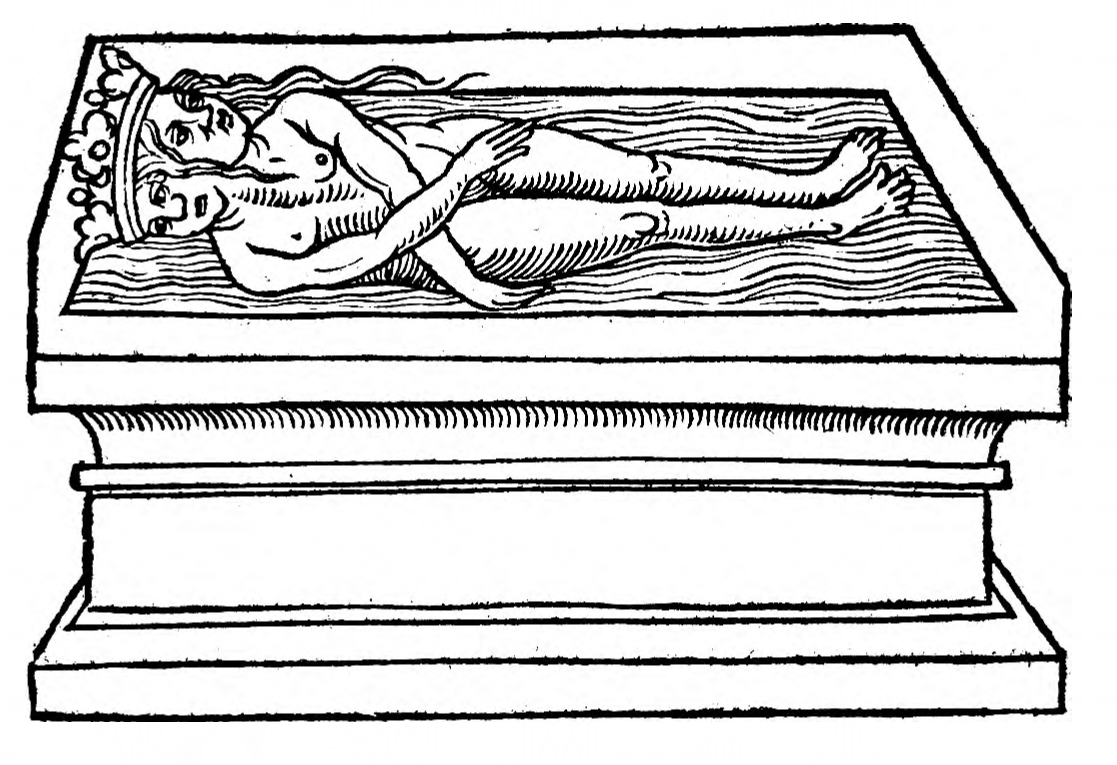
Figure 6.
Hye ligen könig und köningen dot /
Die sele scheydt sich mit grosser not.
Here lie king and queen dead;
The soul separates itself in great distress.
Aristotle, King and philosopher: I have never seen any animate thing grow without putrefaction. Unless it is made putrid, the alchemical work will be in vain.
[p. 56]Morienes: This earth is putrefied and cleansed with its water. Once it has been cleansed, with God’s help it is directed toward the whole work.
The philosopher Parmenides:[1] Unless the body is destroyed and shatters, unless it is putrefied and transformed within a substantial substance [in substantia substantiali], the hidden virtue can be neither extracted nor mixed with the body.
The philosopher Bachus:[2] When natures are corrupted and putrefy, then they give birth [gignunt]. The philosopher Plato: We have an example in the egg, which first putrefies and then gives birth to the chick which, after the corruption is complete, is a living animal.
Plato: Note that generation cannot happen without corruption. Be therefore studious in putrefaction. A philosopher: The corruption of the one is the generation of the other.
Hermes: The second stage is to putrefy and pulverize. This stage’s direction, then, is first of all to blacken and putrefy. Plato: The first rule of Saturn is to putrefy and to apply to the Sun. The composition takes four nights.
Democritus:[3] Do not be lazy or hasty in putrefying limestones [calculos]. Attend to the bodies which you bring together and conjoin in your work, and you will succeed. Rosinus to Euthesia: Take a marine animal, dry it, and putrefy it. Morienes: Nothing is made to grow or be born except after putrefaction. If [p. 57]it has not been putrid, it will not be possible to pour it or dissolve it, and if it has not been dissolved, it will be reduced to nothing.
Morienes: Our stone is the accomplishment of this magisterium; it is similar in its rank to the creation of man. First is Coupling [Coitus], second Conception, third Pregnancy, fourth Birth [Ortus], and fifth follows Nourishment. O grasp these most precious words of Morienes, and you shall not err in the truth. Open your eyes and see that the sperm of the philosophers is living water. Earth is the imperfect body, and earth is justly called mother, for it is the mother of all elements. When sperm is conjoined with the earth of imperfect body, then it is called coupling [coitus]. Then the earth of the body is dissolved in the water of sperm, and the water is made one, free of division.
Hali: The solution and coagulation of the body are two, but they have one operation. The spirit is coagulated only by means of the body’s solution, and the body is dissolved only by means of the spirit’s coagulation. But when the body and soul have been conjoined, each acts upon what is similar to it. For example, when water is conjoined with earth, the water strives to dissolve the earth by means of its moist virtue. It makes the earth more subtle than it was before—more similar to itself, since water is subtler than earth. The soul acts likewise in the body. [p. 58]In just the same way, water is thickened by means of earth, and is made like compressed earth, since earth is thicker than water. There is thus no difference between the solution of the body and the coagulation of the spirit; this work is not separated in any way. The work is one without another, just as when conjoining water and earth there is no span of time that separates [the dissolution of the one and the coagulation of the other], by which the one might be grasped or separated from the other in their operations. Just so, man’s sperm is not separated from woman’s sperm in their hour of coupling [coitus], and their end [terminus] is also one. It is made one, and one and the same operation comprehends these two at once.
Merculinus[4] says likewise, in verses:
Rerum mixturam coitum vocat et genituram,
Semina miscentur quasi lac quae mixta videntur.
He calls coupling the productive mixture of substances.
The seeds [or sperms] are mixed; once mixed, they seem like milk.
Next is the conception. When earth is dissolved in black powder and starts to retain a bit of Mercury in itself, then the masculine acts upon the feminine (that is, azoth acts upon the earth). Thus says Arisleus: Men [masculi] do not beget by themselves, nor do women conceive by themselves; for generation comes from males [maribus] and females, more particularly from their composition. Indeed, nature rejoices in males’ taking of female wives and the coming to be of true generation. But if a nature is conjoined ineptly with a nature alien to it, then it will not bear the truth of sperm.
This is what Merculinus says, in verses:
Qui quasi lac fuerat conceptio sanguinem mutat,
Pallida nigrescunt rubea diffusa litescunt.[5]
[p. 59]The conception that was like milk changes into blood;
The white blackens, the scattered red glitters.
Arnaldus: Whatever colour appears after black is praiseworthy in the Turba philosophorum. When you see that your material is blackened, rejoice, for this is the principle of the work.
Arnaldus: Burn our Copper with a fire that is slight, like that of a hen nursing her eggs. Do this until the body is constituted and the tincture is extracted. Do not, however, not extract it all at once. Rather, let it come out bit by bit each day, so that it is completed over a long time.
I am the black of white and the red of white and the yellow of red. I am certainly truthful and do not lie. Know that the head of the art is the raven which flies without wings in the blackness of night and the brightness of day. Colouration is taken from the bitterness of its throat, but from its body redness is taken, and from its back pure water. Therefore, understand and receive the gift of God, and conceal it from all novices.
Out of the caverns of metals there is a secret whose stone is wonderful and animal; there is a splendid colour, a sublime mountain, and an open sea. And we profess that, [p. 60]after true cleansing, the greater part of the philosophical stone is quicksilver. This is why it is not burnt except inessentially [per accidens]. It is the most precious word, made wholly by nature. Do not believe that it can be made by any artifice, as some fools have believed, and still believe.
The philosophical stone, albeit created, is found by nature. By the grace of God who is above all things, it lacks nothing except that what is superfluous in it must be removed. Therefore let the material be prepared so that what is pure may be taken from it, while what is earthly and feculent is removed. The philosopher Tudianus:[6] Know that our airy and volatile stone is cold and moist in its manifestation, but hot and dry in its secrecy. The coldness and moisture in the manifestation is a watery smoke that destroys and blackens; it destroys itself and all things; it flees from fire. And the hotness and dryness in the secrecy are gold, gold that is hot and dry. It is the purest oil, which penetrates into bodies and does not flee. Only alchemical hotness and dryness tinct. Thus, make it so that the watery coldness and moisture in the manifestation are like unto the hotness and dryness in the secrecy. Do this so that they come together and are conjoined, becoming a unity which penetrates, tincts, and [p. 61]deepens. As for the moistures, they must be destroyed through fire and degrees of fire, that is, with mild tempering and a suitably moderate digestion.
Philosophical putrefaction is nothing but the corruption (or destruction) of bodies. When one form has been destroyed, nature introduces itself straight away into itself another, better, subtler form. Putrefaction is the same as breaking apart what is putrid. Through putrefaction, every substance is digested, and becomes a breaking of what is putrid—that is, between what is foul and what is clean. Once the clean body has been putrefied, immediately it grows and multiplies in its kind. This is evident in grain, which, after it has rested for many days in the heat of the earth, swells so that what is clean in it may grow and multiply; but what is foul evaporates. Thus, for the aforesaid reasons, putrefaction is necessary in our work.
Let the conception and marriage take place in putrefaction at the base of the vessel. Let the procreation of the procreators [generatio genitorum] take place in air (that is, in the head of the vessel, that is, of the alembic). The body makes nothing unless it putrefies, and it cannot be putrefied except by Mercury. Mercury seems to require thirty-six parts of water in order to putrefy one part of body. Let the putrefaction take place by means of the very slow fire of hot and moist horse’s dung—and by no other means—so that nothing rises. For if anything were to rise, then there would be a separation of parts, which ought not happen [p. 62]until the masculine and feminine are perfectly conjoined, and the one receives the other. (The sign of this [conjunction], to a superficial understanding, is perfect solution.) The azoth may appear white in the first mixture or conjunction because the feminine has overcome its own colour. Nevertheless, both [masculine and feminine] are blackened in putrefaction by grace of fire, namely fire that increases the heat within the moisture. This is what putrefies the blackness that is tincture, and that must be protected as such.[7]
The Great Secret: Once gold’s nature has been putrefied in aqua fortis,[8] it surpasses all natures. Be it noted, with respect to the stone’s composition, that no stone excels the mineral stone in virtue. A philosopher: Make a round loop out of the masculine and the feminine; extract a square from it, and a triangle from the square. Make a round loop, and you shall have the philosophers’ stone.
Geber proves in his book of experiments that, if Sun and Moon are embodied [incorporentur] together through the art, then they are not easily separated. The one seeks after the other because the one is dry and the other moist. After the one has overtaken the other, then they embrace each other with a strong bond and hold each other together; the one cannot easily be wrested from the other. [The bond] will be yet stronger if the other is spiritual (that is, medicinal) and thus able, because of its spirituality, to be tinctured. Gold is gold in actuality. But at the same time, it is a material [p. 63]which, after being spiritualized, is made from actuality into potential, and from matter into form, and from patient [acto] to agent [agens], and from woman into man, and from a born substance [re nata] into a substance that produces by nature [res naturans].[9] There is thus no gold matter, and there is no gold that was not formerly silver. As a philosopher says: If such a form is joined with its matter (that is, with the Moon), then surely they will embrace each other avidly, and the more perfect one will perfect the less perfect one, and it will do this naturally and amicably. For every nature naturally desires to be perfected, and fears to be destroyed.
It ought to be known what is written according to Avicenna in a letter to Hasen. The intent of those who work in this art—or rather the intent of the art itself—is to endow one sort of matter with the form and nature of another, in conformity with the possibility of the nature of things. Thus, for example, to endow copper [cuprum] with the form and nature of silver, or lead with the form and nature of gold, and so on. Let the nature of each substance be [united] with its form, as it says in the second book of the Physics. But if some substance should be stripped of its form and another form be superimposed on it, then I doubt whether its nature has been transmuted beyond its appearance. We say that the name alkimia in Greek means “transmutation.” So we say also that alkimia is the science of the transmutation of things out of their forms and appearances, in accordance with which the forms of substances have been divided up.
[1] A speaker in the Turba philosophorum.
[2] Of uncertain identification.
[3] The Greek atomist (460–380/70 BC), here reflecting a pseudepigraphal corpus attributed to him.
[4] Telle suspects this name to derive from a contamination of Mercurius with Merlinus, “Merlin.” The poem attributed to Merculinus later circulated as the Laudabile sanctum and was attributed to Merlin.
[5] This passage also appears in the section on conjunction. As before, reading nitescunt for litescunt. The passage as previously quoted begins with quae rather than qui; the alteration renders the passage grammatically defective, and so the translation reads it as quae.
[6] According to Telle, probably a corruption of Rudianus, under whose name the Liber tria verborum circulated. Otherwise unknown.
[7] The last two sentences have grammatical difficulties.
[8] Nitric acid, lit. “strong water.”
[9] Lit. “a substance that natures.” Cf. Spinoza’s natura naturans, “nature that natures.”