Previous section | Next section | Back to Rosarium index | Back to main page
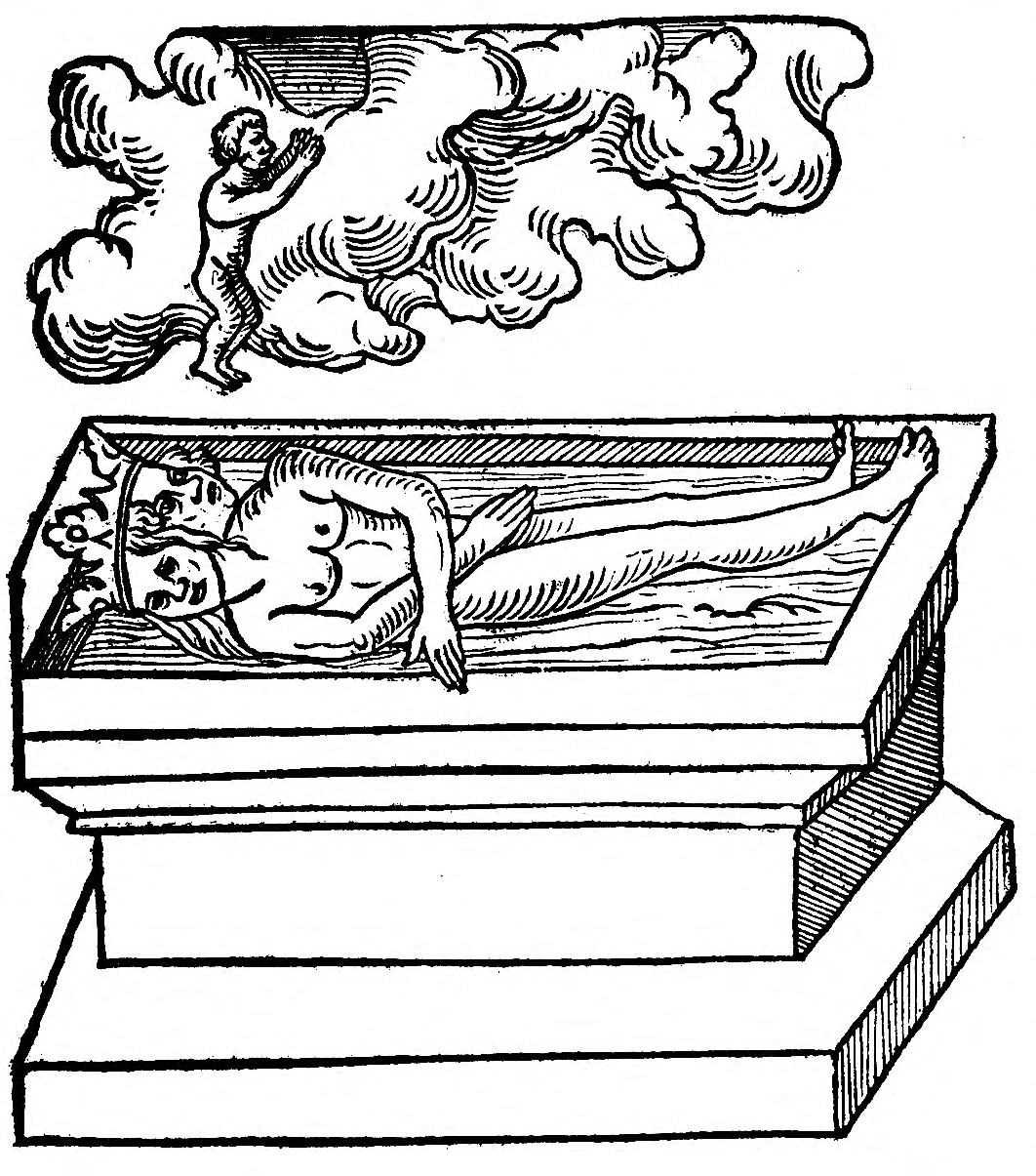
Figure 7.
Hye teylen sich die vier element /
Aus dem leyb scheydt sich die sele behendt.
Here the four elements divide themselves;
The soul swiftly parts itself from the body.
[p. 65]Several accounts of blackness.
Hermes the King in the second treatise: My son, know that four elements govern and compose our stone, which has many names and various colours. We must divide these elements, dissecting them into their members; we must sequester them tightly and mortify their parts, turning what is in them into nature. We must protect the water and fire which inhabit the stone; it is made out of four elements. If there is anything [in the stone] that is not water (that is, the fiery form of true water), then we must protect the waters of the elements by means of the stone’s water. We must permit what rises in the vessel to do so; these contain spirits through their bodies, and they become capable of tincturing and enduring.
In the first Distinction of the craftsman Sorin:[1] Take from it little by little, divide up the whole, pulverize it step by step, until it is like a powder seized by death out of the straining of blackness. This is a great sign; many have perished in investigating it. But once you discern something, pulverize it step by step, separately.
Morienes: If any body lacks a soul, then darkness and shadow are found [in it]. Hermes: We must mortify two quicksilvers at the same time. Again: take its brain and pulverize it with the sharpest vinegar, or with boys’ urine, until it is darkened. Now that this is done, it lives in putrefaction. The black clouds which were above it, and [p. 66]which were in its body before it died, now return [into the body]. But when the process is repeated as I have written it, then it dies again, just as I have described. It is necessary to sequester it by means of two sulphurs, and it must be cooked continuously until black water is made. Whoever blackens earth achieves his purpose and will do well. Arnaldus: As soon as it is blackened, we call it the key of the work, since the latter is not without blackness. It is the tincture we seek, the tincture that can tinct any body. Indeed, it has been hidden in its air, just as the soul is hidden in the human body. The Mirror: Therefore, my dearest son, when you are at work, make sure at the beginning that you have a black colour. Then you shall be certain that you putrefy, and that you are going along the right road.
O blessed nature, blessed also is your operation. Through the true putrefaction, black and obscure, you make the perfect out of the imperfect. After this, you cause [the perfect] to germinate into new and diverse things; by your greenness, you make diverse colours appear. The blackness is heralded when earth has been gently decocted so many times that the blackness appears above it. You have two elements: firstly water in itself, and then earth from the water. As Avicenna says in a title concerning the humours: Heat acting on a moist body first produces blackness. This is seen in the usual way of producing calx [i.e., by heating slaked lime]. Menabdes says likewise: [p. 67]I bid you make the following bodies into non-bodies by dissolution, and make the incorporeal into the corporeal by gentle decoction. Take great heed that the spirit does not turn into smoke and evaporate because of an excessive flame. Thus Maria[2] says: Guard it; beware that nothing flees into smoke. Let the fire be measured by the heat of a July Sun. Do this until the water is thickened through a long, gentle decoction, and it turns into black earth. Thus you have the other element, earth. And this is enough blackness for the method.
The philosopher Steffanus:[3] Open your eyes and your heart. Listen and understand: I show and tell using intelligible words—which, if you are intelligent, you will be able to understand. Know that nothing proceeds from man but man, and likewise any given animal only begets its kind. But we see there are some substances which, although born, are dissimilar to their roots. We see substances with wings produced from those which do not have wings. We also see and know of a few substances which men do not know. From these there comes a nature which we know is enough for us, although it is unknown. These are the profound substances. And if you seek them, perhaps they are beneath the earth. Know that the mineral art is made from this nature, not from any other. Avicenna: Therefore recognize the mineral roots, making your work out of them. [p. 68]Aristotle in the second book of De Anima: The most natural and perfect work is for something to produce the same kind as itself, as a plant produces a plant, a goat a goat.
The work of alchemical art would be of no use in itself unless you were to grasp the visible natures without error. Hermes: O water, abiding form, creatrix of the royal elements! O highest nature, creatrix of natures, who contain nature. Nature, she who came with the light and was born with the light, is no mean power.
From the Lucidarius of Arnaldus.
Some have said that every imaginable colour in the world appears in the work of the Stone. This is a sophism of the philosophers, since only four principal colours appear. All the others have their origin in these; this is why [the sophists] call them “colours.” Do not be concerned if every colour does not appear to you, as long as you are able to segregate the elements. Yellow [citrinitas] signifies burnt choleric and fire. Red signifies blood and air. White signifies phlegm and water. Black signifies melancholic and earth. Ortulanus[4] says: There are four elements, having four colours. Know that these colours [p. 69]appear in our dissolution.
I ask in what span of time this blessed stone may be made. To this the response is given that a certain author, the philosopher Lilius,[5] claims to have accomplished the magisterium in eight days. Another says seven days, another three months, others four, others a half year, others one year. Maria says she did it in three days. I say that the cause of this diversity, of this brevity and prolongation, might be a defect in the virtue of water of Mercury. Or it could be because they were working with Sun and Moon, but some of them added more and others less. Now, Sun is fixed and does not flee, and they were working only with this [kind of substance]. But when they mixed it with Sun by melting it, they caused a great part of it to rise up, because their fixation was weak and their fire impatient. And when it rose up like this, they called it water and soul and spirit, saying that their water was not common water, or was water of Mercury. The earth remained in the base [of the vessel]. Then they reduced the water above the body, and caused it to rise up again by force of fire, and then again mixed it with the earth, until it bore the whole earth in its belly. Thus someone says: The wind bore it in its belly.[6] Thus, it was necessary for them to have a great quantity of this water. And then [p. 70]the spirit of the body was fixed. And they repeated the sublimation until everything was fixed and unable to rise up. And then the spirit was fixed in the body, and Moon was incorporated into Sun and mixed into its smallest parts, and thus the operation was complete. Thus, the diversity we spoke of in performing the work could have been [due to] adding more fixed body than unfixed, or the other way round. When there was more unfixed [body], it rose up more quickly, but when there was more fixed, it rose up more slowly.
But what do you say about this saying of the philosophers? Our gold is not common gold, and our silver is not common silver. I say they are calling water “gold,” meaning, that which has risen above by virtue of fire. Truly, that gold is not common gold, for a common man would not believe that it could rise above, given its fixity. Know also, by God, that this has been a customary mode of expression for the philosophers. They always waver in the surest step. They seem to have affirmed a matter, and then they obscure it, sometimes by types and figures, and sometimes using false and foreign practices. And whenever they notice that they have spoken a truth, then they say that they had spoken in parables. Thus Geber says: Wherever we have spoken openly, there we have said nothing. But where we have set something under an enigma and [p. 71]in figures, there we have concealed the truth, etc.
A certain Metrista[7] says: Salts and alums are not the stone, but they are the stone’s helpers. Whoever has not tasted the salts’ flavour will never come to the desired Ferment of ferments. [The latter] ferments what is limited [finitum] through its excellence.
What is above is like what is below. Burn in water, wash in fire. Cook and re-cook, and cook again. Bury often [in earth], and always coagulate. Kill the living and resuscitate the dead. Do this seven times in turn, and truly you shall have what you seek. If you know the rule of fire, then Mercury and fire will suffice for you.
A verse:
Aes nostrum si bene scis sufficit si caetera nescis.
It is enough that you know our copper well, if you do not know the rest.
Ortulanus, on the Epistola Hermetis, says:
Only he who knows how to make the philosophers’ stone understands the philosophers’ words about the stone. The philosophers have striven manifestly to make this art open to the worthy—and to conceal it from the unworthy. This is why they have always spoken truly about the virtue of intention, but not about the virtue of speech. They have said that the philosophers’ stone comes from an egg, because in an egg there are three things that are similar to the three which make up the stone. Hermes says: Its father is the Sun, its mother is the Moon. This signifies that these two enter into the stone’s composition; Ortulanus proves this. The water of the Sun is volatile, [p. 72]and its body is fixed—vice versa for the Moon. And then those words are declared which speak through Geber and the other philosophers: Make the volatile fixed and the fixed volatile and the volatile fixed. [The philosophers] encourage manifold solution, for the whole work lies in the solution. Again, he [Hermes] says what is above is also below. Here, “above” means of greater worth [dignius], and “below” means of lesser worth [indignius]. Let one be made out of the three, that is, one substance out of Sun and Moon, whose parts are equal. This conjunction is called the philosophers’ sublimation. It is called sublimation, exaltation, or dignification, because Moon and Mercury are dignified [dignificatur]. Once the union is brought about in such great dignity [dignitate], then Moon is like Sun and Mercury. And once the fixation, called the “dead body,” is done, then Sun is lowly like Mercury. Sun desires the letters [litera vult illa], which is to make the ascent and descent of the philosophers.
The Stone is said to have four elements, as Arnaldus explains. But when the solution is complete, it is said to be one element, namely water. And when the body is unclean, it is called the second element, namely earth. When it has been calcinated, this earth is called fire. And when it has been dissolved again, it is called air. Again, the stone is said to have body, spirit, and air. By body is meant the unclean body, as stated above. By [p. 73]soul is meant the ferment. And the stone has true power to transform through spirit (also called quintessence), which is disposed to cast forth [se habere in proiciendo]. The aforementioned stone is called Rebis (that is, one substance made out of two substances, namely from body and spirit, or from Sun and Moon, or from the cleansed body and the fermented body). Again, because of its true composition, the stone is said to be found everywhere. When these three—Sun, Moon, and Mercury—are conjoined, then the stone’s virtue reaches through the whole [world], in the mountains and in the plains (that is, in bodies and Mercury) and in the sea (that is, in dissolved water).
Flying creatures receive assistance from it. The flying creatures are living Mercury, and the imperfect bodies which are converted into Sun and Moon, and [what] is called the scorpion (that is, the poison which mortifies and vivifies itself). This triune substance, cast over [projecta super] living Mercury, vivifies it by making it into true body. This is how the philosophers’ sayings may be explained further. Although it is called mineral quicksilver by the philosophers, the material of the philosophers’ stone is water and is understood through their water, as Ortulanus proves. There should be neither more nor fewer [parts of the stone’s composition]. He [Ortulanus] says also that Sun is masculine, Moon is feminine, and Mercury is sperm [sperma]. But so that the generation and conception may come about, the masculine must [p. 74]be joined to the feminine, and moreover seed [semen] is required. Thus the conception and impregnation must be brought about prior to the fermentation. And when the material has multiplied and fermented, it is said that the infant grows in its mother’s womb. Ortulanus and Arnaldus: The soul is poured into the body, and the crowned king is born. Again, in the book Turba philosophorum this doctrine is held: Dissolve bodies and drink the spirit. And they say “bodies” in the plural, because there must be at least two. But they say “Spirit” in the singular, which is needful because it is one. And there is no sperm without the material of bodies, except for Mercury. When it is said, “drink the spirit,” this refers to the operation which fixes Mercury and multiplies the stone (that is, repeats it).
When Mercury mortifies the material of Sun and Moon, then the material persists as ash. This is what the philosophers call their sifting and grinding. About this ash, it is said in the Turba and by Arnaldus: Do not hold this ash in low esteem. Again, this ash, which comes from the three, is called unclean body by the philosophers, because it must be decocted and calcinated until it is white. Therefore Morienes says, in his book: Unless you cleanse the unclean body, and return it to itself whitened, and put a soul into it, you have done nothing in this magisterium. Now, two [operations] are treated this way, namely calcination of the stone and [p. 75]fermentation. Calcination is reduction into white ash, or earth, or white calx, by the spirit’s operation. This is done by means of our fire (that is, water of our Mercury). And when [the stone] is called what is tinctured [and what] tinctures, this means that after the medicine has been calcinated, dissolved, and coagulated, and then fermented till it becomes white, then it becomes Moon. When Sun [is subjected to these operations], then it becomes Sun. Geber proves this to the letter about medicine of the third order: Although it is the same path to the white and to the red, with Sun and with Moon, they differ nevertheless in their fermentation. The medicine of the third order is twofold (namely, solar and lunar), but it is one in essence and one in mode of action. It is the addition of yellow [citrinitatis], or of a citrus colour [citrini colouris], by which the substance [substantia] of fixed sulphur perfects the medicine. With either medicine, this [process] begins with Sun and Moon. But the ferment with Sun becomes red, while the ferment with Moon becomes white. Sun is captured in a twofold way: in the one method through water of the Sun, in the other through the body of the Sun, as [has been described] above.
When it is said that all colours appear, it is true. Every colour does appear before the fermentation, in calcinations, dissolutions, and fixations. Likewise, the Light of Lights says: Know that these are what whiten and redden inwardly and outwardly, namely Sun, Moon, and Mercury. Once these three have been dissolved and fermented, he calls them [p. 76]quicksilver, saying that quicksilver has in itself body, spirit, and soul. Now, the cause [of these operations] is thus: Cook the masculine and the feminine together until they coagulate, and the stone will come to be. It must be noted that our elixir is made only from minerals. All the more, I note that the dragon does not die unless it is killed with its brother and sister—and not with one only, but with both together. The brother is the Sun, the sister the Moon. Finally, Arnaldus says: The philosophers have said truly whatever they have said about the stone. They spoke about the virtue of speech in order to conceal it from the unworthy, but they always spoke truly about virtue of speech to the worthy. The philosophers know that this sort of matter ought to be handed down as a mystery, like poetry, in fables in parables. And when the philosophers speak of great matters, then they do not involve parables or fables, as Macrobius says.[8]
[1] Not in fact a name, but derived from sorin (Arabic surin), “red vitriol.” The passages attributed to “Sorin” are from the Allegoriae Sapientium.
[2] A legendary Jewish alchemist from the 2nd or 3rd century. The balneum Mariae, bain-marie, is attributed to her.
[3] A character in the Allegoriae Sapientium.
[4] An unknown author associated with the Hermetic corpus.
[5] Probably not a name, but rather a corruption of the commonly used title Lilium (“Lily”) for alchemical texts.
[6] From the Tabula Smaragdina.
[7] Of uncertain identification.
[8] Macrobius (early 5th c.) wrote a commentary titled Commentarii in somnium scipionis (“Commentary on the Dream of Scipio [a chapter of Cicero’s De re publica]”) which later became an important Neoplatonic source.