Previous section | Next section | Back to Rosarium index | Back to main page
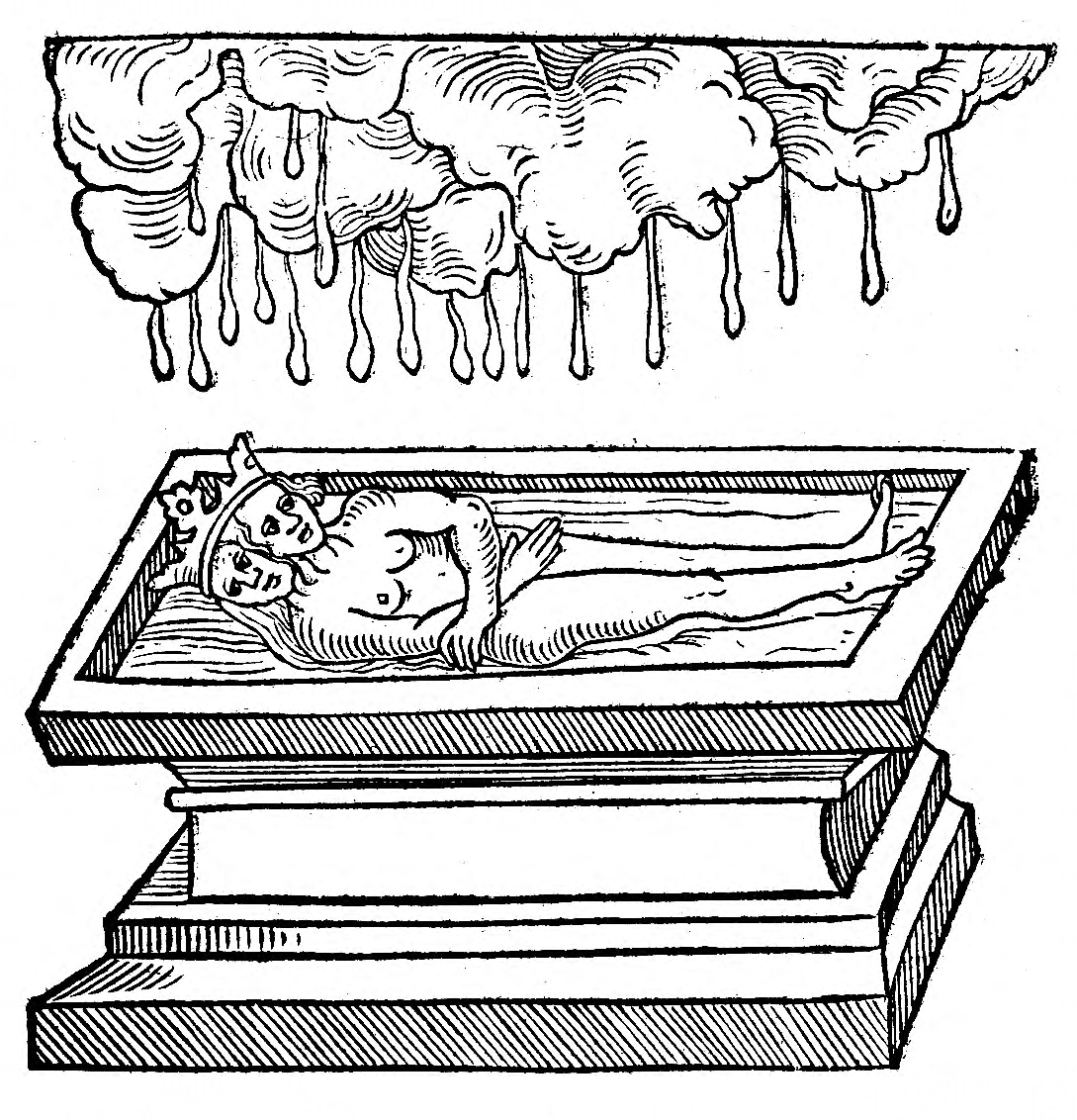
Figure 8
Hie felt der Tauw von Himmel herab /
Unnd wascht den schwarzen leyb im grab ab.
Here falls the dew down from heaven
And washes off the black body in the grave.
[p. 78]The first whitening of the first stone.
Senior in the letter of Sun and Moon.
The water I spoke of is a substance which descends from the heavens. The earth takes it up with its moisture; it retains the water of heaven with the water of earth. And the water of earth honours [the water of heaven] because of its slavish position and its sand [arenam]. The water is gathered together into the water, and the water retains the water, and albira will be whitened with astuna.[1]
Hermes: Spirit does not enter bodies unless they are cleansed. Alphidius: Accept white and send black away. Democritus: Cleanse tin with a special ablution; extract its blackness and darkness from it, and then its bright whiteness [candor] will appear.
In a work of Sorin: Dissolve it with white fire until it looks like a naked sword; and by whitening make the body bright white [candidum]. Rhazes: When water is mixed with Copper, it whitens it within. Some call this whitening impregnation, because the earth is whitened. Governed by water, the earth grows and is multiplied, and the growth of new offspring springs from this. Alphidius: You must ablute the black earth, and whiten it with hot fire.
[p. 79]Hali says: Take what sinks to the bottom of the vessel, and ablute it with hot fire until its blackness is removed and its thickness recedes. Cause the added moisture to fly away from it, until there comes down an exceedingly white, spotless calx. Then the earth is pure and fit to receive the soul.
Thus says Merculinus, in verses:
Firmans mutatum pregnatio, spondet hiatum.
Quae bene praegnantur, concordi pace ligantur.[2]
Pregnancy, which makes firm what has been changed, promises an opening.
Whatever has a good pregnancy is joined together in harmony and peace.
Morienes says: This earth is putrefied and cleansed with its water. Once it has been cleansed, then the whole work is directed with the help of God. Hermes also says: Azoth and fire ablute latten[3] and remove blackness from it.
Thus a philosopher says: Whiten latten and tear up the books so that your hearts may not be broken. This is the composition of all the Wise, and also the third part of the whole work. As it is said in Turba: Join the dry with the moist (that is, black earth with its water), and cook it until it is whitened. You have, in this way, water and earth in themselves. The earth has been whitened with the water, and this whiteness is called air.
[p. 80]Solomon, in the seventh book of Wisdom.
He chose to have this science instead of light, and instead of all health and beauty.[4] He did not compare it unto any precious stone, because all gold in respect of her is as a little sand, and silver shall be counted as clay before her.[5] For the merchandise of it is better than the merchandise of silver, and the gain thereof than fine gold. It is more precious than all riches, and all the things that can be desired are not to be compared unto it. Length of days and health are in its right hand, and in its left hand honour and endless riches. Its ways are beautiful, praiseworthy, well respected operations, and its paths are moderate, not hasty but persevering in daily labour. It is a tree of life and undying light to them that lay hold upon it; happy is everyone that retains it.[6] For the science of God shall never perish, to which Alphidius testifies: Whoever discovers this science shall have lawful and eternal food.
Aristotle: O how marvellous is this substance! It has in itself everything we seek. We have neither added nor taken anything away from it; the sole preparation is for us to remove what is superfluous.
Arnaldus: The first matter of the metals is a certain smoky substance [substantia], containing in itself unctuous moisture. From this, the craftsman [p. 81]separates off the philosophical moisture which is suitable for the work. The latter is clear as a teardrop, and metallic quintessence dwells in it. It is a metal easily pacified, and the means of conjoining tinctures is within it. This is because it has the nature of sulphur and the nature of quicksilver. Geber: O how useful is this substance! We use it as a crude medicine; but after it has been cooked and digested, it is the greatest poison, above all poisons. The philosopher Gratianus: In Alchemy there is a certain noble body which is moved from master to master. In its beginning there will be misery and vinegar, but in its end, happiness and joy.
Astanus, in the Turba: Take the same unburning black spirit, and dissolve and divide the bodies with it. It is wholly fiery, dissolving through its fieriness, and dividing all bodies along with their coequals. Rosarius: If someone wishes to enter into our Rose Garden [Rosarium], to look around there, to have roses as white as they are red—but lacks the lowly substance which reveals what is ours to reveal—then he like a man who wants to walk without feet. For in this lowly substance is the key with which the seven metal doors are opened. Without it, what is precious is never perfected. Ablution is the ending, or cleansing, or blackness. It causes white to become perfectly white, and red fully red. Azoth and fire [p. 82]eradicate fire’s darkness.
Mortification is the separation of hardness from the body. Then the soul is dead, but the body lives by virtue of its hotness and dryness. Everything that has heat has life. And thus alchemical calx is said to have life, for the philosophers were careful to kill their imperfect life and to return to perpetual life. Revivification takes place by reason of its nourishment, or of its perfected humor. Restoration of the rectifying moisture takes place by way of its imperfect humour.
From a certain torn paper.
Now, concerning this proposition of mine about the hidden stone of all the philosophers, I speak to you openly, in a natural mode of thought. This stone is a stone is adorned with threefold vestment, a stone of riches, a stone of charity, and a stone that alleviates every lack, and a stone that cures all weakness. Every secret is contained in it; it is called a God-given divine mystery. There is nothing in the world more sublime than it—after the rational soul.
You must carefully note: I have said to you that [p. 83]our stone is adorned with threefold vestment. This means that it is to be divided into three parts, [namely] into body, soul, and spirit. Thus, the dead body which lacks a soul is dark.
“If you wish, my Son, to revivify the body, then return its soul to it, and immediately it has life.”
“O my Master, I do not understand.”
“My Son, I tell you more precisely: There is one stone (or one substance) only, because the body has been driven back into its nature (that is, into its water, or into its first matter; for the first matter of bodies is unctuous water). Only then it is called one substance, because the bodily substance [substantia] and water of union are united indivisibly in their smallest parts, and it is called the philosophical stone from which infinite branches multiply. It is called the Stone that is known in the philosophers’ books. Therefore, my Son, the Stone’s own water is extracted from it, and it is in the spirit by means of separation.”
Our sublimation is the raising up [elevatio] of the unfixed parts from the fixed parts. The unfixed parts are raised up by smoke and wind. But we wish for these two to be fixed together and to yield an easy melting. Understand in this way that our sublimation is true and sure. [This is] the stone which nobody can touch with his tongue. Hermes says: Divide the subtle from the coarse, etc. Earth [p. 84]is calcinated, water sublimated; earth remains below, water rises above; earth is purged by calcination, water by sublimation, both by putrefaction. Water defends earth so that it does not burn; earth binds water so that it does not flee. Once both have been sufficiently purged, then they become one, inseparable, for the one cannot be without the other. When its first part is cast over [proiecta super] a hundred parts of quicksilver, it tincts them into true silver. And when such a tincture has been made and one part of it turned over into the red [in rubeum versa], then it tincts just as many parts into true gold, and nothing better than this gold is known. This comes from a secret nature, and is gotten by the heat of fire, etc.
Note: The spirit of the Lord was hovering over the waters before the creation of heaven and earth (Genesis 1[:2b]). Therefore, it ought to be seen that everything has been created from water. God divided this water when he spoke, and he took one part of the water into dryness, and called it earth. On behalf of the earth, he preserved the water that was not transformed for irrigating and moistening. For dry earth bears little fruit unless it is often moistened by rainwater from above, and without water it hardly bears fruit, or not at all.
[1] The forms albira and astuna suggest transliteration from Arabic into medieval Latin. “Albir” is listed in Martin Ruland’s alchemical lexicon, meaning pitch from the bark of the yew.
[2] The original text reads, “Thus says Merculinus: Firmans ... / Verses: / Quae bene ...”. The first line clearly belongs with the other metrically and in sense, so I have placed them together. Concordi pace ligantur (“is joined together in harmony and peace”) paraphrases Ovid, Metamorphoses, Bk. 1, l. 25.
[3] An alloy of copper and tin, or copper and gold, identified with orichalcum.
[4] Wisdom 7:10. The Biblical verses in this passage are variations on the Vulgate; the translation adapts the King James version.
[5] Wisdom 7:9.
[6] Proverbs 3:14–18.