Previous section | Next section | Back to Rosarium index | Back to main page
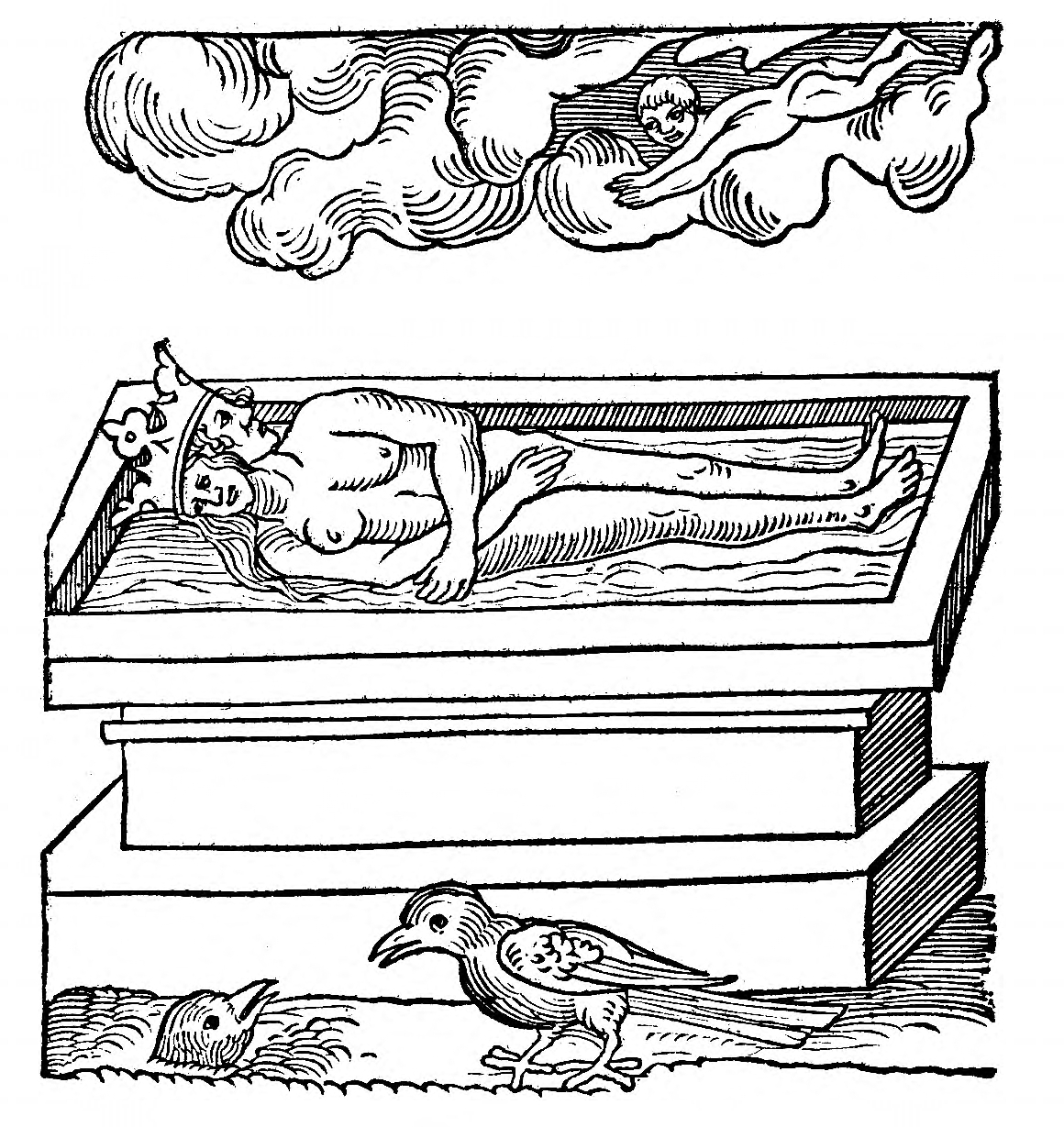
Figure 9.
Hie schwingt sich die sele hernidder /
Und erquickt den gereinigten leych nam wider.
Here the soul swings downward
And, revived, takes the purified body again.
[p. 86]Now follows the fourth word: Once the water that was with the earth has been thickened and coagulated, it ascends by sublimation. In this way you have earth, water, and air. And this is what a philosopher says: Whiten it and sublimate it in a quick fire, until the spirit that you shall find within it comes out of it, and this is called bird, or Hermetic ash. Morienes also says: Do not hold ash in low esteem, for it is the diadem of your heart and the ash of what endures. In the book Turba it is said: Strengthen your control over the fire. After the whiteness it arrives at the incineration [cinerationem], and this is called calcinated earth. Morienes says: Calcinated earth remains at the bottom [of the vessel], and it is of a fiery nature. In this way you have four elements in the aforementioned proportions, namely dissolved water, whitened earth, sublimated air, and calcinated fire. On these four elements, Aristotle says, in the book On the Governance of Rulers:[1] Once you have water from air, and air from fire, and fire from earth, then you will have the whole art of philosophy. This is the end of the first composition, as Morienes says:
Patience and time are needed in our magisterium. Indeed, in this magisterium, haste is in the devil’s interest.
Hermes: What is dead wishes to be revivified, and [p. 87]what is sick wishes to be cured. Again: You must conjoin body and soul by means of grinding [contritio] in Sun. Again: Sow your gold in white foliated earth. Senior: The smoke that is above will descend to what is below, and the smoke conceives from smoke. Again: This divine water is a king descending from heaven. Again: It is the reducer of soul to its body, which vivifies [the body] after its death. There is life through it, and after it there shall be no death.
Rosinus: The body rejoices when the soul enters into it. Again: The body takes possession of [occupat] the soul, and every body that finds a soul easily takes possession of it. And note that the soul is punished with the body, and is incarcerated with it, and is turned by it into a body. Hermes: The spirit is the extractor of the soul and the reducer and the transformer [reformator] of the whole work; all that we seek is in it. Senior: Nothing is lowlier in appearance than it, and nothing more precious than it in nature. God has not set it to be bought for a price.
Senior: Our preparation arises from nature, through what unlocks what is locked. Hermes: We must be able to think through the principles of natural things as much as artificial things. Whoever is ignorant of the principles does not attain the end. Again: This secret is the life of any substance, and it is water. [p. 88]Water undertakes the nourishment of men and other [beings], and the greatest secret is in it. But so that you may not stray so much, it is fit for you to know that our sublimation is nothing other than to exalt bodies—that is, to lead them into spirit, which happens only by means of a slight fire. We say, “it has been sublimated into a Bishop [Episcopum],” which means, it has been exalted. And the common sublimation, which is merely a signal for action (that is, that the body is now to be sublimated), is itself made spiritual so that it may be sublimated. Beyond the preparation of the first stone, nothing contributes to our work or is necessary, for such a [common] sublimation does not spiritualize [spiritualizat] but only indicates the action of spirituality. And so that Regal philosopher Geber speaks well: In the work of our magisterium, we lack nothing but a single vessel, one furnace, and one disposition (by which understand [Geber to mean] after the preparation of the first stone).
Genesis: All things were made from water, and the Spirit of God hovered over the face of the waters,[2] and the principle of man’s generation comes from it [water]. Hermes: O strong nature, who conquer and overcome natures, who make natures to rejoice when they have been poured out! Geber: He explains the principles of this art and the principal roots; do not be ignorant of what is of the being [esse] of the work. Basius: Our sulphur is stronger than all fire. The philosopher Alanus:[3] One substance is to be chosen over all, and it is bluish [lividi] in colour, having a metallic, clear, and transparent [liquidam] appearance. [p. 89]It is a substance hot and moist, watery and burning, and it is living oil and living tincture, mineral stone and water of life [aqua vitae], of wonderful effect. Aristotle: No tincting poison is produced without Sun and its shadow (that is, its wife).
Sublimation is twofold: The first is the removal of what is superfluous, so that the remaining parts are pure and segregated from all elementary dregs [faecibus elementaribus]. In this way the remaining parts may possess the virtue of quintessence. And this sublimation, where bodily density passes into spiritual subtlety, is the reduction of bodies into spirit. The second Sublimation is the extraction of what has the nature of quintessence from within it, separating [the quintessence] from all elementary dregs. I say that quintessence tincts the soul, for which ablution is necessary. By ablution may be extracted the unctuousness of arsenic (that is, the oily nature of the purest unctuousness) which is bound with the dregs which do not permit it to be sublimated.
Vincentius, on the elixir of the stone.
Vincentius in the Speculum Naturale, Book I: The Alchemists have striven to do in a brief time what nature does in a thousand years, in mineral bodies just as in nature’s operation. And they have taught how to make a certain substance, which transmutes bodies over which it is cast [super quibus projicitur]. [p. 90]They call it elixir, and it is called the stone that is not stone: stone, because it is pulverized; not stone, because it is poured out. It flows without evaporation, like gold; no other substance is fit for this property. Avicenna: Therefore the elixir is the substance which is cast over [projicitur super] a greater body and changes its substance from its own nature into another. It is made when a lesser body is mixed with spirit and elements and ferment, and one product is made out of these all. “Elixir” is a Greek word, which means a great treasury, or rather treasuries. And Elixir which mixes with body is like Tutty[4] with Copper [Cupro]: Copper increases and grows with Tutty, and the reason for this is that Tutty is an earthly substance. But Elixir is a spiritual substance, and by nature it turns one kind into another kind.
An alchemist: The Elixir is made by two methods. In one method, it is made from mineral spirits and clean bodies. In the other, it is made out of certain substances that come from animals, namely from hair, or from an egg, or from blood, etc. The first way is thus: Certain spirits are mortified and sublimated until they are made clean. After this, one of the naturally produced bodies is burned until it is pulverized, and then calcinated until it is made clean in the same way as calxes. At length, when spirit and body have been prepared in this way, they are pulverized and drunk with [p. 91]distilled sharp waters [aquis acutis]. Then, they are moistened for as long as it takes until they transform into clear water, and then they are frozen. Finally, they are set in fire for as long as it takes until they are fixed.
Concerning the completion [complementum] of the elixir.
Avicenna in his letter to Hasen: The Elixir tincts with its tincture, and it is submerged in its oil and fixed in its calx. The white is completed by three [elements] in which there is no fire, but yellow is completed by the whole four [elements]. Glosa:[5] It is true that the white Elixir requires nothing but three things, namely oil, tincture, and calx. But the red requires four, namely oil, calx, tincture, and tincture again, which is called fire. This is why Avicenna adds, “in which there is no fire.”
On manifold fire.[6]
Fire is manifold; its quality is diverse and divided into certain grades. One sort of fire is hot in the first grade and moist in the second grade. This is the fire of the horse’s belly, whose property is that it does not destroy oil, but rather increases it because of its moisture. Others destroy it because of their dryness. Nothing in the world is like this [fire], other than the material fire of a healthy man’s body.
The fire of the Sun is hot in the same grade [as the fire of the horse’s belly, i.e., in the first grade], but is dry. It is what tames substance; it is made of animate substance, and is suckled [p. 92]like a boy to whom milk is given in the beginning. For a boy is fed and grown on what is hot and moist (just as the fire of a horse increases oil because of its moisture), but he fixes the stone using his well-tempered heat.
And there is another kind of fire between these two, which is hot and dry in the second grade. It is like the fire of a furnace after the bread has been taken out. It melts gently and does not burn, because there is no flame or force of heat in it. This heat recedes, declining bit by bit; but if it were to remain, then it would fix the spirit within or without the body. But the fire of a horse neither melts nor burns, but rather tames and increases what is moist.
The fourth kind of fire is the furnace’s fixing fire. This fire melts and fixes, but does not burn because it is not flaming. It does not differ from the preceding [fire] other than that, in this fire, the heat is continuous, unlike in the other.
The fifth kind is called flaming, and it is hot and dry in the third grade. This fire only calcinates and does not melt. That is, it is for comparing gold and silver and other bodies of the same or higher grade. This is the fire in the calcinating furnace.
The sixth is hot and dry in the fourth grade, and this fire melts and fixes forcefully by softening bodies gently. It does not dissipate or disperse them. This is the fire of the furnace which melts in the same grade.
There is also the fire of bellows, which dissipates and disperses and melts bodies, and this is the seventh kind.
[p. 93]The eighth kind melts and calcinates, and it is flaming, for this is the only one in which flame works. The substance [substantia] of this fire is charcoal and flame. This is the only case in which it is a flame of wood, and it is in the same grade as the preceding kind.
The ninth kind of fire is also of the same grade, and it is the fire of assay, which melts and burns and dissipates and disperses what is bad, but preserves and rectifies what is good. It is like a judge, who discerns the just from the unjust.
The fire of junipers.
Maintain a continuous artificial fire, of the grade you desire, for one, two, or three months, until the charcoals are exposed. You must always keep them covered, and you may increase or decrease the heat at your will by the addition or more or fewer lit charcoals. First, at the beginning, have ready enough ash made from Juniper wood only. Then, have ready a big ceramic pot, and let there be a smaller pot, or crucible, in the center of it. Place the ashes in the big pot while it stands over the fire’s heat until the ash itself grows hot. All around the smaller pot, place charcoals above the ashes, which must also be made solely from the aforesaid Juniper wood.
Next, have ready some warm ash [p. 94]of the same wood. Scatter it over the aforesaid charcoals, and then cover them very well with hot ash. Have the material to be digested within the smaller pot or glass, and put a cover on the bigger vessel. Set it in a heated room[7] underneath a bench, or above it, and set a stone on top lest by chance it suffer some damage. In this way you will be able to prepare many of this sort of fire. You may also place hot water, or the moist belly of the horse with a vial of material in it, within the smaller pot.
Make the aforesaid charcoals in this way: Cut Juniper wood into little parts of the thickness of two digits or larger. Place them into a large vessel, filling it thoroughly, and seal and lute it. Place the vessel for a whole day into the strong fire of a ventilated furnace or of a wood fire. Then permit it to cool on its own, open the pot, and you shall have what you desire. As for common ashes, simply burn [the wood]. This fire may be a fire of the first or second grade with respect to fixing spirits.
[1] De regimine principium. A book by this title is attributed to Thomas Aquinas, or more reliably his student Giles or Rome.
[2] Genesis 1:2b.
[3] Of uncertain identification; possibly a pseudonym.
[4] Crude, powdered zinc oxide found as a product of sublimation in furnaces used to smelt zinc; used for polishing.
[5] According to Telle, not in fact a name but a corruption of glossa, i.e., an editorial gloss of the preceding passage from pseudo-Avicenna.
[6] The types of fire are summarized here; higher grades indicate greater strength. First type: horse’s dung (hot in the first grade, moist in the second). Second type: solar heat (hot in the first grade, dry). Third type: coals burning down (hot and dry in the second grade, diminishing). Fourth type: coals flameless but hot (continuous). Fifth type: calcinating fire (hot and dry in the third grade). Sixth type: smelting furnace without bellows (hot and dry in the fourth grade). Seventh type: smelting furnace with bellows. Eighth type: charcoal and wood. Ninth type: fire assay.
[7] In stubam. Stuba is not attested in Latin, but exists in Middle High German stube and Old High German stuba, meaning ‘room with means for heating,’ or ‘bathroom’ (cf. modern German Stube, ‘heated living room’; English ‘stove’).