Previous section | Next section | Back to Rosarium index | Back to main page
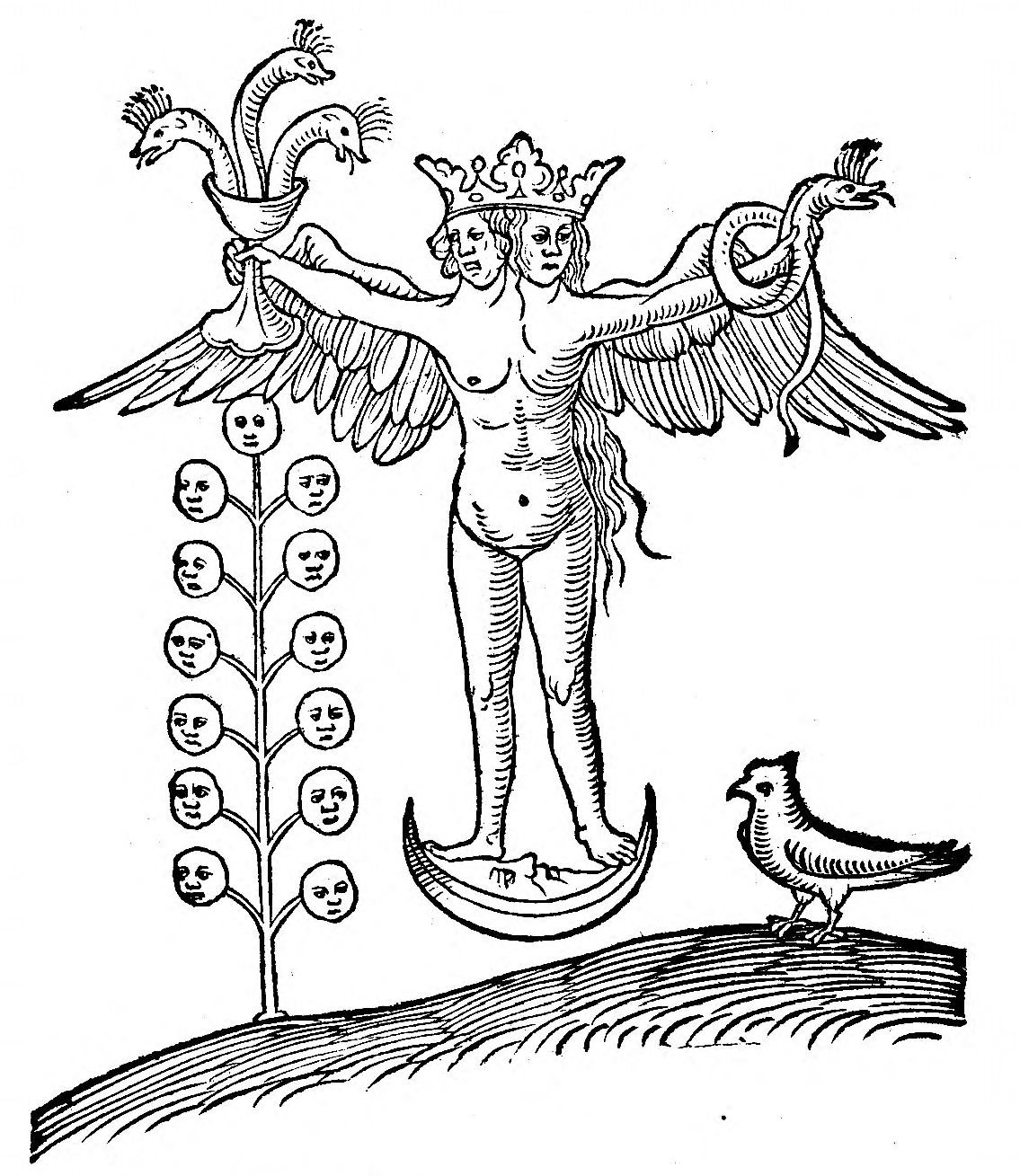
Figure 10. [1]
Hie ist geboren die eddele Keyserin reich /
Die meister nennen sie ihrer dochter gleich.
Die vermeret sich / gebiert kinder ohn zal /
Sein[2] undötlich rein / unnd ohn alles mahl.
Die Königin hasset den todt und armuth.
Sie ubertriffet goldt silber eddel gesteyn /
Alle Artzeneie / gross unnd klein.
Nichts ist aufferden ihr geleich /
Des sagen wir danck Gott von Himmelreich.
O Gewalt zwingt mich nackendes weib /
Dann unsälig was mein erster leib.
Unnd noch nie mutter was ich worden /
Biss ich zum andern mahl ward geboren.
Da gewan ich aller wurtz unnd kreutter krafft /
Inn aller kranckheyt ward ich sigthafft.
Meines Sones nam ich da wahr /
Unnd kam mit ihm selbandder dar.
Da ich seiner wardt schwanger /
Unnd gebäret uff ein unfruchtbarn anger.
Ich wardt Mutter / und bleib doch Magt /
Unnd wardt in meinem wesen angelagt.
Das mein Son mein Vatter wardt /
Wie das Gott geschickt hat wesentlicher arth.
Die Mutter die mich hat gebäret /
Durch mich wardt sie geborn aufferdt.
Eins zubetrachten / natürlichen verbunden /
Das hat das gebird meisterlich verschlunden.
Dar auf kommen vier inn eyn /
Inn unserm meisterlichen stein.
Unnd Sechs / inn dreifalt bedacht /
Unnd in ein wesentlich arth gebracht.
Wer das bedenken kann eben /
Dem ist von Gott der gewalt gegeben.
Das her alle kranckheyt thut verdreiben /
An metallen / und menschen leyben.
On gottes hülff das niemand mag bawen /
Dan der sich selbs kan durch schawen.
Auss meyner erd entspringt eyn brun /
Darauf rinnen zween straüm.
Der eyn fleust gen Orient /
Und der ander gen Occident.
Darauf zwen Adler flygen und verbrennen ir gefider /
Und fallen bloss in die erd nider.
Und werden hin wider gefidert schon /
Ihm sein untherdenig Son und Mon.
O Herre Jhesu Christ:
Du der die gaben geben bist.
Durch deinen Heilygen geyst so gut /
Der hat es als in seiner but.
Wem er es gibt furwar /
Der vernimt der Meyster sprüch gar.
Das er bedenck das känffeig leben /
Als leib und Seel gefügt werden eben.
Das sie schweben in ihres vatters reich /
Also helt sich die kunst aufferdtreich:
Here is born the noble, rich Queen;
The masters call her equal to their daughter.
She multiplies, bears numberless children
Which are undying, pure, and without any stain.
[p. 96]The Queen hates death and poverty.
She surpasses gold, silver, gemstones,[3]
All medicines great and small.
Nothing on earth is her equal;
For this we thank God in Heaven.
O force compels me, a naked woman,
For wretched was my first body,
And I had never yet become a mother
Until I was born a second time.
Then I gained the power of all roots and herbs;
In every illness I was victorious.
Then I grasped my son truly,
And came forth together with him.
Then I was pregnant with him,
And gave birth upon a barren meadow.
I became mother / and yet remained maid,
And it was inherent in my being
That my son should become my father,
As God has ordained it according to his nature.
The mother who bore me
Was born on earth through me.
To contemplate the one naturally united,
The mountain has masterfully swallowed it.
Then come four in one
In our masterly stone,
And six, conceived in trinity,
Brought into one essential form.
To him who can even conceive this
God has given the power
To drive away all sickness
From metals and human bodies.
[p. 97]No one can build it without God’s help,
Except he who is able to see through himself.
From my earth springs a fountain,
Down which two streams run:
The one flows toward the East,
And the other toward the West.
From it, two eagles fly and burn their feathers
And fall bare to the earth,
And are already becoming beautifully feathered again.
The Sun and Moon are subservient to it.
O Lord Jesus Christ,[4]
You who give these gifts, are
So good through your Holy Ghost,
Who has it as if in his care.
To whom he gives it, truly,
That man fully hears the master’s saying—
For he considers the struggle of life
Even as body and soul are joined.
For they hover in their Father’s realm—
Thus the art keeps itself on Earth.
Hermes: Know, you seekers of rumors and sons of wisdom, that the vulture appearing above the peak of the mountain cries out with a loud voice, saying: I am white, black, red, and yellow; I speak truly and do not lie. Alphidius: But the quicksilver that is extracted from the black body is moist, white, and outwardly clean, so that it may not perish. Morienes: You should know that white smoke is the soul. It is the spirit of those bodies which have been dissolved. If there had been [p. 98]no white smoke, there would certainly have been no gold of alchemical whiteness. Rosarius: This is our most noble Mercury, and God has never created a nobler substance beneath the heavens, except the rational soul. Plato: This is our material and our secret. Ortulanus: Thus you have true Mercury, which has been extracted from those aforementioned two bodies. It is well bathed and digested, and I swear by God that there is Mercury in the course of the universe other than the one just named. The whole of philosophy depends on it, and whoever speaks otherwise speaks falsely. Parmenides in the Turba: Some who hear the philosophers use the name “water” think that it is cloudy water. Certainly not; if they had reason, they would know that it is enduring water, and that this enduring water cannot be without its body, with which it [the water] has been dissolved.
Alphidius: The philosophers call this medicine by every name. So many names are applied to this Mercury that hardly—never—could anyone truly apply a new name to it. And the philosopher Plato says: We have revealed everything except the secret of the art, which it is not permitted to anyone to reveal. But we have attributed it to the glorious God who inspires whom he wills and who conceals from whom he wills. King Solomon: This is the daughter about whom it is said, the Queen of the South has come from the east, like the dawn rising [aurora consurgens] to hear and understand and see the wisdom of Solomon,[5] and power, honor, virtue, and [p. 99]dominion are given into his hand,[6] and upon his head a bright royal crown that gleams red with the rays of seven stars.[7] And the wife is ornamented just as much as her husband, with these golden letters written upon her vestment in Greek, barbarous language, and Latin: I am the only daughter of wisdom, wholly unknown to fools. Hermes: Just as the Sun is among the stars, so is gold among metals. The Sun gives light to the stars and contains every fruit. Likewise, gold contains every fruit. Again, day is the birth of light, and the Sun is the lamp of day which God created for our work, that is, to rule the world. The tincture must be corporeal, extracted from perfected metal bodies, thanks to the mediation of minerals.
General rules
Every substance comes from that in which it is dissolved. Ice is made into water by means of heat, and so that water must first have been like ice. In this way, all metals were previously quicksilver. This is evident because, when they are liquefied in fire, they are turned into quicksilver. Here, note that the philosophers also call a metal that has been liquefied “Mercury” or “quicksilver,” and so the reduction of metals into quicksilver is likewise called its liquefaction [liquatio]. Even if this is brought about by force of fire, it still retains the appearance of quicksilver during this forceful liquefaction, and so again it is called quicksilver. This latter solution, however, is not philosophical but common [laicalis]. Note, therefore, in particular, that it [merely] corresponds in sone ways with the sayings of philosophy.
[p. 100]Second rule. Every nature naturally desires to be perfected, and it abhors and flees from being destroyed. Nature avidly embraces that which is its own corrector, and spits out what is contrary to it as much as it can. The art must imitate nature accordingly; otherwise it always errs.
Third rule. Whoever works badly in an art strives by his natural badness to destroy what is better. Whoever works well in an art strives to perfect what is worse. Therefore, from the beginning you must know the natures of substances, so that you are able to discern what is better or worse in nature, and how it is perfected and from where it is prohibited. The quantity of what is worse may not exceed the quantity of what is better, or else you will err in the extreme.
Fourth rule. Everything dry naturally desires to drink its moisture, so that it may be continuous in all its parts. Here, take note of what is the radical moisture of everything that may be liquid. Pasture what is dry with this sort of moisture, and it will be well tempered, etc. Thus you shall have what you desire.
[p. 101]From a certain approved treatise, called the Correction of the Foolish:
On the difference between common sulphur and the simple unburning sulphur of the philosophers.
Generally, when a philosopher says that sulphur coagulates, it must be said that this is not so, since all common sulphur, according to a philosopher, is extraneous and contrary to metal. Avicenna: It does enter into the magisterium because it does not arise from it. It always stains and blackens and corrupts, however it may be artificially prepared; it is the corruption of fire, and so it hinders melting. But if it is calcinated, it returns into an earthly substance [substantiam], like dead powder. In this way it is able to give life to other things. Now, it has a twofold superfluity, namely inflammable substance [substantiam] and feculent earth. Given all this, then, do not consider common sulphur to be philosophers’ [sulphur]. Sulphur of the philosophers is simple, of living fire, and it vivifies other dead bodies and matures them. Likewise, it makes good what is defective by nature, since it is itself of an overflowing maturity. It is perfect in its nature, and by the art is made purer and [p. 102]purer.[8]
Avicenna: Such sulphur is not found above the earth, except insofar as it exists in those bodies, Sun and Moon—and indeed in another [body], which is not spoken of to anyone unless it is revealed to them by God. In Sun it is more perfect, because it has been more greatly digested and decocted. The philosophers have subtly conceived of how the sulphurs can be removed from those more perfect bodies, and how to purge their qualities through the art, so that by the art, through nature’s mediation, they might possess what had previously not appeared in the bodies as fully as desired, and what was at hand only in a hidden way. They [the philosophers] deny that this can ever come about without the solution of the body and its reduction into first matter, which is the quicksilver out of which they [the sulphurs] were made in the first place, without any admixture of extraneous substances. These extraneous natures do not improve our stone, because nothing is fit for a substance except what is near to it. It is a medicine of a simple and virtuous nature, which has been produced from mercurial water; gold and silver had already been dissolved in it.
For example, if you put ice in simple water, it dissolves in it through heat and returns to its watery first substance [primam substantiam]. In this way, the water is tincted from the virtue, up till then hidden, which was in the ice. But if the ice does not dissolve through heat in water, then it is not conjoined with the water. It floats on the water and does not tinct the water with its virtue, which had been coagulated in it beforehand with respect to its appearances [ex parte specierum]. In this same way, if you have not dissolved a body in Mercury with [p. 103]Mercury, then you cannot get the virtue that has been hidden in it, namely, sulphur that has been digested and decocted by the work of nature in minerals. The stone is one, one medicine; according to the philosophers, it is called “rebis.” It comes from a double substance [bina re], namely, from body and white spirit (or red spirit); many fools have erred in this.
In what way red sulphur is in Sun, and white sulphur in Moon.
As has been said, red sulphur of the philosophers appears in the Sun through a greater digestion, and white sulphur in the Moon through a lesser digestion. A philosopher: Yellowing is nothing other than complete digestion, for heat that acts upon what is moist first produces blackness; and if it acts upon what is dry, it causes whitening. And if fire goes beyond this [stage] while acting upon it [the dry], it transforms it into purest yellow; all these things may be seen in the calcination of lead [i.e., lead when heated first becomes white-hot, then yellow]. And a philosopher says that every perfect body in actuality contains good sulphur with Mercury (that is, golden gold, silvery silver); thus white sulphur is gold through the yellow. For this reason, the sulphur in it [the Sun] is red sulphur, the substance [substantia] of fire, and it has more greatly digested the white [sulphur]. And so the white and red sulphur exists, each [colours] in its own part, in Sun. Fire is its perfection and it is generated in fire. Its nature rejoices in friendship with its fiery nature.
[p. 104]Some extraneous substances are not able to cause this in bodies. This is because the art, by nature’s mediation, is nothing but the decoction and digestion of nature through simple labour. For example, when I get up in the morning and I see that my urine is white, I judge that I have not slept enough, and then I lay myself to sleep again. Once I have slept, the urine turns yellow, because of the greater digestion of natural heat which exists in me. In just the same way, follow nature through the art: Decoct, digest, mature, and sublimate likewise, until nature in actuality contains natural fire in itself, by which it is matured. Those [extraneous] substances do not have this [natural fire], and so they cannot give it. But in the Moon there is nothing but white sulphur, which is simple but, unlike red sulphur, not digested or purged of blackness by the action of the heat which is naturally contained in it. Rather, the appearance of the fire is veiled and hidden, and the fire acts upon it in the art just as it does in nature, and vice versa. Thus it is not impossible that art be mediated by nature. (Here, take note of mediating nature or the medium of nature [mediantem naturam sive mediam naturam]. It digests and perfects more greatly, since it naturally strives to be perfected—but it cannot do this in itself unless it is set in motion by the art and operation. But these labours, I think, I will not reach a man with a thick neck.) True gold is not made unless it is digested and decocted, so that what is better makes better what is worse. The intent of all the philosophers is to perfect what is worse through the better. [p. 105]Fools have understood this in reverse when they strive to perfect the better through the worse, and when they seek in a substance what was never in it, namely, gold and silver in combustible substances, as has already been explained.
That it is not useful to seek this sulphur in other sick bodies, for it is not there.
It may be asked, not without merit, whether this white and red sulphur can be extracted from other sick bodies in order to tinct Mercury. I say no, for it was said earlier that there is no substance of greater temperance than what is found in those two bodies [Sun and Moon, i.e., gold and silver]. As was said earlier, tincting rays are in them. Sick bodies contain sulphur that is foul, combustible, and not of a virtuous nature like [the sulphur] in the other bodies, etc. No art is of any worth except through nature’s service; let it follow nature. You could purge metals with lesser minerals, but, having done this, they would nevertheless not have a gold or silver nature in them, because no digestion or decoction of gold were in them as they were in the others; nor, likewise, will there be mature sulphur. What is immature should be helped to mature through what is mature. Therefore they [the sick bodies] do not tinct, but are tincted. The tincture of gold and silver has a nature proportionate to these things, namely, to what is immature or imperfect, because they take their origin from Mercury. From this it is plain that lesser minerals [p. 106]cannot tinct. Imperfect metal bodies, which are not fit for gold and silver from the perspective of mature Mercury, are not able to tinct or melt the nature of gold or silver. One should only tinct using what has the power of tincting. Therefore, tinct with gold and silver, because gold yields a golden colour and nature, and silver a silvery one. Despise all else, which does not have the power of tincting by virtue or by nature. There is no fruit in these, but only ruination of substances and gnashing of teeth.
[1] The text below (Das Nackte Weib) differs significantly from that of the 1530s manuscript. Some key discrepancies are noted below; see Alchemische Vereinigung for more.
[2] Reading as sind, following the 1530s manuscript.
[3] This line in the 1530s manuscript reads, Sie ubertrift gold, silber edlstain in der guet (“She surpasses gold, silver, and gemstones in goodness”), and is followed by a line that is omitted in the 1550s text: Es ist der aller edlest stain, “It is the noblest stone of all”; alterations in the remainder of the stanza make it clear that it pertains to the stone rather than the Queen.
[4] In the 1530s text, O her got, “O Lord God,” without explicit reference to Jesus Christ. The poem from here to the end also differs especially from the 1530s text, which reads: O her got der dise gob geben bist / Durch dinen hailgen gaist so guet / du hasts alles in dinem gwalt und huet / Wem du es gibst zu sinem hail und diner er / Was mag er begern uff erden mer / Dan alain das er betracht das k[u]nftig leben / Und nach diner er und huld tue streben/. Und das er der armen und elenden vatter sy / Und sich nach dysem leben mit der frey. “O Lord God, who gives these gifts, you are / so good through your Holy Spirit; / you have everything in your power and care. / To whom you give it for his salvation and for your honor, / what more on earth can he desire / than alone to consider the life to come / and to strive for your honor and grace, / and to be a father to the poor and miserable, / and to rejoice with you after this life.”
[5] Cf. 1 Kings 10:1–10, Matthew 12:42, Luke 11:31. Aurora consurgens is the name of an important alchemical treatise of the 15th century, attributed to Thomas Aquinas.
[6] Cf. Daniel 7:14, Revelation 5:12.
[7] Cf. Revelation 12:1.
[8] A significant change of style occurs after this point in the text, which is also the end of a leaf in the manuscript. See Translator’s Note.