Previous section | Next section | Back to Rosarium index | Back to main page
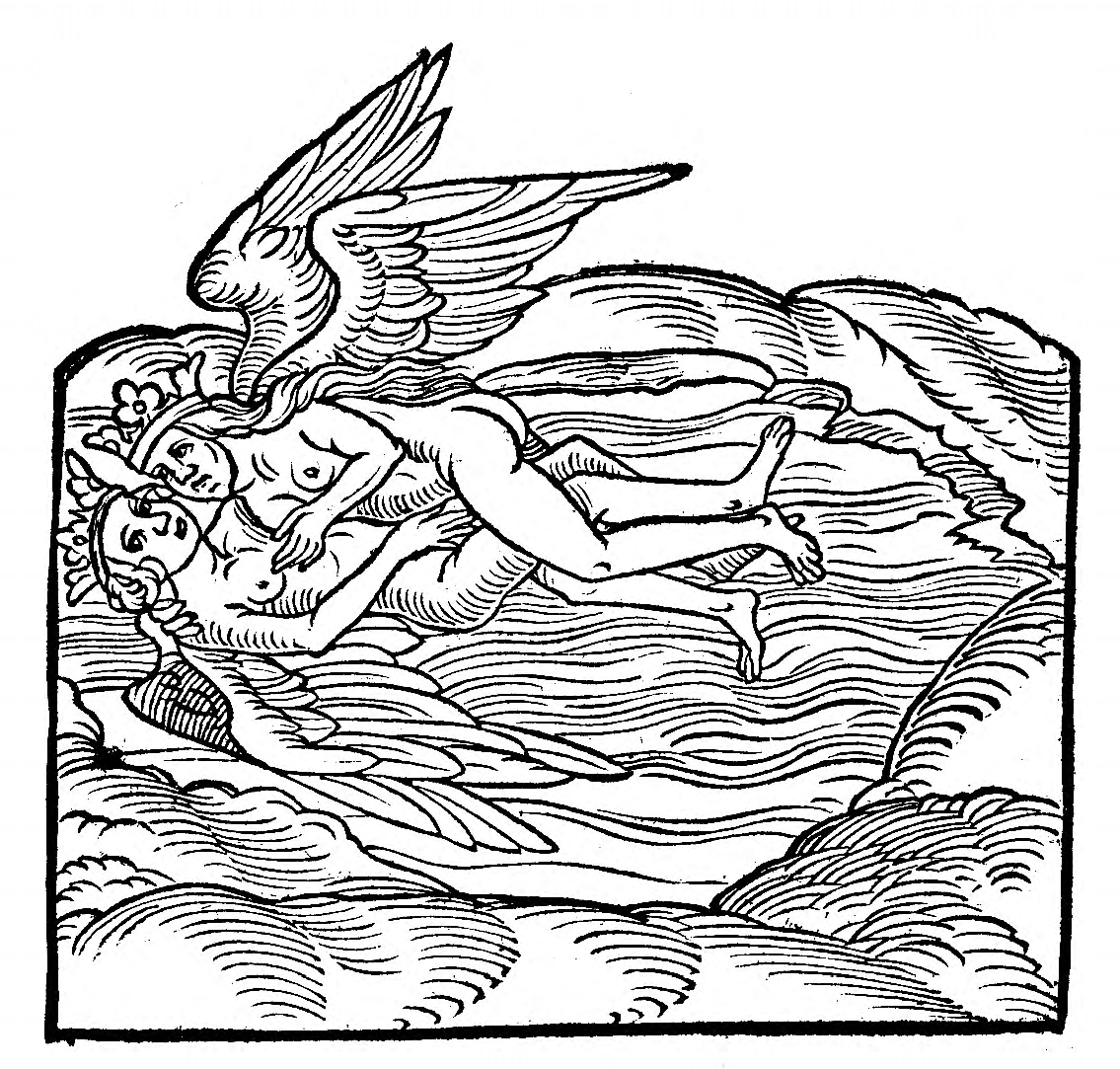
Figure 11.
Hye wird Sol aber verschlossen
Und mit Mercurio philosophorum ubergossen.
But here Sol is closed up
And poured over with Mercury of the philosophers.
[p. 108]Hermes, in the seventh treatise, on the Sun:
My sons, there are seven bodies of the philosophers. The first is their excellent gold, the king and head. Earth does not corrupt it, nor do burning substances burn it, nor does water alter it, for its constitution [complexio] is well tempered and governed by nature, in heat and coldness and moisture and dryness. Nor is there any excess or lack in it. For this reason the philosophers have preferred and extolled it, and have said that gold stands among the bodies as the Sun, with its light and splendor, stands among the stars. Through it, all vegetable matter in the earth germinates, and all fruits are perfected by the will of God. Likewise, the gold in bodies contains all bodies in itself and vivifies them. This is the yeast [fermentum] of elixir, without which it is never completed, just as dough does not ferment and rise without yeast. So it is also when you whiten, sublimate, and cleanse bodies, and extract the dregs [fecem] and foulness from them. Then, when you wish to make them one, conjoin them and mix them at the same time, apply the yeast to them, check that the yeast of the dough is nothing other than yeast, and so ponder and consider whether the substance of the yeast might not be of its own nature. This is the key of all the philosophers. And it must be noted that the ferment [fermentum] whitens the product, hinders combustion, holds tincture fast from flying off, softens bodies, and causes itself to enter [into bodies] and to conjoin. [p. 109]This is the end of the work. By its science, the bodies are cleansed, and their work, God willing, is finished.
Raymund in an opening section: Now as for the second part, the stone will colour itself. Let it be fixed and fermented. The ferment of the white stone is silver; that of the red stone is gold, as the philosophers demonstrate. Without ferment, neither Sun nor Moon come, nor anything else which is of its nature. Therefore conjoin ferment with its sulphur so that it can produce its colour, and also its nature and its weight and its soap and its sound; for every kind produces its kind. Like the Sun, ferment tincts and transforms its sulphur into enduring and penetrating medicine. Thus says a philosopher: Whoever knows how to tinct sulphur and quicksilver attains to the highest mystery. Thus it is necessary that Sun and Moon be in the tincture, and in the ferment of the same spirit and of enduring water of quicksilver. Those natures must be fixed through this water, and nourished with its natural heat, as long as it takes until they have been perfectly fixed and melted. After this, the rule is to conjoin the stone with its ferment, that is, until the work has reached its completion. This will not come about with one turn only, for that is not nature’s intention, but rather by copulation, that is, little by little. Also, [p. 110]the true and uniform medicine is made by coagulation. Thus, the copulation is caused by subtle parts that have been transmuted and altered into a spiritual form and essence. For it is written that the coarse body cannot be conjoined with the simple, nor the simple with the coarse, because of their contrariness, unless the coarse is made transformed into its subtlety through its simple spirit; and then they can be mixed together. The philosophers make note of this, declaring it to a certain son of truth. They say that the perfect mixture is the union of miscible, transformed bodies which have been joined to each other through indivisibles. For obvious reasons, this requires that the mixture, or union, cannot come to be without alteration, namely, the subtilizing of the body and its reduction into spiritual form.
For their part, the philosophers say that once the medicine has been finished and has passed from one kind into another, crystalline kind, then it will become apparent that the blade [of a leaf] is composed of subtle, natural parts. These have been conjoined uniformly through their natural disposition, without any division of the parts, little by little. This kind [of conjunction] cannot come about without nature’s subtilizing and homogeneity. And so it is fit that the material arises which is so subtle that all its parts in nature may be mixed equally with water. And [p. 111]you will be able to see this intellectually when one transparent body has been made, that is, made one through the conjunction or commixture of many parts, without discontinuous division or demarcation, but rather in one transparent thickness and figure through all its parts.
Now, my son, you already possess not a little of the secret. Therefore, first illuminate the body before you impose its soul, for otherwise it will not be able to take up the spirit or hold it fast in itself: thus says Raymund.
The philosopher Calidius: No one ever has been able, or afterwards will be able, to tinct foliated earth, except with gold. Hermes anticipates this, saying: Sow your gold in white foliated earth, which through calcination has been made fiery, subtle, and airy. Therefore we sow gold in that earth when we have applied the tincture of gold to it. But gold can never perfectly tinct a body other than itself—certainly, if it has not been perfected by the art, it cannot do this.
Gold is the ferment of the work, without which nothing is accomplished. It is like the yeast [fermentum] of dough, or the rennet [coagulum] of milk in cheese, or like musk in good perfumes. The greater composition of the elixir is made with it, because it illumines and preserves from burning, which is the sign of perfection. And know that, [p. 112]without gold, our work is neither perfected nor improved, because gold is quicksilver’s halter. Quicksilver is congealed only within the body of magnesia, within which the one is burnt, while the other flies off. Gold is the third of these, and it receives tinctures and is [itself] a reddening tincture; quicksilver transforms all bodies with it. Thus, whoever you are, if you do not put gold in gold, you do nothing.
Arisleus: Know most certainly that if a little gold is put into the composition, a visible and bright white tincture will come out. By ferment of the Sun is meant the sperm of a man, and by ferment of the Moon is meant the sperm of a woman. Coupling [coitus] results from these first, and then true and chaste procreation. The ferment [fermentum] of gold is gold, just as the yeast [fermentum] of bread is bread. Rosarius: Just as, in the working of bread, a bit of yeast raises and ferments much dough, so a bit of earth which contains the stone is enough to nourish the whole stone.
Of the twofold difference of minerals, from the same treatise, the Correction of the Foolish.
Mineral bodies are particularly distinguished into two parts, namely the metal part and the mineral part. What is in the metal part [p. 113]takes its origin from Mercury; what is in the mineral part does not take its origin from Mercury. Some examples of metals: Sun, Moon, Jupiter, Mars, also electrum. Some examples of minerals: salts, inks [atramenta], alums, vitriol, arsenic, orpiment. Now, all metals, which take their origin from Mercury, are ductile and liquifiable, because their material is a watery substance [substantia] which has been mixed together in a strong mixture with earthy substance [substantia] so that the one cannot be separated from the other. This is why the watery substance freezes better in the cold after the action of heat; in this way they [metals] will be ductile, or workable. The water alone does not freeze unless through the dryness of the earthy substance, which alters the wateriness, since there is no unctuous moisture in these [metals]. Their freezing comes about from the dryness of the earthy substance, which is not easily dissolved except by the vigorous action of heat upon them [the metals], which commingles them [the watery and earthy substances] more and more strongly. But it is the smaller or middling minerals about which it is said that they do not take their origin from Mercury. Of these, some are salts which liquefy easily in moisture, such as alums, simple salt, ammonium salt, rock salt, and all kinds of salt. But some are virtuous and do not liquify easily in moisture alone, like orpiment, arsenic, and sulphur. [These indissoluble substances arise] when the wateriness of sulphurous bodies has been commingled with viscous earth by a forceful mixture under fervent [p. 114]heat until they have been made virtuous, and then have been coagulated in the cold. Inks are composed out of salt and sulphur and stones. It is believed that inks have in them the mineral force of certain liquifiable bodies that are made of inks, like chalcanth[1] and olocari.[2] Metallic bodies cannot be made artificially out of these, as they are of a different nature and do not take their origin from a first matter near to that of metals, namely Mercury or quicksilver. I do not deny that metals may be purged or dissolved with these, or that a sophistical form may be introduced through them in order to deceive men, etc.
Sulphur is twofold, namely living and burning. Living sulphur is the cause of metals (however much they might have seemed different from each other till now), and it appears rather stained by the viscosity of earth. But as for simple living sulphur, which is the cause of gold and silver, it is nothing but hot and dry vapour, produced from the purest dryness of earth. Fire predominates in [simple living sulphur] among all its characteristics. It is called the element of metals with Mercury, etc. Sulphur is clearly understood from the above.
That it is impossible for lesser metals to be made artificially into metals.
But since it was determined in the previous chapter that it is impossible for lesser minerals to be made artificially into metals, it remains to be proven here, chiefly as follows. Lesser metals of the first matter of [p. 115]metals, namely Mercury, are not generated. For, in the first place, their generation differs from the generation of Mercury in form, in nature, and in composition. Also, metals cannot be made because there is one prime matter of the one appearance of substances, and [one] sperm from which they are generated. The chief part of the preceding is clear: Lesser metals do not generate from Mercury. This is why sulphur always remains in the first matter of metals and not in extraneous things.
Aristotle and Avicenna: If metals had to be made, they would first have to pass into the first matter of metals. But since this cannot happen by artificial means, metals cannot by any means be made out of them.[3] Thus the chief part of the preceding is evident and sufficiently stated. Second, likewise, lesser minerals cannot be made artificially into the principle of metals, which is Mercury. They do not tinct through to the middle or the end, which are [respectively] metal and the tincture retained by metal. The nourishment in man cannot become a man by procreation unless it is first converted into sperm. In this way, a new man in its kind is produced in addition. But the lesser metals are extraneous to the metals by nature, however well they may participate in some mineral force; and they are of rather feeble virtue, and combustible. Thus the metallic nature does not rejoice in this, but spits it out and preserves what is of its own nature. As an example: If water were mixed with earth, they would separate from each other. Earth seeks the bottom since it is heavy and dry; water seeks the top; [p. 116]and never can they be conjoined in this way by artificial means, for then contrary natures would stand in one conjoint nature. Water is indeed well able to ablute and cleanse earth, but it ought not to be believed that the dryness of earth is transformed by artifice into watery moisture. It is true that earth is moistened by water, and in this way the lesser minerals can indeed be conjoined with metals and purge them, and introduce a new form in some way—but as for the lesser minerals to persist with them, or as for what is immature to become mature, nature has not granted this.
Through diverse works and sophistries, fools lead many men into deception. They lead them to disproportionate substances which neither give nor receive material, such as afterbirths, eyes of animals, eggshells, hairs, blood of red men, worms, herbs, roots, human excrement. Many fools have laboured and still labour in these vegetable and sensible substances, where they nevertheless have found nothing of the truth. We are pointing out a few humiliations of this sort to the unknowing, so that they may avoid these deceptions. For, out of these things which had to be mentioned, they [the fools] extracted over a long time what they called artificial quicksilver, and oils, and waters which they called the four elements, namely water, air, earth, and fire; and ammonium salt, arsenic, and sulphur, and orpiment—all of which they would have done better to buy in the market, and so more quickly perfect them. [p. 117]In vegetable and sensible substances they also sought after dry things, lacking moisture and combustible and corruptible, seeking in this the tincture which they lack. Such [fools] have been harmed by an obvious harm, and here are the reasons [for which they harmed themselves]: human hairs, brain, human spittle, women’s milk, human blood, urine, human excrement, embryo, menstruum, sperm, bones of the dead, chicken’s eggs; and simply all matter, natural or artificial, of animals, brutes, fish, flying creatures, worms, scorpions, toads, basil—whatever involves the greatest mockery—in tortoises, juices of certain herbs and flowers of trees, and especially in the lunar herb and the solar herb which is called toxic; and in everything to which they have affixed the name of “metal” at their whim. They deceive themselves and others, wishing to make the best out of the worst substances and to make good what nature lacks with such things. But since they do not really imagine or inspect any virtue in these substances, they wish to sow excrement and reap wheat, which experience knows is impossible. It is said that if a man sows here he will also reap; therefore, if you sow excrement, you will also reap shit. It is no wonder, then, that barely one in a thousand, or none at all, of such men accomplish [their aim]. But sow gold and silver and it will bear you a thousand fruits through your labour, with nature’s help. This alone, [p. 118]and no other substance in the world, has what you seek. Everything else is foul; their natures withdraw from the assiduity and assay of fire.
And there are other Alchemists who labour at lesser minerals (that is, in four spirits: common sulphur, arsenic, orpiment, and ammonium salt), hoping to perfect the tincture from these. But they cannot do this, as is evident from the definition of tincture, for to tinct is nothing other than to transform what is tincted into its own nature through tincting, while enduring without any transformation in itself. And it [tincture] teaches nature to battle by nature against fire, for the nature of what tincts is in harmony with that of what is tincted. For example, if you tinct lead or tin or anything like this with gold or silver, then it will be in harmony with respect to the natures [of gold and silver], for from either part it has taken its origin from Mercury, and the mature is conjoined with the immature, so that in this way the immature is perfected. But as for those four spirits [common sulphur, arsenic, orpiment, and ammonium salt], they are of a different nature than metals, as was well enough said before. Therefore, if they are supposed to tinct, I ask whether they are supposed to transform or to be transformed. If to be transformed, then there is no tincture, as is evident from its definition. If to transform, then by tincting it transformed [another substance] into its own nature, which is earthy and extraneous from the nature of metals. Therefore, they cannot make metals by means of tincting. It is proven that by tincting it converts [other substances] into its own nature from the fact that everything that produces does so according to its own kind. But since this tincture is the producer of the four earth spirits, [p. 119]this will also produce its own kind, which is also earthy, like itself. Thus, with respect to the tincture and everything else, despise whatever is not found in a property of nature, along with all other extraneous paths. In these are nothing but the squandering of things, a waste of time and work. All these others are mere appearances and non-existent metals, which ought to have been worked over as lesser minerals or the like.
[1] Blue vitriol, i.e., cupric sulfate.
[2] Unknown. Perhaps a form of orichalcum.
[3] The antecedent of “them” is unclear; possibly it refers to the “lesser metals” of the preceding passage.