Previous section | Next section | Back to Rosarium index | Back to main page
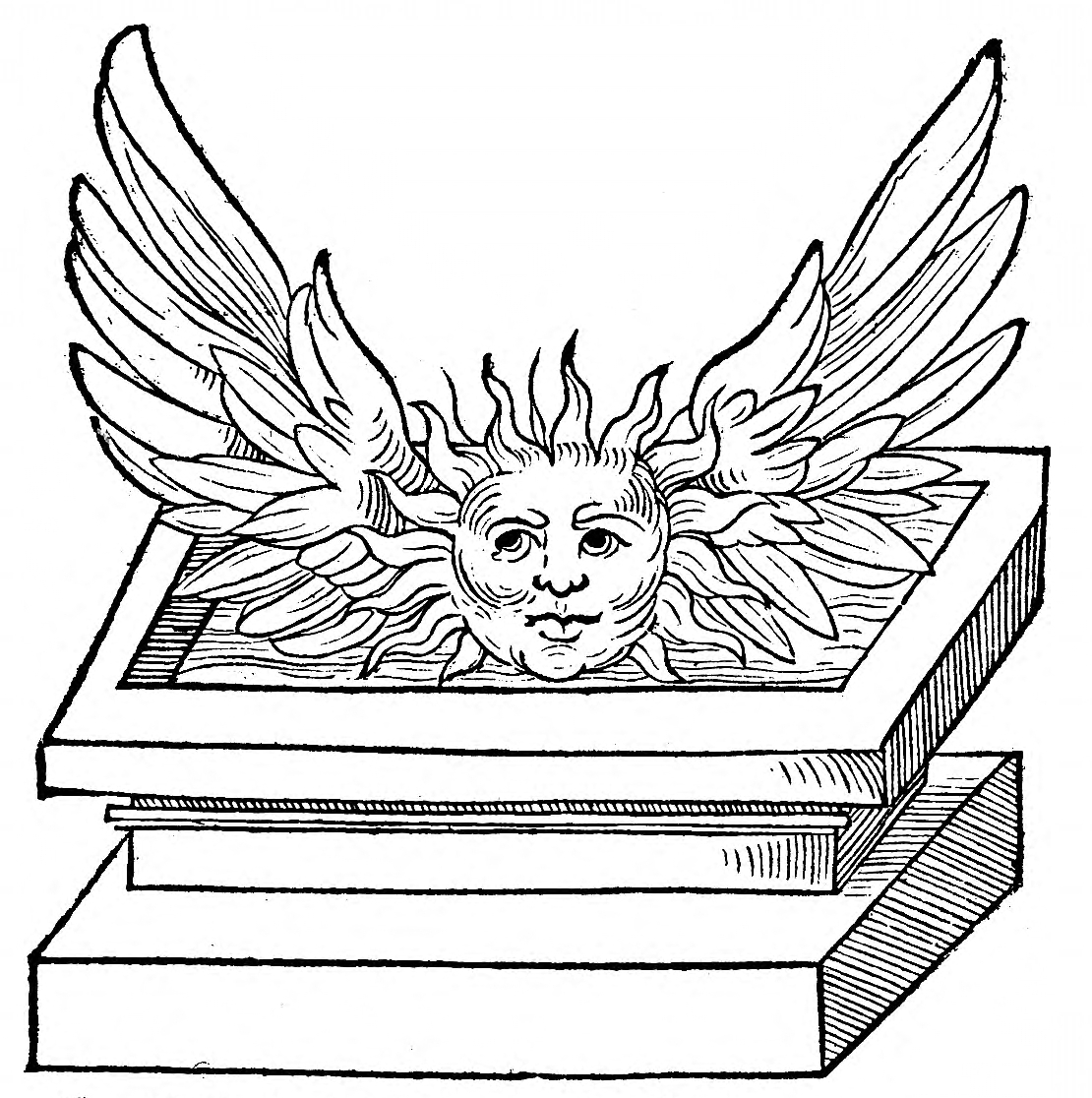
Figure 12.
Hye ist Sol wider gar versuncken /
Und in dem Mercurio philosophorum erdruncken.
Here Sol has sunk again
And drowned in the Mercury of the philosophers.
[p. 120]Raymund: Although our stone now contains the tincture naturally within itself—for it has been perfectly created in the body of magnesia—yet it has no motion in itself, unless it is perfected by art and operation. Geber says, about the operation of roots: This operation is made so that the tincture of gold in gold may be improved beyond its own nature, and also so that the elixir may be composed according to the Allegories of the Wise, etc. But surely what we lack is not gold alone, and no other body. Listen to Hermes, who says: Its father (that is, the father of the first composition) is the Sun. Its mother is the Moon. The father is hot and dry, and produces tincture. Its mother is cold and moist, and nourishes what has been produced. Therefore, if in our stone there were only one of these two, the medicine would never flow easily, nor would it impart the tincture. And if it imparted [anything], still it would not tinct except as a residue, and the Mercury would fly off as smoke because there was no receptacle for tincture in it. But our final secret is to have medicine that flows before the flight of Mercury, and thus the conjunction of those two is necessary in our work.
Geber says in the perfect magisterium: Gold is the most precious of the metals. It is the soul that conjoins spirit with body, that is, with the imperfect. Just as the human body is dead and immobile without a soul, so also the unclean body, without the ferment that is its soul, is earthy [p. 121]and vegetable. The tincture of redness transforms all bodies; it is the ferment that converts a whole mass into its nature. Just as Sun and Moon are lord over the other planets, so these two bodies are lord over other metal bodies, and the latter are transformed in conformity with the nature of the former two bodies. Thus it is called ferment, just as seeds are not grown without it. And just as a bit of ferment corrupts a whole mass, that is, transmutes and raises it, thus it happens also in our stone.
Hermes says: My son, extract the shadow from its ray, and take up to the fourth part of it, that is, one part of ferment and three parts of imperfect body. Dissolve the ferment in water of Mercury equal to it; cook it at the same time with a very slight fire; and coagulate the ferment, so that it is made like the imperfect body. Then, after shutting the mouth of the vessel, the preparation for all things should be made in the same way and order as has been said. Aristotle: In place of the stone, pick out for yourself that through which the kings worship in their Diadems, and through which physicians are able to their sick; for this is close to fire.
My son, take from the simplest and round body. Do not take from a triangular or square body but from a round one, for the sphere is closer to simplicity than the triangle. It must be noted that the simple body has no angle. [p. 122]It is the first and last among the planets, like the Sun among the stars, just as we see in the Astronomy of the firmament that the Sun is lord of all the planets and all the planets need its light. It gives its light upward as far as Saturn, and downward as far as the Moon, and so has regard for everything superior just as much as what is inferior. Aristotle: My son, you ought to take of the fatter flesh; my son, you ought to know that every seed corresponds to its sprout. Thus, what you sow, you will also reap.
What are the particulars which are perfected in this art.
I declare universally, to all those observers who have come to this present speech, that in the whole progression of the art there are only two particulars, which must be perfected as particulars according to the philosophers and to nature. The first particular exists in white as well as red Mercury. [It is present] without the administration of perfect medicine, although a body may be perfected by it. It contains its own tincture hidden within itself, just as nature requires, since [the tincture] is within it as a particular with respect to both appearances of substances. Mercury is composed out of the first matter of all metals, out of exceedingly sulphurous white earth and clear water. Thus, the whiteness of earth shows through the transparency of water, and the colour in it [the earth] is [p. 123]very white, as experiences teaches. And it contains in itself good, mature, and clean sulphur; and then it is possible for Sun and Moon to be made from it as particulars.
A philosopher: Let it be admixed through the art with other metallic bodies, for it is of their nature and they were produced from it, and therefore it can be done through the art. And let it imitate the digested nature [in the other bodies], so that it may be perfected with them. Once it has embraced them in this way, it is similar to the metals, having no extraneous admixture, just as nature rejoices simply in its nature and not in anything extraneous, and just as when Sun is made with Sun, Moon with Moon, Venus with Venus, etc. —when anything sends its force into itself. And it contains within itself its good, immature sulphur, which is matured through the art. For this reason, other metals, which have been coagulated and tainted through combustible sulphur, cannot become a particular like it, or become like Sun and Moon.
The first reason: If they [the other metals] were transformed into Mercury and admixed with Sun and Moon, then their Mercury would have in itself that aforesaid bad sulphur. And if it were purged, it could not be purged to such an extent that it would reduce to Mercury as simple as it was before. Nor could a body dissolve in it through Mercury, and since it would not be dissolved, then also it could not send its bound force into it. [p. 124]But once the natures of both parts have been bound, then each part is separated from the other in the assay [examen]. This happens insofar as each part does not have hidden in itself a perfect nature, by which it would be able nearly to make [both parts] perfect through their own dissolution. But as for these [two parts], it is always necessary that other perfect bodies be brought to their aid, by mediation of the art, and through the nature [of each], which is naturally perfect.
Second, if what is undissolved is adjoined to perfect bodies, then gold and silver are less able to be made. [Gold and silver] are each naturally bound by congelation, and this is not a medium which opens their natures to send one force into another. Thus, they cannot be conjoined by a natural conjunction, so that they return into the Mercury from which each takes its origin. Moreover, the fervency of fire would separate them one from another through the combustion of the imperfect nature, as is well known. But when you wish to conjoin, make Mercury through Mercury which dissolves and opens bound natures, so that one is able simply to move into another. And make the perfect send its force into the imperfect, so that the latter is perfected by it. These are the labours of the particular way; in this way, gold and silver can be made as particulars. Note that raw Mercury [mercurius crudus] dissolves bodies and reduces them into their first matter or nature, but Mercury of bodies [mercurius corporum] cannot do this. This is because of the rawness of its [raw Mercury’s] sulphur, which it [p. 125]possessed in the first white earth, and with which it was made in the first place out of clear water. This rawness always seeks to corrode what is close to its nature: first of all gold, second silver, etc. But the other Mercury, that which has been congealed from bodies, cannot do this. Through congelation, the raw sulphur that was previously in it was altered in nature. It does not corrode like the first kind, nor does it open what is bound; one force is not sent into another. Rather, each thing remains in itself, and so they are conjoined unstably. For this reason, the imperfect is burned away through the assay and asperity of fire, and the perfect remains: One nature cannot help another. But with raw quicksilver it can be done—that is, unbinding and opening natures, so that every like substance is a help to its nature. Thus, if silver is dissolved, the nature of silver will be found; if gold, then a golden nature; if lead, a leaden one, etc. Through their sulphur it is congealed. A philosopher: As for those bodies which participate in its nature—just like those you seek within many foul ad unclean substances—it is possible for gold and silver to be made as particulars from either part of it (but not, as you have heard, from other bodies).
Note that the solution of bodies in Mercury is twofold: through Mercury, and in mercurial water. The first solution is required for particulars, the [p. 126]second for universals. The first solution of bodies in Mercury is nothing but a redissolution [resolutio]. What is bound is opened only by resolution, through the entrance the nature of one into another. This redissolution is within particulars. The second solution is in mercurial water, and is effected universally. It is not made only through the dissolution of immature sulphur in Mercury, but through the putrefaction of body and spirit in moisture. The putrefaction of all mutually bound natures is solution and separation. Thus, the bound parts are mutually separated, one part from another, and this comes about through the separation and solution of the elements which were connected in the generation of Mercury, namely, waters and earths. The same parts, while they are being purged in nature, are conjoined through this transformation, and they love each other more than they naturally did before, because of this cleansing. This separation cannot happen in bodies except by the spirit.
Thus, in one way, the art transcends nature: Artificial things are made well and quickly, whereas before they were naturally stretched out. Do not believe that these are common elements, namely cloudy water [aqua nubis] or the like, but rather cold and dry earth, cold and moist water, moist and hot air, hot and dry fire. These are the elements in nature, and the art can never separate the parts that have been conjoined in generation. Simply let [p. 127]what was in the elements be transmuted, just as nature first changes one quality into another, so that the art is well able to separate the moist from the dry, the cold from the hot. Now, one quality of the natural mixture possess the nature of another in some part. Through these [shared natures], they can each be conjoined in turn, just as they are divided through the art. If it were not that one quality participated in the nature of another—namely, water in the nature of earth by its coldness, and air in the nature of water by its moisture, etc.—then it would follow that the natural work would be totally destroyed. The elements would be utterly simple, just as they were before the generation of Mercury. The art would have destroyed nature from its head (that is, from gold and silver), down to the principle (that is, quicksilver), and beyond this, [it would have destroyed] the principles of the simplest elements by which they existed prior to the generation of Mercury—and this is an impossibility even without the art. If, then, it could follow that the art could compose elements without the first matter of metals, or vice versa, then the art could produce Mercury just as it destroyed it—but this is impossible to do through the art. But, indeed, the art is destroyed from head to foot (that is, Mercury which builds from the foot up to the head in a subtler form), for the art withdraws from the substance [substantia] of nature which was before.
If it were not that one quality participated in the nature of another, namely water in the nature of earth in its coldness, and air in the nature of water in moisture, etc., then it would follow that the natural work would be totally destroyed. The elements would be utterly simple, just as they were before the generation of Mercury. The art would destroyed nature from the head, that is, from gold and silver, to the principle, that is, quicksilver, and beyond these principles of the simplest elements, according to which they existed prior to the generation of Mercury; and this is an impossibility, removed from the art. If, then, it could follow that the art could compose elements without the first matter of metals, or vice versa, the art could produce Mercury just as it destroyed it; but this is impossible to do through the art. Indeed, the art is well destroyed from head to foot – that is, Mercury, building up from the foot up to the head in a subtler form, for the art withdraws from the substance [substantia] of nature which was before. Thus the appearances of things are divided when they are transmuted into another form than was before.
[p. 128]Thus says Aristotle: Let the craftsmen of alchemy know that the shapes of things cannot be transformed. For it is true that, unless they are reduced or converted into first matter (that is, into quicksilver), and unless they care for nothing beyond this, then it will be impossible, etc.