Previous section | Next section | Back to Rosarium index | Back to main page
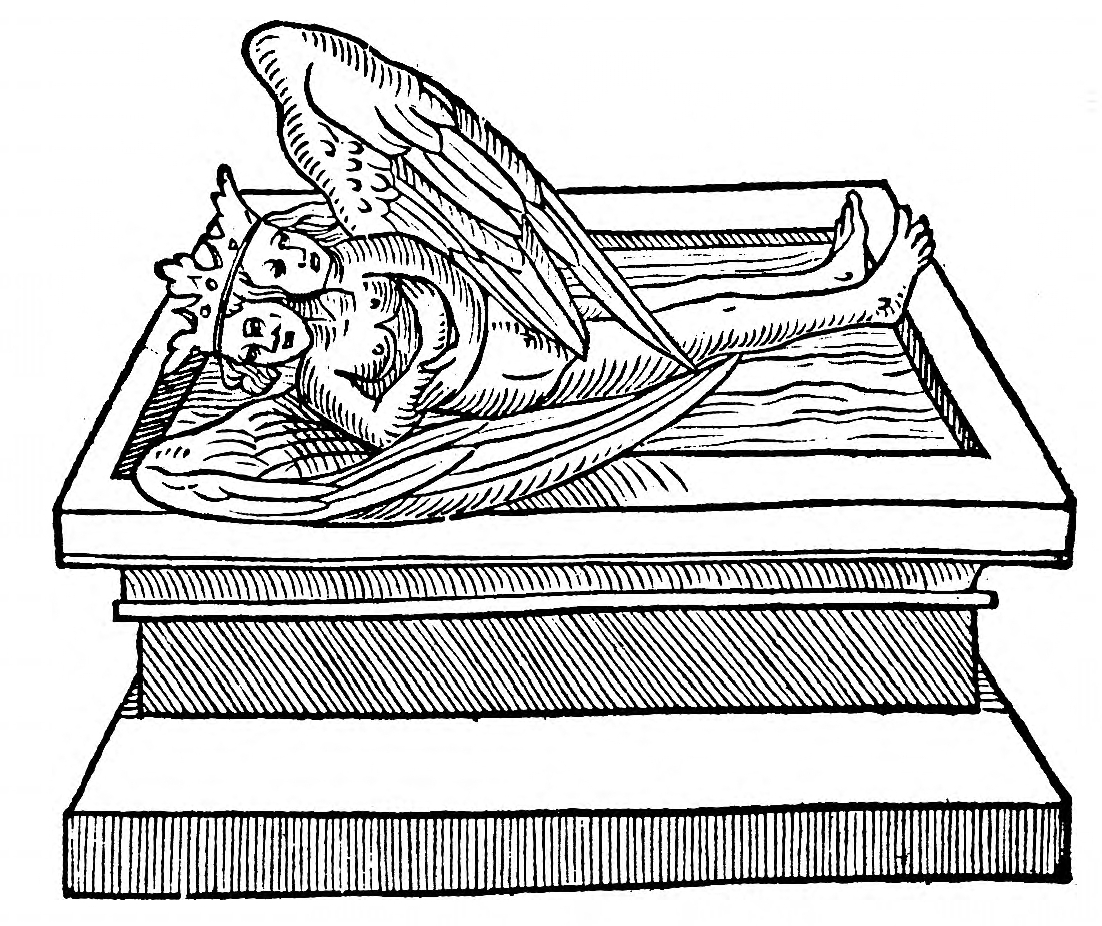
Figure 13.
Hie ist Sol worden schwartz
Mit dem Mercurio philosophorum als eyn hartz.
Here the Sun has turned black,
With the Mercury of the philosophers like a resin.
[p. 129]The second particular is in Sun, Mercury, and sulphur of the philosophers.
It goes together with what has been said above, that the Moon contains in itself white sulphur just as gold contains red, but the appearance of fire in the former is hidden under its whiteness. All silver may be made into gold. A philosopher: There is no gold that was not previously silver. Silver contains in itself certain undigested qualities which may be purged from it through the art, so that as a particular it passes into fixed Mercury and is very near to the nature of gold. Then, by applying red sulphur of the philosophers through which it is better digested, it contains everything itself, even gold. The yellowing in it is caused by the adjunction of a perfect body, as they are simply of one nature. But for this to happen in other bodies is impossible, since, unlike it [silver], they do not have such nearness to a perfect nature, and their generation through combustible and foul sulphur is an impediment. Nor are they [the other bodies] the mercuries about which a philosopher has spoken; it has not passed from extreme to extreme, nor is it in the middle. Gold is not produced from Mercury unless it was previously silver, nor does it have sulphur of a simple unburning fire in itself. Therefore they cannot be transformed as particulars into Mercury, as was said above through Aristotle: Let the craftsmen know that they may make what resembles them [gold and silver], and [p. 130]they may tinct yellow through red so that it seems to be gold, and they may tinct white with white until much is made like unto silver, and also they may wipe away the uncleanness of lead or of other sick bodies, so that they seem like gold and silver. But lead always remains lead, since in itself it does not have the digested qualities of gold and silver, as has been said above. It is like those who use ammonium salt or other minor minerals to delude men, and who join copper [cuprum] or tin with Mercury, so that it seems to men to be silver that is workable and that can be tested in fire (according to those who have tested it). In this they are deluded, for it does not have in it the true nature of silver, as is apparent in the colour and in the test.
The first reason is: Copper [cuprum] contains in itself Mercury that is clean to some extent, except insofar as some sulfur from outside appears in it. This is foul and combustible sulphur which burns [the copper], and which does not have a well digested redness, but rather is red and unclean sulphur. But Mercury proffers its own substance [substantiam] before sulphur, and so it is used up more slowly in fire compared to lead or tin. Mercury resists, except insofar as it suffers violence from the sulphur that has been mixed with it. Lead is burnt more quickly, and this is because of its corrupted Mercury. Corrupted Mercury with corrupted sulphur is like lead. [p. 131]It seeks something near to its own imperfection, and when silver and copper [cuprum] have been mixed in silver, nothing comes out of it but a corrupted substance. But in copper, what is found first of all is burning sulphur with which it [Mercury] mixes quickly. In this universal mixture, the Mercury is more greatly corrupted by the copper, so that lead is made from both parts (that is, from what is corrupt of the Mercury and of the sulphur). Also, because what is bad adheres quickly to more of what is bad, it [the product] will be so much the feebler and worse, and thus it adheres quickly to copper and silver, corrupting and burning them. Since the nature of copper and silver, as you have heard, is bound in both parts, it cannot come to the aid of what is worse. Thus, lead burns copper and silver, and the latter is more slowly separated without lead. The more imperfect it is, the more feeble and combustible it will be. But in the instant conjunction with copper and Mercury, somehow it opens their natures and conjoins these two (that is, tin and copper), as well as the Mercury which is clean in both parts. When tin has clean Mercury and sulphur is feebly mixed with bad Mercury, then Mercury is conjoined with Mercury. And Mercury always has the power of sulphur to vary the colour of copper so that new forms appear, just as [the same power] is in sulphur. And now the sulphur cannot quickly burn, as it did to Mercury before. And when the raw Mercury is coagulated through it, then it is altered in its nature by them, in such a way that silver appears—[p. 132]although it is not real silver, since there has not been the necessary digestion and decoction in it. The sulphur of fire is not of a simple and virtuous nature, unlike quicksilver, from which gold and silver come in both parts (that is, Mercury and sulphur) when they have been sufficiently digested, and are of good maturity, and have been perfected in all digestion. Thus, from copper, tin, and Mercury, you have sophistical silver. And if you then admix some powders of lesser minerals, it is not impossible [to produce some result], if the Mercury also works above its potential. But since it [the sophistical silver] is now imperfect, it is, in the end, always diminished and burnt in fire. This is because the sulphur is not of a virtuous nature, like the Mercury itself, but rather is always secretly harmful and corrupts the Mercury, however well provisioned the Mercury may be. And so it [sophistical silver] will shortly return into excrement, just as it was before. Understand, then, how different gold and silver are from what is sophistical, even though many sophistries are performed in like manner in other metals, red and white, by adjoining lesser minerals or something of them. Those labourers are deluded when they think themselves to have discovered a good appearance. It is their ignorance that does this, for they do not know the natures of metals, etc.