Previous section | Next section | Back to Rosarium index | Back to main page
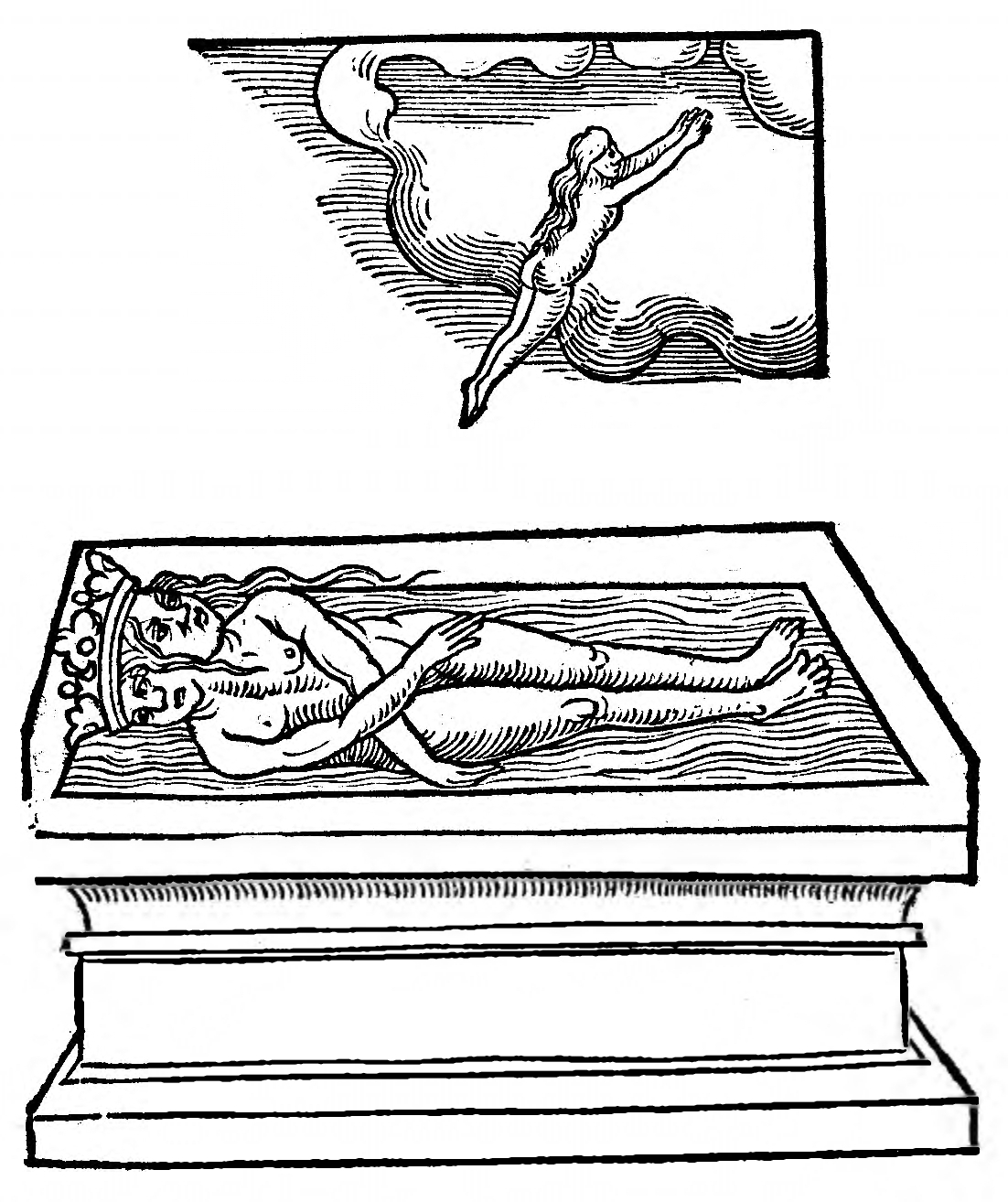
Figure 14.
Hye hat der lune leben gar ein end /
Der geyst steigt in die höhe behend.
Here the life of the Moon has an end;
The soul rises nimbly upward.
[p. 134]Raymund: Now I will speak of the fixation of tincture, or of the air which carries tincture in itself, etc. It is made by calcination; I will pass over the method. The philosopher Lilius: In the end, the king crowned with his diadem will come out to you, radiant like the Sun, clear like a carbuncle, flowing out like wax that persists in fire, penetrating and holding quicksilver fast. Arnaldus: The colour red is created from the completion of digestion, for blood is not produced in man unless first it is thoroughly cooked in the liver. Likewise, when we see in the morning that our urine is white, we know that we have slept too little, and we return to bed. After having slept, the digestion is completed, and our urine is yellowed. Likewise, only through decoction can white proceed to red. Our white copper [aes], if it is thoroughly cooked in this way with a continuous fire, reddens very nicely. Therefore let it be decocted with a dry fire and a dry calcination until it becomes red like cinnabar. And do not in any way add water or any other substance until the red ending of the decoction.
[p. 135]What is helpful to melting [fusionem], entering in [ingressum], and fixation.
Geber, in the fifth chapter of the second book, says:
We say that what leads to the perfection of all solutions is water, which is subtle, very sharp and sour, pontic [ponticibus][1] and free of dregs [fecem], as for example distilled vinegar, sour grapes, very sour pears, pomegranate (when it has been similarly distilled), and the like. The cause of the discovery [of this water] was the sublimation of those [substances] which neither melt nor enter in, because of which much utility was lost with respect to [working with] fixed spirits and other [substances] of that nature. Everything that is dissolved must have the character of salt or alum, or must have a nature very similar to these. These have the nature of causing [other substances] to melt before they vitrify. And so the dissolving spirit is useful in like manner to what is similar to it, since much of its own nature agrees with bodies, and vice versa. Melting is necessary to penetrate into bodies by means of it, and through penetrating, to transmute them. But this is not accomplished without the magisterium—namely, after it is dissolved and coagulated, let some unfixed [substance] that has been purified from spirits be applied to it, and let the latter be sublimated by the former several times over till it rests in itself; then [the applied substance] will aid in [the original substance’s] rapid melting, and [p. 136]will protect it against vitrification while melting. It is of the nature of spirits and bodies not to be vitrified, and to preserve from vitrification what has been mixed [with them] (insofar as there was spirit in it). Therefore, whatever spirit better preserves nature also more greatly defends it against vitrification. Now, the spirit that has only been purified has better preserved [nature] than that which has been purified, fixed, calcinated, and dissolved. Thus, it is necessary that it [spirit that has only been purified] be mixed with it, and the result is good melting, as well as [the power of] entering into [other bodies] and lasting fixity.
We may prove from the works of nature that only what preserves the nature of salts, alums, and other like substances is soluble. Having considered all its [nature’s] works, we have found nothing that is dissolved but these. Thus, whatever is dissolved must of necessity be dissolved by their [salts’ and alums’] nature, through the reiteration of calcination and solution; and we prove through this that all things which are calcinated approximate to the nature of salts and alums, and must be akin in their properties. Now, the method of solution is twofold, namely by hot dung and by boiling water, of which one is intention and one is effect. The method of dung is as follows: Put what is to be calcinated in a glass ampoule. Pour over two times this quantity of distilled vinegar or something similar. Cover the head [of the vessel] so that it does not breathe, and leave it under tepid dung for the span of three days, then remove the solute by a filtered distillation. Let what is undissolved be calcinated again, and after [p. 137]the repeated calcination, let it be dissolved similarly, until by repetition of the work the whole is dissolved. Now, the method by boiling water is quicker: Place what is to be calcinated in an ampoule similarly arranged with vinegar, and stop the opening so that it does not breathe. Let this [ampoule] be submerged in a bath full of water and straw, just as we laid it out in the precepts for water distillation. After this, place it over a fire until it boils for an hour, and then let the solute be distilled and the rest saved, etc., as above. As Geber says in the seventeenth chapter of the seventh book, the last perfection by which the ingression is made is melting through a moderate flame: Let everything that has been redissolved be coagulated, solely by aid of fire, and this in a firmly sealed vessel. And take this secret from me: The perfectly coagulated substance flows with a suitable application of fire, and it desires the test of fire. But if this is lacking, redo the work, and by repetition you will attain to your purpose, with God’s help. Raymund: Our infant has two fathers and two mothers. It has been nourished at a high price, out of the whole substance [substantia] in fire, and this is why it never dies. Ceration[2] is the reduction of earth’s moisture by means of fire, so that the former, deprived of moisture and made dry by calcination, softens and is reduced to fluidity. And so it is able to enter into things—not through that common liquefaction in which the vulgar liquefy through fire, but [p. 138]by the philosophical one, which is made through water. Fixing is when a body receives a tincting spirit and removes its volatility, and this is done through frequent repetition until an ash of perpetual duration is made, and it endures intact in fire.
How metals specifically are produced from Mercury.
The nature of all liquifiable substances comes from quicksilver and is of its substance [substantia]. It is characteristic of quicksilver that it is coagulated from vapour (that is, from the heat of white or red unburning sulphur). Aristotle in the fourth book of the Meteorology: If white sulphur is unburning, it congeals Mercury into good silver; but if sulphur is pure with a clear red colour, and if the simple, unburning force of fire is in it, then it congeals into purest gold, which is better than what the mines produce. Everything dry naturally drinks up its moisture, so that it may be continuous in its parts. Thus, the vapour of quicksilver’s sulphur must be coagulated from a substance that is earthy, subtle, airy, decocted, undigested in its first united mixture by heat, and then elevated, decocted, and digested until it has the force of sulphur to coagulate quicksilver in metallic bodies. Gold has much of sulphur’s virtue and [p. 139]little of its substance [substantia], and it has much of the substance [substantia] of Mercury and little of its virtue. Thus, because of Mercury it is very weighty, and because of the virtue of sulphur it is very red. Now, silver is the other way in all this, for silver has much of the substance [substantia] of sulphur and little of its virtue, and little of the substance [substantia] of Mercury and much of its virtue. Thus it is white, because its colour follows a multiplicity of virtue, but its virtue is located in vapour. Its material is closer to the material of gold than any other metal. Thus it is easily turned into gold; no other work is needed than to transmute the colour and to give it weight.
The difference between oil and water with respect to tincture.
Arnaldus.
There is a difference between the tincture of water and that of oil, for water only ablutes and cleanses, but oil tincts and colours. An example of this is that, if a cloth is submerged in water, it is cleansed by it, and when it is dried, the water recedes, and the cloth remains in the same state and colour which held before, except that it is cleaner. It is the opposite in oil, for if a cloth is dipped in oil, then the former is not separated from the latter by heat of fire or by air, unless it is wholly destroyed; [p. 140]and the oil cannot be separated from the cloth except by ablution and drying by fire. Water is spirit that extracts the soul from bodies. But when the soul is extracted from the bodies, the spirit continues to carry it, just as the tincture of tinctures is carried by water beyond the cloth. Then the water recedes by drying, and the tincture remains fixed in the cloth because of its oiliness. Thus, water is spirit in which the tincture of air is carried, and when the latter is reduced over white foliated earth, then the spiritual water is instantly dried, and the soul remains in the body, and the soul is the tincture of air. The spirit retains the soul, just as the soul retains the body, for the soul does not tarry in the body except by means of the spirit. And when they are conjoined they are never separated, for the spirit retains the soul, just as the soul retains the earth. Hermes says: Their venerating the souls in the stones is also their dwelling in them. They retain with them what flees; thus, it is our coagulation, since they retain what flees. Therefore sow the soul in white foliated earth, for it retains the latter, and it will ascend from earth to heaven and descend again to earth, and it will receive the force of what is inferior and what is superior, etc.
[p. 141]On inceration,[3] or the method of reducing water above earth.
Arnaldus.
First, therefore, pour in water. Alternately grind it in and then gently calcinate until the earth has drunk the fiftieth part of its water. Know that the earth must first be nourished with a bit of water, and then with more, just as it is seen in the education of children. For this reason, grind the earth carefully while it drinks in the water bit by bit. Every eighth day, decoct it in dung so that the burning is removed by the addition of moisture, and so that the substance is directed back into its first matter. After this, calcinate it in a moderate flame, and let it not weary you to repeat this many times, for earth does not bear fruit without frequent irrigation. And if the pulverizing is not well done until the water becomes one with the earth, it will produce no body. Therefore, do not hold back your hand from the difficulty of pulverizing, or from pulverizing and roasting, because this produces white earth. Take care that you do not imbibe the earth, except bit by bit. Supply it with a long pulverization after drying out the earth. In doing this, the weight is always to be noted, lest by administering too much dryness or excessive moisture they may corrupt it. Thus, see that you decoct by roasting only as much the dissolution [p. 142]increases, and that you dissolve by imbibing only as much as the roasting is lacking. At every turn after the calcination of earth, pour over warm water, neither too much nor too little; for if there was too much then the sea is made turbulent, but if too little, then it is burnt to an ash. Thus, you shall irrigate the earth gently, without haste. Every eighth day, decoct it in dung and calcinate it until the earth has drunk the fiftieth part of water. And note that, after the drinking in, it should be moistened for seven days. Repeat the work many times over, as long as it may take, for you shall not see the tincture, nor the effected good, until it is complete. In every work be studious of every sign that appears in whatever decoction; record them in your mind, and investigate their causes.
Now, there are three colours: black, white, and yellow. When it comes out of earth, the blackness is imperfect, and the blackness is complete. Turn after turn, bit by bit, invigorate the fire to calcinate until white earth comes out of the fire’s strength. Just as blackness is strengthened by heat acting on moisture, so whiteness is strengthened by heat acting on dryness. Thus, if the earth has not been white, pulverize it with water, and then calcinate again. Azoth and fire ablute latten and remove the darkness from it;[4] [p. 143]its preparation is always made with water. The earth is as clear as the water is clear. And the better abluted the earth has been, so much the better the whiteness: Out of the manifold repetition of drinking in, with forceful grinding and frequent roasting, the greater part of the wateriness of Mercury is erased—that is, the wateriness [is erased] whose residue is similarly removed by the repetition of sublimation. Thus says Arnaldus, word by word, in his Rosarium.
On the method of sublimating and whitening; and a recapitulation of the whole magisterium.
Now, when the earth has drawn out a fiftieth part from the water, then sublimate it quickly with the strongest fire you can, until it rises up in the manner of very white powder. When you see that the earth is like whitest snow, and like dead powder, adhere it to the joints and sides of an Aludel.[5] Repeat the sublimation above it, without the sediment [fecibus] that remains below, since the fixed part of it adheres and is fixed with the sediment, and it can never be separated from them by any sort of ingenuity. The powder that rises from the sediment is an ash extracted from ash and earth; it has been sublimated and honoured. [p. 144]But what remains below is ash of ashes, and the lower ash is censured and condemned, sediment and dross. Therefore make a difference between [the sediment and] what is clear and limpid in it. When it rises like whitest snow, then it will be complete. Then gather it together, taking care that it does not fly off as smoke, for this is the good that was sought after: white foliated earth, which congeals what must be congealed and cleanses arsenic and white sulphur. Aristotle has said of it that it is the greatest substance, and that the alchemists are able to take it and make silver with it. No one ought to sublimate earth for the sake of sophistical works, but one ought to sublimate it for the sake of our perfect elixir. And those things which are sublimated are sublimated in two ways: either in themselves, if they are spirit; or with others, if they incorporate themselves with spirits.
Now, since Mercury is a spirit, it is sublimated in itself; but since our earth is calx, it is not sublimated unless it incorporates itself with Mercury. Therefore convert calx and imbibe Mercury and decoct them until one body is made. Let it not weary you to repeat this many times, for unless the body is incorporated with Mercury, it will not rise up. Thus it is necessary that you subtilize its nature as far as you are able, and that you pound it forcefully with Mercury, until one substance is made. We do not perform the sublimation except that bodies may be reduced to subtle matter, that is, so that they may be spirits; and so that the body may be light, so as to rule [p. 145]in all substances, even in Sun or Moon. And we perform this sublimation so that bodies may be directed back into their first matter, that is, into Mercury and sulphur. Thus, we perform this sublimation for three reasons: one is so that the body is made spirit, subtle matter and nature; the second is so that Mercury incorporates itself thoroughly with calx; and the third is so that the whole takes up a white or red colour. When calx is sublimated for Moon, it should be white, and the Mercury similarly should be white. And when calx is sublimated for Sun, it should be red, and the Mercury, made hot by fire, should be similarly red, and should be incerated powder. Do not put red Mercury with white or white with red, but rather put each kind with its kind. Set it to a fire that has been raised and sublimate the whole. Do not mix that which remains below with that which rises above, for you shall repeat the sublimation of what remains at the base through the incorporation of Mercury until it rises wholly; do not otherwise place it into the magisterium. Let the alembic[6] in which you sublimate Mercury be of glass, with an earthen glass cucurbit, and let there be a large mouth at the base [of the cucurbit] so that Mercury may rise freely. But the alembic should be joined with the cucurbit in such a way that Mercury cannot exit or evaporate, lest the magisterium come to ruin, etc.
[1] I.e., dissolving, penetrating, and liquefying.
[2] From cera, “wax,” i.e., making like wax, softening.
[3] Making like wax, or applying wax onto something.
[4] This phrase appears previously in the Rosarium in the section on ablution; there it is attributed to Hermes.
[5] A pot without a bottom used for sublimation. Aludels of diminishing size were fitted on top of each other, so as to condense the sublimate.
[6] “Alembic” here seems to refer specifically to the cap, as distinct from the cucurbit.