Previous section | Next section | Back to Rosarium index | Back to main page
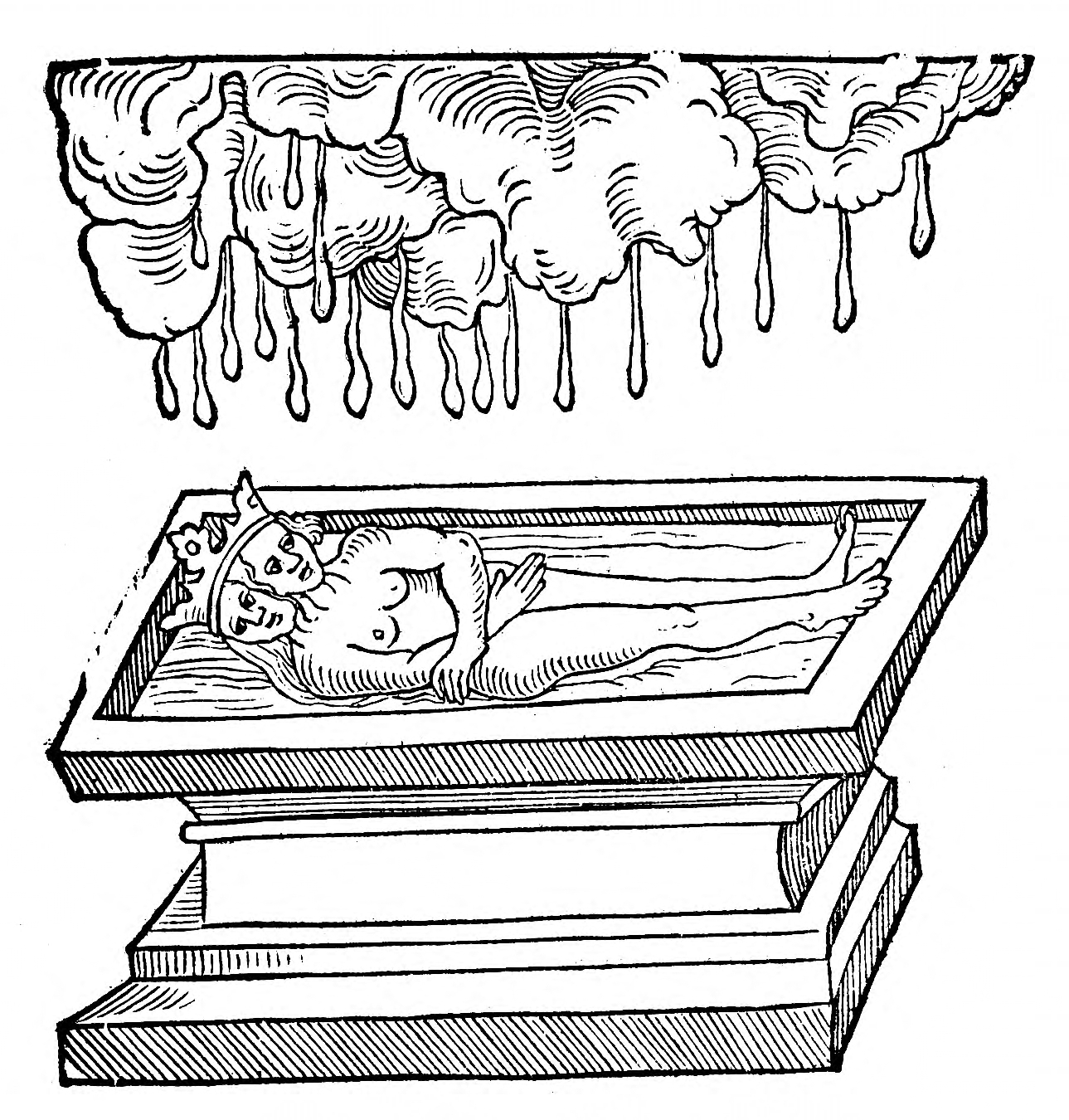
Figure 15.
Hye thut [si]ch das wasser sincken /
Und gibt dem erdtrich sein wasser wider zu trincken.
Here the water comes down
And again gives the earth its water to drink.
[p. 147]Geber, book 3, chapter 79.
As for the preparation of solar medicine, let there be an addition of unburning sulphur, administered perfectly by fixing and calcinating it shrewdly and diligently, and with a manifold solution, reiterating this many times until it is made clean. Once the perfect administration has been accomplished and perfected through sublimation, then another kind of addition is proper to it, namely, to repeat the sublimation of the unfixed part of the stone, and to conjoin it ingeniously until it [the unfixed part] is elevated with [the rest of] it, and until what [the sublimation] was repeated over is fixed with it and remains. And when the sequence of the exuberance of this completion is repeated often, then so much more is the exuberance of the medicine greatly multiplied, and its goodness is increased, and its increase of greatest perfection is multiplied.
As for us, so that we may not be bitten by the impious, we tell the whole of this magisterium in a brief but complete and learned word. Its intention is that the most perfect stone, and its addition, may be cleansed by way of sublimation; and from there, that what is volatile in these things may be fixed by an ingenious method; and then that what is fixed may become volatile, [p. 148]and what is volatile may again become fixed. In this way, the most precious mystery is accomplished, which is above all mysteries of knowledge in this world, and is an incomparable treasury. And as for you, work towards it with the greatest perseverance of labour, and with constant daily meditation. You shall find it in this way, and in no other way. With repeated administering of goodness to this medicine, and likewise with diligent caution in the preparation of the stone, it may be brought about that quicksilver transforms into infinite Sun-maker and true Moon-maker [infinitum solificum et verum lunificum]. This depends on nothing but its multiplication. Now, then, let the sublime and blessed God of natures be praised, the glorious God who revealed to us the order of all medicines together with their proof. We have sought after the latter with goodness in our investigation and perseverance in our labour; we have seen with our eyes and touched with our hands the completion that was sought from our magisterium. But if we have cloaked it, the son of doctrine will not wonder at this, for we have not cloaked it from him, but from wicked and wrongful men. We have transmitted it in a such a manner of speaking that it happens to be hidden from the foolish, while at the same time the wise may be drawn to the search for its discovery.
Therefore, you sons of doctrine, seek this most excellent gift of God. It has been kept for you alone. Foolish sons of wickedness and of endless, malevolent depravity, flee from this science, for it is an enemy and adversary to you, and [p. 149]it will set you in the misery of poverty. By divine providence, this gift of God is utterly concealed from your judgment and totally denied from you: thus says Geber. He says the same thing in the twenty-sixth chapter of the first book: Therefore we have intimated to you, following the opinion of the ancients who were of our sect (that is, of those who imitate the art), that the natural principles are foul spirit (that is, sulphur and living water, which we also concede to be named dry water). We have divided the foul spirit: it is white in the hidden, both red and black in the magisterium of this work, and openly it is both [red and black], tending towards red. Again, in chapter thirty-nine of the second book: The consideration of substances which help what is perfect is the consideration of the natures of those substances which we see adhering to bodies without artificial help, and which cause alteration, such as marcasite,[1] magnesia, tutty, antinomy, and lapis lazuli. Moreover, it is the consideration of those bodies which cleanse bodies without adhering, such as salt and alums, nitre and borax, and those substances which are of their own nature; and it is the consideration of a cleansing vitrification through an alike nature.
The cleansing of sharpest vinegar, according to Geber in the book of the investigation of the magisterium.
It is vinegar of whatever kind (that is, something sour is subtilized and purified), and its virtue [p. 150]or effect is improved by distillation. We have sufficiently treated of the cleansing and purification by which imperfect bodies may be prepared, purified, improved, and made subtle—always by means of the required fire. For they are prepared and purified by the latter, that is, by the direction of fire in this way. These imperfect bodies have excesses of moisture and combustible sulphuriness. When sulphury, burning, productive blackness is mixed into them, it corrupts the aforesaid bodies. They have an unclean, feculent, and combustible earthiness; it is too coarse, it hinders ingression and melting. These and the like are the excesses in the bodies we spoke of. But in our experience and investigation, these [bodies] have been discovered to be sure and fit—for these excesses come upon these bodies as accidents [accidentaliter], and not as roots [radicaliter]. Thus spoliation is possible even accidentally. Therefore we, after having cleansed the aforementioned bodies with artificial fire, must remove all the excess accidents, so that only the substance [substantia] of quicksilver and of radical sulphur [sulphuris radicalis] remain. This is the whole preparation of the imperfect and the purification of the perfect. The improvement, purification, and subtilization of these (that is, of their pure remaining substance [substantiae]) are performed in many ways, depending on what the elixir lacks.
[p. 151]In general, the method of purification is this: First, all the excess and corrupt moisture in their essence is to be driven off by a proportionate fire. Likewise, calcinate its subtle and burning excesses. Then, all the remaining corrupt substance [substantia] in the calx of their excessive, burning, black moisture is to be corroded by means of the aforementioned cleansed sharp or sour corrosives, until the calx is white, or red, or coloured according to its body, nature, and property. [Do this] until it is pure from all excess or corruption, as has been described. These [bodies] are cleansed by the corrosives through grinding, imbibing, and washing. Then, all the unclean earthiness and the combustible and coarse feculence are to be erased, or removed. Along with the substances mentioned before, whatever is not able to melt with metals must be cleansed or purified, and must be mixed and ground together with the aforementioned calx after it has been purified in the aforesaid manner. These [substances], in the melting [fusione] or reduction of calx, will retain a coarse and unclean earthiness in themselves, but the body will remain pure, cleansed of all corrupting excess.
Moving on from all this, the method in general of improving and sublimating their pure substance [substantia] is this. First the purged and reduced body is to be calcinated again with fire, with the help of the aforementioned cleansing agents. [p. 152]Then it is to be dissolved with these, for they are also dissolving agents. Now, this water is our stone, and is quicksilver from quicksilver and sulphur from sulphur. It has been extracted from the spiritual body, and has been subtilized without weakening. It may be improved by strengthening in it the elemental virtues, by means of other prepared substances that were made of the same kind as its kind, and by augmenting its colour, fixity, weight, purity, melting [fusionem], and other [properties], all that pertains to the perfect elixir. And this is the method, which we alone have discovered, of preparing, purifying, subtilizing, and improving the bodies of minerals in general.
The multiplication of the elixir is done through two methods: one by repeated solution and coagulation of the stone, and the second by casting the first stone of the elixir, either white or red, over a body [projectionem ... super corpus] in the same quantity as the body. Then it is converted into medicine, and at the same time these are placed to dissolve in their water and menstruum. Thus the elixir is the first yeast [fermentum] of the tincture, just as women bakers do [i.e., by using vaginal yeast to ferment dough].
[p. 153]On the inceration of the white elixir.
Then, make an extraction from the shiny crystalline sheet which you shall find at the base [of the vessel]. First pulverize it and apply wax to it from the previous inceration, dripping it drop by drop from a crucible above. Keep the crucible over a light fire of its own white air, which was previously spoken of, until the wax pours forth without smoke. Then, test it over a red-hot sheet; if it dissolves very quickly like wax, then it is cerated; but if not, then reduce it from its white oil in order to cerate it drop by drop until it pours forth like wax without smoke. And this is the precept of all the philosophers: that you fix the cleanest part of the earth with the sublimated parts. Repeat the sublimation of the residual unfixed part over the fixed one until it is similarly fixed. Then test this over the fire. If it melts well, then you have repeated the sublimation enough. But if not, repeat the sublimation of the unfixed part again and again until it pours forth quickly like wax without smoke; then extract it and leave it to cool. Pay attention to the zealous intent of the author, in the part of the chapter just spoken of, in that he repeats the method of inceration so many times. Perhaps it would have sufficed for him to repeat it once. But so that the necessary multiplication of untiring inceration might strike the intellect of the reader strongly and tenaciously, [p. 154]he repeated it this many times. The whole force of the elixir depends on this, etc. Consider also that ceration, fixing, and sublimation are the same and are the same action, for by inceration the spirit is fixed and the body is sublimated.
Arnaldus says the same in a prior chapter: After the water has been distilled seven times, save a part of it, for this is Mercury of the philosophers which dissolves and makes matrimony, and it is water of life [aqua vitae] which ablutes latten. Just as you have done with the white water, you shall do also with the red, for they are abluted in one and the same manner and to quite similar effect—other than that the white water must be whitened and the red water reddened. Therefore do not mix the one with the other, for you shall err if you do otherwise.
In another chapter Arnaldus says: But if it pours more heavily, which arises from a defect in ceration, help it with oil (that is, with air), dripping it drop by drop over a light fire until it pours like wax. When you incerate, mix with more hot and moist substance than cold and dry. And when you fix, mix with more cold and dry substance than hot and moist. Understand what I say: The perfection of this work is the permutation of nature. Note, in what has been said above, that water, air, and oil are the same, that is, spirit of mineral Mercury, etc. Again, in another chapter: There are four principal modes of control [regiminis], which transform each other reciprocally: to dissolve, to ablute, to reduce, and to [p. 155]fix. To dissolve the coarse in the simple and to subtilize; to ablute the dark in the light; to reduce the moist in the dry; and to fix the volatile above the fixed body. To dissolve is to divide bodies and to make first matter or nature; to ablute is to moisten, distill, and calcinate. To reduce is to fatten, to incerate or impregnate, to subtilize. To fix is to marry, redissolve, and coagulate. Through the first [solution], nature is inwardly changed; through the second [ablution], outwardly; through the third [reduction], above; through the fourth [fixation], below.
[1] A yellow crystal made of iron disulfide, chemically identical with pyrite, fool’s gold.