Previous section | Next section | Back to Rosarium index | Back to main page
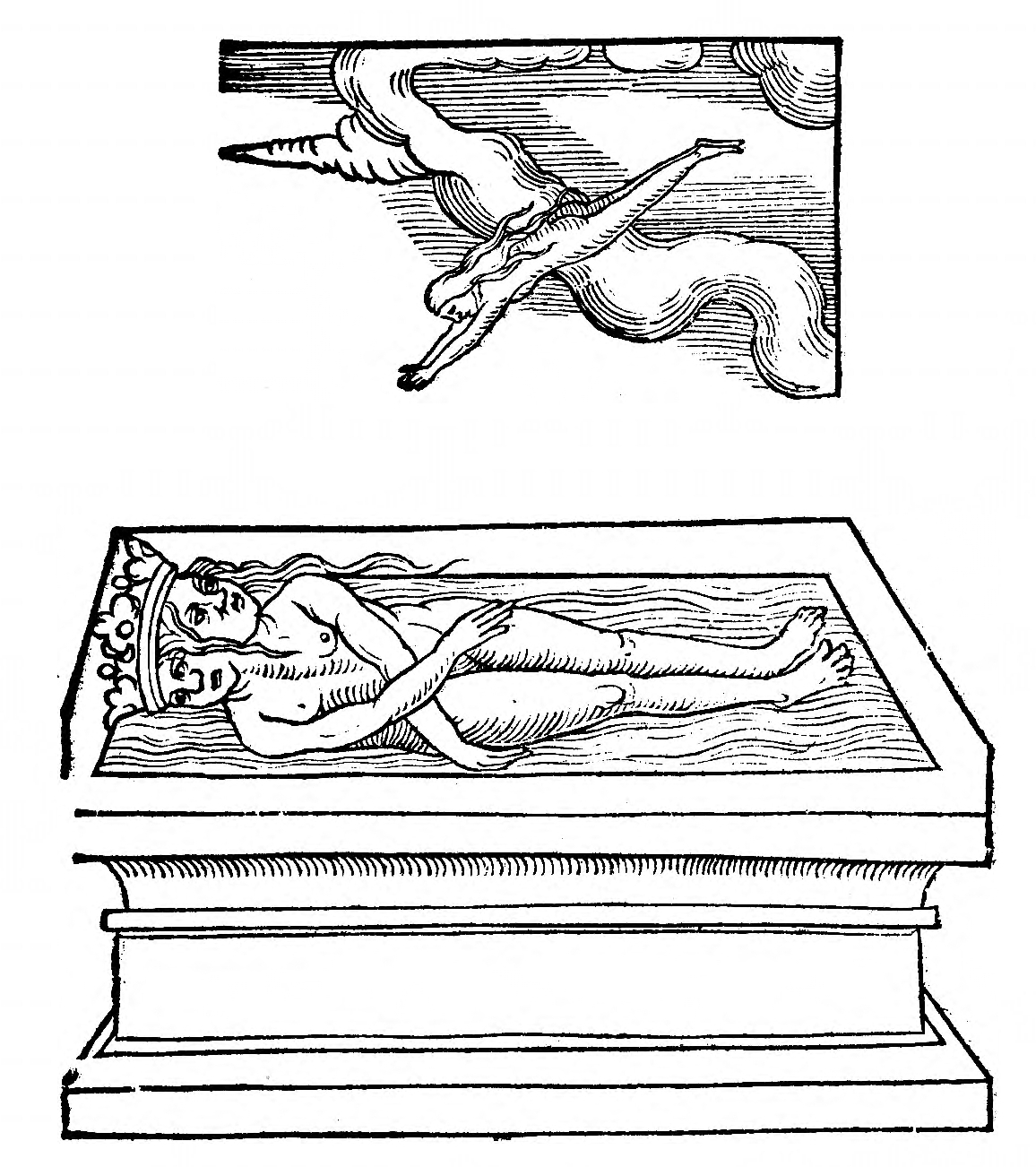
Figure 16.
Hye kompt die Seele vom himel schon und klar.
Und macht aufferstehen der philosophi dochter furwar.
Here the soul comes from heaven, beautiful and clear,
And resurrects the daughter of philosophy.
[p. 157]Geber, in the ninetieth chapter of the third book. The epilogue of the whole. We have now most thoroughly treated of the noted experiments on the sufficient causes of this magisterium, following the needs and purposes of our exposition. It remains to us to complete the whole work in this one chapter, and to compile in a brief summary the magisterium which has been dispersed across chapters. Therefore, we say that the summation of the intention of the whole work is nothing but that the stone, as it has been understood in these chapters, should be taken up, and then that the work of sublimation of the first grade should be applied assiduously to it with persevering labour, and through this be cleansed from corrupting impurity. And it is, of course, the perfection of sublimation, and with these [substances] the stone is subtilized until it reaches a purity of the utmost subtlety, and it becomes volatile to the utmost. But after this, it is fixed with the methods of fixation until it rests in the asperity of fire; and this is the marker of the second grade of preparation.
But the stone is likewise served in a third grade, which lies in the final completion of the preparation. Namely, once the stone has been fixed, make it volatile by the methods of sublimation, and make the volatile fixed, and the fixed dissolved, and the dissolved again volatile, and again the volatile fixed—until it flows and alters in sure Sun-making and Moon-making completeness [complemento solifico et lunifico]. By the repetition of this [p. 158]third grade of preparation, there results a multiplication of the goodness of alteration in the medicine. By the diversity of the repetition of the work over the stone in its grades, there results a diversity of the multiplication of the goodness of alteration, so that from the medicine some bodies are made sevenfold, some tenfold, and some a hundredfold, some a thousandfold, and some into boundless Sun-maker [infinitum solificum] and true Moon-maker of perfection [verum perfectionis lunificum]. Now, finally, let it therefore be tested whether the magisterium stands in perfection.
Let anyone attend to the properties of action and modes of composition of the greater elixir. We seek to make one substance [substantiam], although it is aggregated, united, and fixed out of many [substances]. When placed over fire, the fire does not expel it, and it mixes with liquids and liquefies with them, since there is penetrable substance [substantia ingressibili] in it, and it mixes because there is miscible substance [substantia permiscibili] in it, and it is solidified because there is solidifying substance [substantia consolidative] in it, and it is fixed because there is fixing substance [substantia fixativa] in it, and it is not burnt from that which burns gold and silver, and it becomes solid when the required perfect fire is applied.
But do not yet think, after this short time, that it may be restored for the first time in the span of a few days or hours. And yet this [elixir] is sooner completed than other [p. 159]modern medicines, or the natural work of truth. A philosopher has said: The medicine is his, who has anticipated a long time. Thus I say to you to sustain the work patiently, for perhaps it may be delayed, and haste belongs to the devil. As for whoever does not have patience, let him keep his hand from the work, for credulity hinders the one who hastens. Every action naturally has its own mode and its determinate time, and it will be finished more or less in that span.
Three things are necessary for this [work], namely patience, time, and aptitude for the instruments. We have spoken of the art of these [three requirements] in the summary of our magisterium across various chapters. In these chapters, one may test whether [the art] has been sufficiently traced out. In them, we have concluded through clear and manifest proof that our stone is nothing but foul spirit and living water (which we have named dry water), and that it has been cleansed through natural proportion and united in such a union that it can never be absent from itself. And a third point should be added to this, in order to summarize the word: This is the perfect thinned body.
The substances in which truth is near, and which perfect the work itself, are evident from the premises.
[p. 160]On the coagulation and preparation of the first stone and its sublimation.
Now follow some notable matters from a book by a certain Ademarus,[1] about Geber, the king of the Persians. In the fourth chapter he says:
As much as the stone may have been cleansed through sublimation, and its burning removed through the extraction of its oil, and its fleeing destroyed through its fixing, it nevertheless neither pours nor enters into [other bodies] nor is mixed, but rather it is vitrified, as it says around the middle of Geber’s tenth chapter. Rather [than these other operations], it must be dissolved in the sharpness of waters and calcinated many times over, as it says in the sixty-seventh chapter and the first and seventh and seventy-third chapters of Geber.
He says again, in the sixth chapter: Out of the manifold repetition of imbibition with grinding and gentle roasting, the greater part of its wateriness is removed. This is the sublimation of the first grade, by which the watery part of Mercury is removed. After this, let the whole substance [substantia] be thrown into the base of an aludel vessel (which is described in chapter twenty-eight). Then, let the fire be increased, as it is said around the middle of the thirtieth chapter, until the part of it which is whiter than snow, like dead things in its whiteness, adheres to the joints of the aludel. This is [p. 161]our sublimation, through which feculent earth and parts of sulphur remain in the base with the sediment [fecibus]. In our sublimation, the stone is purified by its nature. And then it is fixed by the method of fixing (that is, it is fermented). For what has been fixed fixes (that is, it is ferment). Then it is placed in dung. It follows that it rests in the asperity of fire, and this is called the second preparation (that is, the second grade of sublimation). But if it is asked in what way Mercury can be subtilized, [the answer] is that it has a most subtle substance [substantia] in action, as it says in chapter thirty-nine. Also, what is stated in chapter seventy-three ought to be said, namely that by the method of sublimation or subtilization (that is, by sublimation of the first grade), it is cleansed and subtilized. Therefore it is also made volatile to the utmost (that is, it is sublimated by application of fire), so that it rises up from the sediment to the joints of the vessel, shinier than crystal.
Geber: Whiten latten (that is, earth), and put down the books lest your hearts be broken. In another place [of the book Geber says], fire and water ablute latten and wipe away its blackness. It continues: Therefore put the sublimate in an aludel vessel and repeat it one time (that is, fix by sublimating what has been fixed)—as it says around the middle of the sixty-second chapter—so that it glitters so much the more. Do this with caution when applying the fire, so that its moisture is removed only insofar as is required for full and perfect melting. As it is said in the same place, a slow fire [p. 162]conserves moisture and perfects melting. Again, it is said in the twenty-ninth chapter, that quicksilver must first be sublimated, then fixed.
Again, in the twenty-eight chapter it is said that Mercury is fixed through successive, repeated sublimation, so that it causes metals to melt. You will find often find this in his sayings. All of what has been said ought to be understood with respect to the preparation of the first stone and its whitening, before it is placed into dung. It must be incerated many times with sharp water, and dissolved and coagulated over ashes, until it becomes exceedingly soft, whitens, and, at length, flows like the splendid Moon, etc. This is its sublimation, that is, its true purification into a higher dignity and virtue, etc.
It follows in chapter seven: But I advise that you begin this work even though the stones be imperfect (this came from the original and secret intellect of Geber himself). Thus you have it in chapter seventeen, that the nature of Mercury is in bodies just as it is in Mercury, but in the noted stone it is the most perfect. Again it is said in the third chapter, that in marcasite the nature of Mercury has been mortified and moderately prepared, which is of great value. In his works, that philosopher desires the nature of Mercury alone, but the whole nature of the Sun comes from Mercury, as it is said in the eighth chapter.
Again, that philosopher desires the mortified substance [substantiam] of Mercury, but [p. 163]its Mercury is naturally in that venerable stone, as is plain to everyone, therefore, etc. Again, that philosopher desires that the substance [substantiam] of Mercury be fixed, for geniuses [ingenia] have taught how to fix with great caution and ingenuity. But whoever should doubt that the substance [substantiam] of the precious stone is very fixed is certainly nobody who knows the stone, etc.
Again, the philosopher desires his stone to be fixed, with caution use of fire so that its moisture is conserved. But where is the heat warmer than in the bowels of the earth, etc. Again, the philosopher desires that his stone be poured out. Therefore it is evident that the stone is the master of the philosophers, which is like saying that it creates naturally through itself what it is held to create. And so the philosopher is not the master of the stone, but rather its minister. Therefore, whoever seeks outside of nature, by art and artifice, to lead anything into a substance which is not naturally in it, errs and will weep for his error.
The Sun is the principle of the red work, the Moon for the white which has been purged of its burning sulphur and combustible sulphur. That such a substance [substantia] is in the latter, you have in the forty-seventh chapter. But that the Moon becomes the stone by the white work, you have in the eighteenth chapter. Therefore take this precious stone, which is spirit, body, and soul, and calcinate whatever in it has not been touched with its moisture or with Mercury.
[p. 164]But the stone is treated also with a third grade, which consists in the final completion of the preparation. This, namely, is that you make the fixed stone volatile by the method of sublimation, and then sublimate it with unfixed spirits. For the fixed to be sublimated means nothing but that the body is converted into spirit; this secret is extracted from the sayings of the philosophers. It is found in the thirty-seventh chapter that spirit does not mix with the body (that is, with fixed substance [substantiae]), whatever it may be, unless first by means of the magisterium (that is, unless the stone is first dissolved and coagulated). But you ask how the stone is dissolved. It should be answered, with sharp water which is pontic[2] and sharp, appearing without sediment, as for example vinegar of wine, etc. But if you ask why the stone is dissolved, it should be said what is in the thirty-seventh chapter, that everything which is dissolved takes on the nature of salts and alums, because only salts melt before they are vitrified. Similarly, according to the nature [of salt], only salts are dissolved. Thus, if our stone is dissolved, it takes on the nature of salts. But what melts also enters in, and whatever enters in transmutes, etc. It is said in the fifty-seventh chapter that bodies are sublimated through the most excellent grade of fire, until the fixed is totally raised up with the unfixed. In the twelfth chapter: If the whole has not been sublimated, let there be added to it a quantity of the unfixed part, [this being] repeated until it is [p. 165]enough for the elevation of the whole by a very strong fire. Understand by this the fire of putrefaction, and of our Mercury, by which our body is elevated in this way (that is, it is converted into spirit). Once it has been raised up, let its sublimation be repeated, until by the repetition of this service the whole is fixed. And let the fixed be dissolved (that is, put vinegar on it), repeating all this four times, as you have seen above. And let the dissolved be made volatile, as it is said that by solution the stone is made volatile. And again, make the volatile fixed; continue likewise, says the philosopher in the fifty-seventh chapter, etc., until it yields melting, or flows. The tenth chapter: Let this work not be for whiteness but for redness. Adamarus responds: Let it be for both (as it is written in the sixty-sixth chapter); the lunar stone and the solar stone are the same in essence. For each [stone] is perfected only in Mercury and by one path in the mode of action, and each is worked through the same operations in the same order. It is therefore one medicine, according to all the philosophers—but they differ with respect to the fermentation.
[1] A follower of the Latin Geber corpus, otherwise of uncertain identification.
[2] I.e., which dissolves, penetrates, and liquefies.